
Theseus’s encounter with the Minotaur is one of Greek mythology’s clearest monster stories: a hero enters a labyrinth, follows a thread, and kills the creature at its center. Yet the familiar outline hides important variations. Ancient authors disagree about the tribute’s schedule, the weapon Theseus used, what happened to Ariadne, and even the color of the signal sail.
The story also served a political purpose. Athenians remembered Theseus not only as a monster-slayer but as the hero who unified Attica and gave civic order to Athens. The labyrinth adventure dramatizes that larger claim: he leaves as one endangered youth among many and returns as the liberator of the city’s children.
Who was Theseus?
Theseus was raised at Troezen by his mother, Aethra. In the best-known account, the Athenian king Aegeus placed a sword and sandals beneath a heavy rock before leaving her. When Theseus became strong enough to lift it, he recovered the tokens and traveled to Athens to be recognized.
His paternity is deliberately double in many tellings. Aegeus is his mortal father, while Poseidon may be his divine father. Such overlapping parentage is common in heroic myth: it connects the hero both to a ruling house and to supernatural power.
Theseus chooses the dangerous land route to Athens and defeats a series of violent figures, including Periphetes, Sinis, Sciron, Cercyon, and Procrustes. These road labors echo Heracles, but they also imagine Theseus making the route to Athens safe by turning each criminal’s own method against him.
Why did Athens send youths to Crete?
The tribute begins with the death of Androgeos, son of King Minos of Crete. The causes vary: Athenian jealousy, a dangerous contest, or a plot involving the Marathonian bull. Minos wages war or calls down divine punishment, and Athens is compelled to send young people to Crete.
Plutarch gives the famous number as seven young men and seven young women sent every nine years, while acknowledging other accounts. Later retellings sometimes say the tribute occurred annually or every seven years. The precise interval is therefore a source variant, not a settled fact.
Theseus volunteers—or is selected, depending on the version—to join the group. He promises Aegeus that the ship will replace its dark sail with a light-colored one if he returns alive. That small agreement eventually becomes as consequential as the fight itself.
The Minotaur and the labyrinth
The Minotaur is the offspring of Pasiphaë, wife of Minos, and a marvelous bull associated with Poseidon. The inventor Daedalus constructs the labyrinth to contain him. Ancient texts do not provide a single architectural blueprint, but the building is imagined as so intricate that escape without guidance is nearly impossible.
On Crete, Minos’s daughter Ariadne falls in love with Theseus and offers the indispensable solution. In the common version she gives him a ball of thread. He fastens one end near the entrance and unwinds it as he advances, creating a route back through the maze.
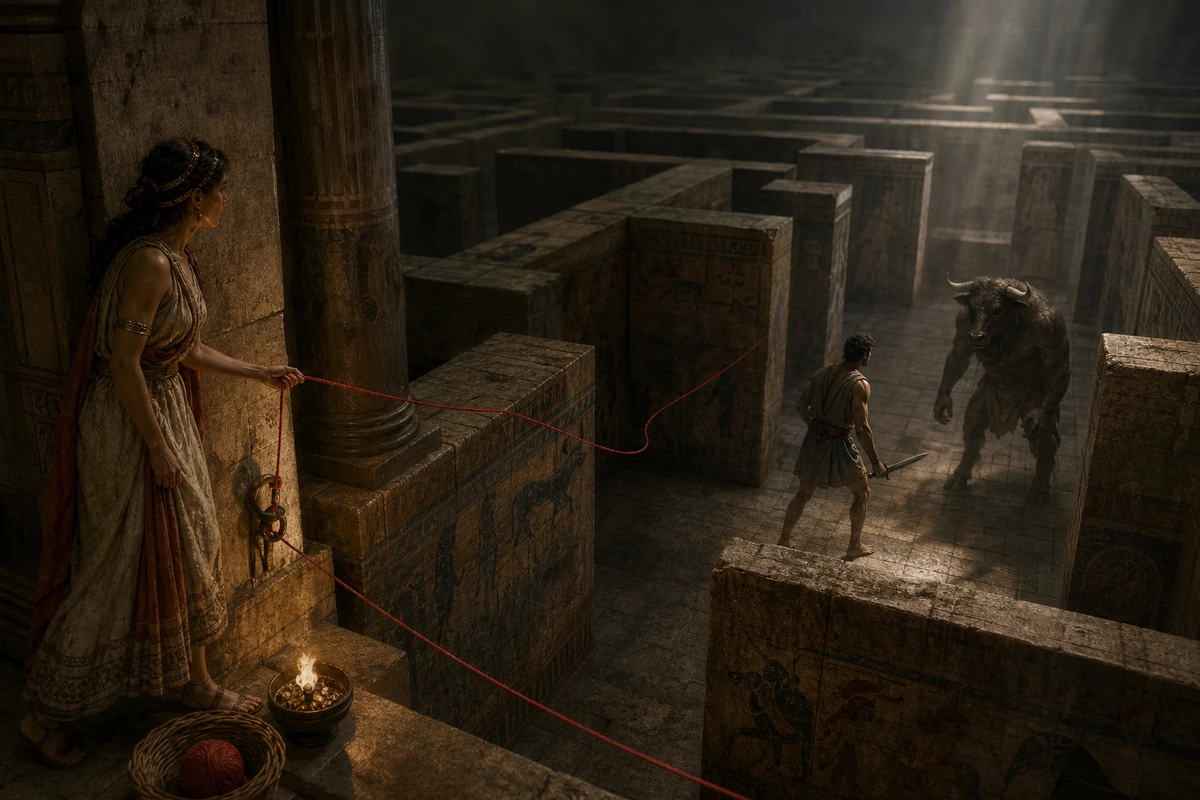
Theseus kills the Minotaur, but sources differ about how. Apollodorus says he strikes the creature to death with his fists; other traditions give him a sword or club. The disagreement is a reminder that the myth circulated in performance, poetry, art, and local tradition before any surviving handbook fixed one sequence.
Ariadne is not a minor helper
Without Ariadne’s knowledge, Theseus can enter the labyrinth but cannot reliably leave it. The “clew” or ball of thread is both a physical guide and the source of the English sense of a clue as something that leads through a problem. Her choice makes the rescue possible.
After the escape, Theseus sails away with Ariadne and the rescued Athenians. What follows depends on the source. In some accounts he abandons her asleep on Naxos; in others divine command, storm, or the arrival of Dionysus separates them. Dionysus then makes Ariadne his wife. A simple claim that Theseus coldly discarded her presents only one ancient interpretation.
The black sail and the death of Aegeus
As the ship nears Attica, Theseus fails to raise the agreed signal of survival. Aegeus sees the dark sail and, believing his son dead, throws himself from a height into the sea. The Aegean Sea was traditionally explained as bearing his name.
The usual contrast is between black and white sails, but Plutarch also records a version in which the safety signal was scarlet. The reason for Theseus’s failure likewise varies. Grief, distraction, forgetfulness, and divine influence all appear in later interpretations. The myth turns victory into a succession crisis: the hero saves Athens’s children but returns too late to save its king.
| Element | Common modern version | Important ancient variation |
|---|---|---|
| Athenian tribute | Seven youths and seven maidens at a fixed interval | The interval and political cause differ among accounts |
| Minotaur’s death | Theseus uses a sword | Apollodorus says he kills it with his fists; other weapons also appear |
| Ariadne on Naxos | Theseus deliberately abandons her | Divine instruction, storm, and Dionysus are used to explain the separation |
| Signal sail | White means success | Plutarch also preserves a scarlet-sail tradition |
Theseus as an Athenian civic hero
Plutarch’s Life of Theseus gathers myths, local traditions, ritual explanations, and rationalized stories rather than offering modern biography. Its Theseus unites Attica through synoecism, bringing scattered communities into one political center at Athens. Festivals, monuments, and family traditions were attached to his name.
The rescue from Crete could therefore be read as more than a private adventure. Theseus ends a humiliating foreign demand, brings a group of citizens home, and assumes his father’s place. Athenians used him to imagine their city as unified, autonomous, and protected by a native hero.
The Ship of Theseus
Plutarch reports that Athenians preserved the ship in which Theseus returned, replacing old planks as they decayed. Philosophers used it to debate whether an object remains the same when all its parts are gradually replaced. The famous “Ship of Theseus” problem is therefore tied to civic memory: continual maintenance kept a legendary return visibly present.
History, myth, and the palace at Knossos
The Bronze Age palace at Knossos, its complex layout, and the prominence of bull imagery make tempting comparisons with the labyrinth story. Archaeology confirms a powerful Minoan civilization and extensive Aegean connections, but it does not verify Theseus, Ariadne, or a historical Minotaur. Myth may retain distant memories without functioning as a factual report.
The strongest reading keeps both levels in view. The story is an adventure about courage and guidance, and it is also an Athenian explanation of political identity. Theseus conquers the center of the maze, but the deaths and betrayals surrounding his success prevent him from becoming an uncomplicated moral ideal.
Key takeaways
- Ancient sources preserve multiple versions of the tribute, weapon, sail, and Ariadne’s fate.
- Ariadne’s thread is essential to the escape; Theseus’s strength alone cannot solve the labyrinth.
- The forgotten signal sail causes Aegeus’s death and turns triumph into tragedy.
- Theseus became Athens’s civic unifier as well as its legendary monster-slayer.
- Knossos provides historical context for Minoan power and bull imagery, not proof that the myth literally occurred.