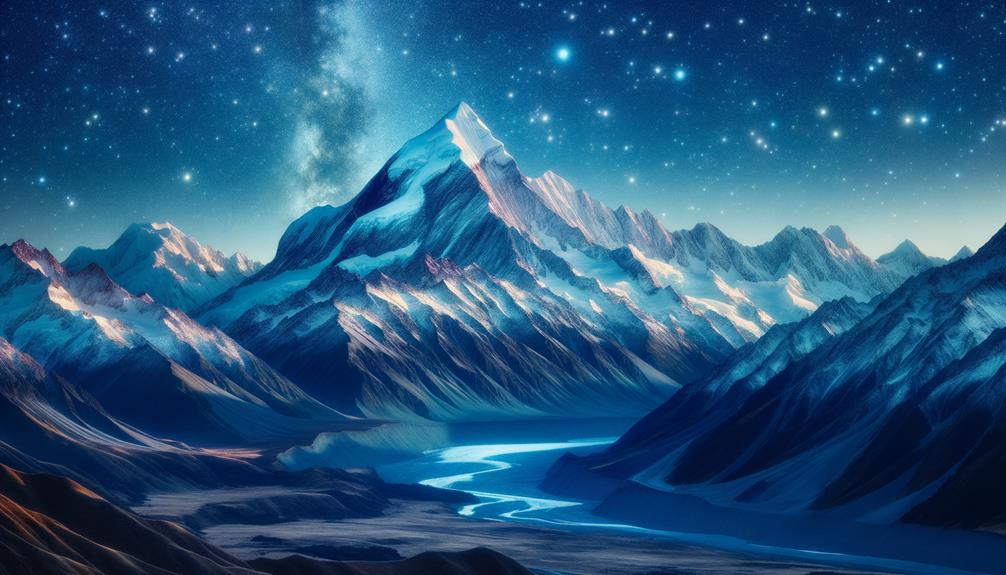
Aoraki is not only the highest mountain in Aotearoa New Zealand. In Kāi Tahu tradition, Aoraki is an ancestor whose body and story are present in the landscape. The peak belongs to a larger ancestral geography linking the overturned canoe Te Waka o Aoraki, the South Island or Te Waipounamu, and the mountain chain Kā Tiritiri-o-te-moana, the Southern Alps.
The spelling Kāi Tahu reflects the southern dialect; Ngāi Tahu is the form widely used in national and legal contexts. Both refer to the same iwi. Because Aoraki is a living cultural relationship rather than a generic “mountain myth,” the most reliable outline begins with Kāi Tahu/Ngāi Tahu sources and with the values formally recognized in the Ngāi Tahu settlement.
Te Waka o Aoraki
In the account published by Ngāi Tahu, Aoraki and his brothers descend from the heavens in a canoe to visit Papatūānuku, their father’s new wife. When they try to return, the karakia needed to lift the waka fails. The canoe falls back to the ocean and overturns. The brothers climb onto its raised side, but the cold south wind freezes them into stone.
Their forms become the principal peaks of Kā Tiritiri-o-te-moana. Aoraki, the eldest, becomes the highest. The overturned canoe becomes Te Waipounamu. This is not merely an imaginative explanation for topography: it expresses kinship between people and land. Mountain, canoe, ancestor, and island occupy the same network of descent and responsibility.

An ancestor embodied in the mountain
Department of Conservation material prepared for Aoraki/Mount Cook National Park describes Aoraki as the most sacred of the ancestors from whom Ngāi Tahu descend. The mountain is a physical manifestation of that ancestor and a link between the supernatural and natural worlds. This framing is more precise than calling Aoraki a “mountain god.” Ancestorhood, whakapapa, and mauri do not map neatly onto the categories used for Greek or Roman deities.
The name also situates the peak within a connected environment. Meltwater flows from the mountains through braided rivers and lakes; ridges and valleys preserve histories of travel and seasonal resource use. For Ngāi Tahu, those features are not isolated scenery. They form a cultural landscape held together by names, stories, customary practice, and inherited obligations.
| Name or concept | Reference | Why it matters |
|---|---|---|
| Aoraki | The eldest brother and the highest peak | Ancestor and mountain are understood together |
| Te Waka o Aoraki | The overturned ancestral canoe | Connects the narrative to the form of Te Waipounamu |
| Kā Tiritiri-o-te-moana | The Southern Alps | The mountain chain is an ancestral body, not a row of disconnected summits |
| Tōpuni | A statutory overlay recognizing Ngāi Tahu values | Signals the iwi’s special association with a place managed as public conservation land |
Aoraki and Mount Cook
The English name Mount Cook was assigned in 1851 by Captain John Lort Stokes in honor of the navigator James Cook. Cook did not name the mountain himself. The official dual name Aoraki/Mount Cook was established through the Ngāi Tahu Claims Settlement Act 1998, placing the ancestral name first.
The settlement process went beyond punctuation on a map. As part of the agreed cultural redress, title to Aoraki/Mount Cook was vested in Te Rūnanga o Ngāi Tahu and then gifted to the people of New Zealand. The act also created forms of statutory recognition for Ngāi Tahu values and associations. These measures did not transform the mountain into an ordinary asset; they acknowledged the Crown’s historical failures and the enduring relationship between the iwi and Aoraki.
Tōpuni and cultural respect
Aoraki/Mount Cook has Tōpuni status. The term evokes the chiefly dogskin cloak placed over a person or object as a sign of mana and protection. In the settlement framework, a Tōpuni records Ngāi Tahu’s values in relation to designated conservation land and requires those values to be considered in management.
Visitors can recognize that significance in practical ways. DOC guidance explains that Ngāi Tahu considers standing on the very top of Aoraki—on the head of the ancestor—inappropriate. Conditions on the mountain are also objectively dangerous, and access decisions belong within current safety rules, conservation management, and the guidance of mana whenua. Cultural respect is not an ornamental addition to mountaineering history.
What “frozen legacy” misses
Describing Aoraki only as a brother “frozen into a mountain” makes the narrative sound finished and remote. For Kāi Tahu, the relationship is ongoing. Aoraki remains a source of identity and authority; the landscape continues to carry mauri; names continue to transmit history; and the settlement continues to shape how government agencies recognize iwi values.
Nor is the account a scientific rival to plate tectonics or glaciology. Geological description answers how rock was uplifted and ice shaped valleys. The ancestral narrative explains relationship, origin, rank, and responsibility. Treating one as a primitive attempt at the other misunderstands what the tradition is doing.
Key takeaways
- Aoraki is an ancestor embodied in the highest peak of Aotearoa New Zealand.
- Te Waka o Aoraki links the mountain chain, Te Waipounamu, and the brothers who became its principal peaks.
- The official dual name and cultural-redress measures date from the 1998 Ngāi Tahu settlement.
- Tōpuni status records Ngāi Tahu values and requires them to be recognized in conservation management.