Ngāi Tahu identity cannot be reduced to a list of “mythic ancestors.” Whakapapa links living whānau with Tahu Pōtiki, with Waitaha and Kāti Māmoe lines, with atua, and with the lands and waters of Te Waipounamu. It records descent, but it also expresses relationship, authority, responsibility, and belonging.
Ngāi Tahu means “the people of Tahu.” Te Rūnanga o Ngāi Tahu explains that registered tribal members trace descent from the eponymous ancestor Tahu Pōtiki. Yet the iwi was formed through many communities and histories. Migration, warfare, marriage, alliance, and shared use of resources gradually wove distinct lines into a common allegiance.
Whakapapa is more than a family tree
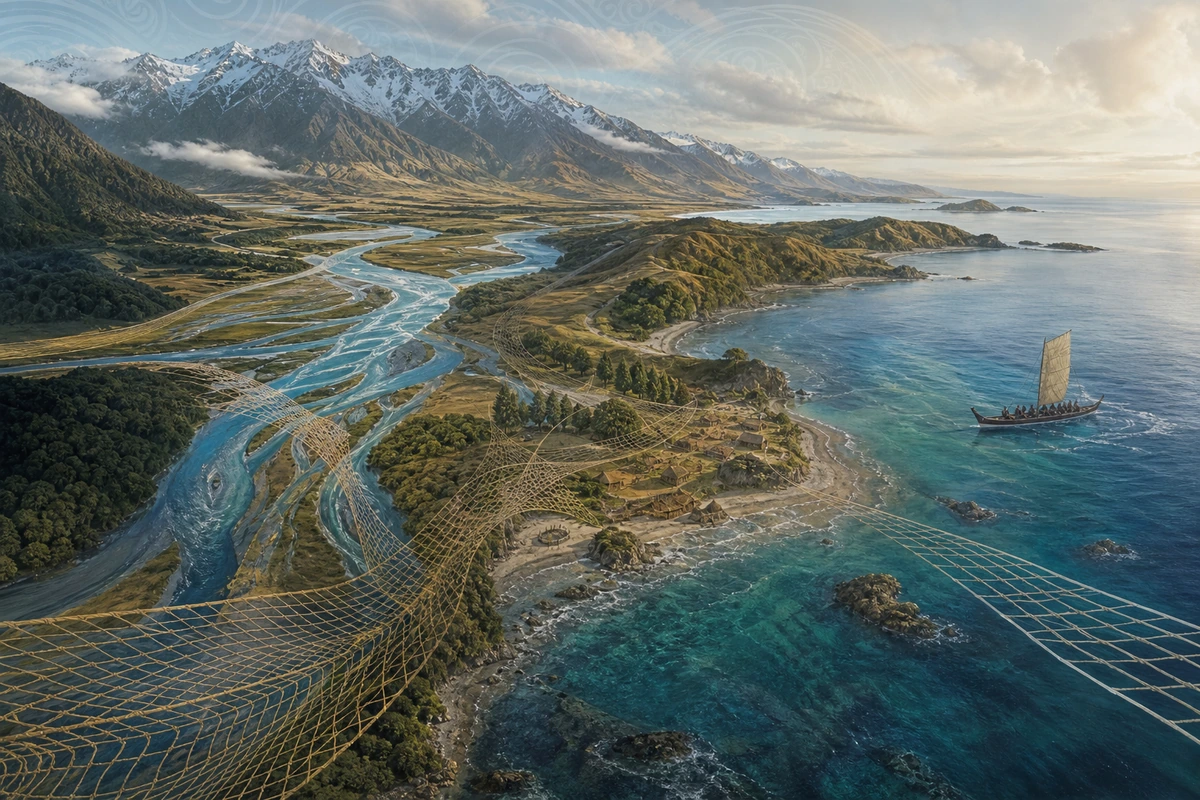
A diagram of parents and children can show one part of genealogy. Whakapapa carries much more. It locates people within relationships extending through generations and outward to mountains, rivers, coastlines, species, and the universe. It helps explain why a place matters, who holds responsibilities there, and how knowledge is transmitted.
That is why an ancestor should not be treated as a fictional character detached from descendants. Tahu Pōtiki is the name-giving ancestor of Ngāi Tahu, while figures such as Rākaihautū and Aoraki belong to ancestral histories that also shape understandings of Te Waipounamu. Different lines are not interchangeable, and a short public article cannot reproduce the depth of knowledge held by whānau and tribal experts.
Tahu Pōtiki and the name Ngāi Tahu
Tahu Pōtiki lived in the eastern North Island world from which Ngāi Tahu ancestors later moved south. The iwi name preserves descent from him even as successive generations formed new relationships and communities. His importance is therefore genealogical rather than that of a solitary founder arriving in an empty land.
The southern dialect form Kāi Tahu appears frequently within the iwi, while Ngāi Tahu is common in national and legal usage. Similarly, Kāti Māmoe and Ngāti Māmoe are dialect forms of the same name. Respecting these forms helps prevent southern Māori history from being squeezed into language conventions developed elsewhere.
Waitaha, Kāti Māmoe, and Ngāi Tahu
Ngāi Tahu’s official history identifies Waitaha as the first people of Te Waipounamu, associated with the Uruao waka. Ngāti Māmoe migrated later, followed by Ngāi Tahu. By the middle of the 18th century, warfare, intermarriage, and political alliances had produced a common Ngāi Tahu allegiance.
That sequence should not be retold as three sealed populations simply replacing one another. Ngāi Tahu sources describe a weaving together of traditions and whakapapa. Many whānau carry Waitaha, Kāti Māmoe, and Ngāi Tahu descent, and regional identities preserve particular combinations of those histories.
| Name or concept | Role in the history | What to avoid |
|---|---|---|
| Tahu Pōtiki | Eponymous ancestor from whom the iwi takes its name | Portraying him as the only ancestor who matters |
| Waitaha | Earlier peoples and traditions of Te Waipounamu, including descent linked with Rākaihautū | Treating Waitaha as a vanished group with no living whakapapa connections |
| Kāti Māmoe | A major stream of southern migration and ancestry | Describing interaction only as conquest |
| Ngāi Tahu | The common iwi allegiance formed through descent, settlement, alliance, and intermarriage | Assuming one uniform local history across every takiwā |
Migration to Te Waipounamu
Ngāi Tahu groups moved from the eastern North Island through Te Whanganui-a-Tara and Te Tauihu before establishing communities farther south. The process unfolded over generations. Hapū followed different leaders and routes; conflict existed alongside strategic marriage and alliance; and inherited Waitaha and Kāti Māmoe rights became part of later Ngāi Tahu authority.
By the time Europeans arrived, Ngāi Tahu exercised mana whenua over most of Te Waipounamu. That authority was lived at the scale of whānau and hapū communities rather than through a single centralized settlement. Seasonal movement connected coastal villages, inland trails, river systems, mountain passes, and places where food and materials were gathered.
Rākaihautū, Uruao, and the lakes
Waitaha traditions remember Rākaihautū as the leader of the Uruao waka. In a widely told account, he travels through Te Waipounamu with his digging implement, Tūwhakarōria, creating or opening the great lakes. His son Rokohouia explores another route, and the journeys help name and order the southern landscape.
The account is not an alternative hydrology textbook. It joins migration, naming, food resources, and ancestral presence. The lakes are places within a network of descent and travel, not scenery added behind a heroic character.
Aoraki and ancestral geography
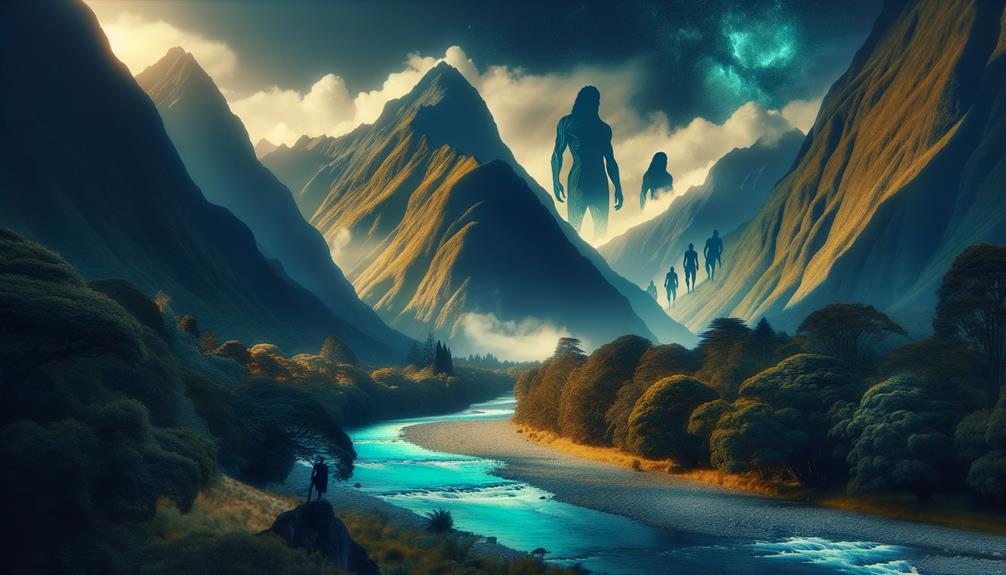
Aoraki is the most sacred ancestor embodied in the mountain that bears his name. In Kāi Tahu tradition, Aoraki and his brothers become the principal peaks of Kā Tiritiri-o-te-moana after their canoe overturns and becomes Te Waipounamu. The story establishes the alpine spine of the island as ancestral geography.
This relationship remains politically and culturally present. The official dual name Aoraki/Mount Cook and the mountain’s Tōpuni status form part of the cultural redress recognized in the Ngāi Tahu Claims Settlement Act 1998. For the full account, see Aoraki: Ancestral Mountain, Te Waka o Aoraki, and Ngāi Tahu Redress.
Mahinga kai and living relationships
Mahinga kai includes the places, species, practices, and access routes involved in gathering food and other resources. It is not simply a translation of “food gathering.” Seasonal work at rivers, wetlands, forests, lakes, and coasts maintained social relationships and transmitted detailed environmental knowledge.
When nineteenth-century land purchases and Crown actions restricted access to these places, the damage was economic, cultural, and genealogical. Te Kerēme—the Ngāi Tahu Claim—concerned repeated Crown failures to honor agreements and protect the iwi’s resources. The 1998 settlement recognized those breaches and included an apology, financial and commercial redress, place-name changes, and mechanisms acknowledging Ngāi Tahu associations with significant places and species.
How to read ancestral histories responsibly
Terms such as “legend” and “myth” can be useful in comparative writing, but they can also make a living whakapapa tradition sound like entertainment. Attribution is essential. Identify the iwi or hapū whose account is being summarized, prefer their publications, and do not assume that every detail is open for unrestricted retelling.
Variation is also evidence rather than a defect. Local histories emphasize the ancestors, routes, marriages, and resources most relevant to a community. Ngāi Tahu identity is shared, but its expression is grounded in particular papatipu rūnanga and takiwā.
Key takeaways
- Ngāi Tahu takes its name from Tahu Pōtiki, but iwi identity is carried through many ancestral lines.
- Waitaha, Kāti Māmoe, and Ngāi Tahu histories were woven together through descent, migration, conflict, marriage, and alliance.
- Whakapapa connects people not only with one another but with lands, waters, species, and inherited responsibilities.
- Aoraki, Rākaihautū, mahinga kai, and Te Kerēme belong to connected but distinct parts of a living history.