Accuracy note: Hávamál says that Odin hangs on a windswept tree and gains the runes, but the relevant stanza does not name the tree Yggdrasil. Identifying it with the world tree is a strong contextual interpretation, not a word that appears in the ordeal itself. Stanza numbering also varies slightly among editions.
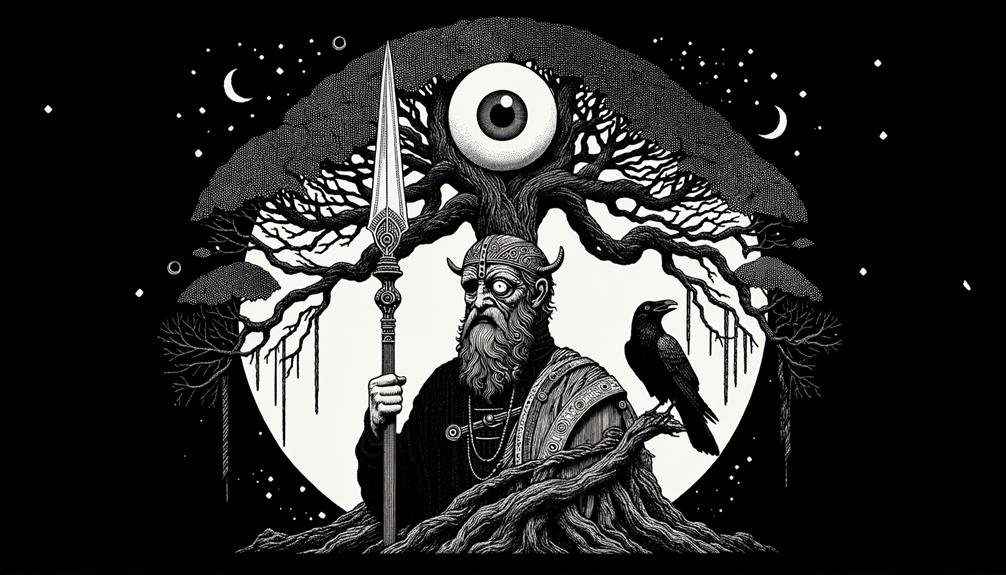
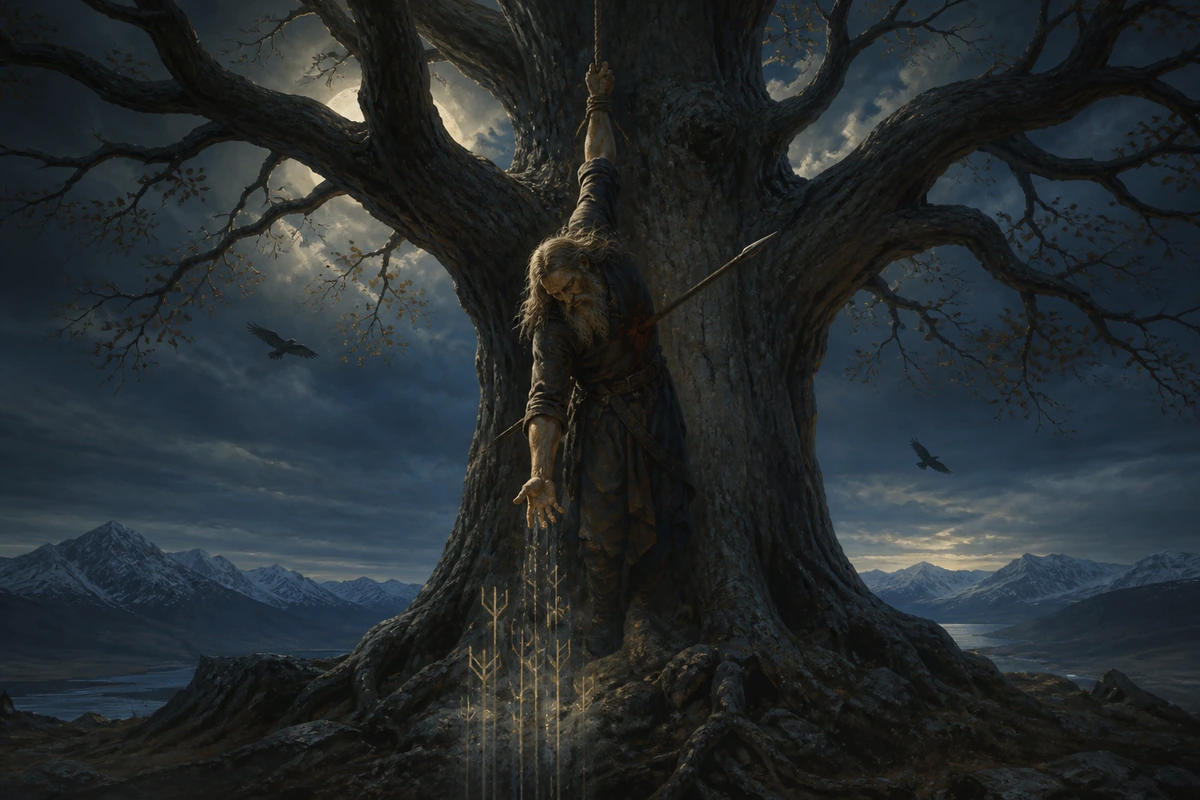
Odin’s hanging is one of the starkest passages in Old Norse poetry. He is wounded with a spear, denied bread and drink, and offered to Odin—“myself to myself”—for nine nights. At the crisis of the ordeal, he perceives or takes up the runes and falls from the tree. The poem presents knowledge as something obtained at an extreme personal price.
Where the story survives
The account appears in the section of Hávamál commonly called Rúnatal, the “tale” or “enumeration of the runes.” Hávamál is a composite Old Norse poem preserved principally in the thirteenth-century manuscript known as the Codex Regius of the Poetic Edda. Its sections combine proverbial counsel, reflections on hospitality and friendship, Odin’s pursuit of wisdom, and magical knowledge.
The manuscript date is not the date when every stanza was first composed. Oral transmission and editorial arrangement preceded the surviving copy, but scholars do not assign the whole poem one certain Viking Age composition date.
What Odin says happened
In the usual modern numbering, stanzas 138–141 describe the central sequence. Odin hangs for nine complete nights on a wind-battered tree. A spear wounds him. He receives neither bread nor a drinking horn. He looks downward, takes up the runes with a cry, and then falls back from the ordeal.
The phrase “given to Odin, myself to myself” makes the sacrifice reflexive. Odin is at once the dedicated victim and the deity to whom the offering is made. The poem does not introduce another god who commands the act or arrives to rescue him.
Does the poem call the tree Yggdrasil?
No. The ordeal stanza calls it a tree whose roots no person knows, but does not use the name Yggdrasil. Elsewhere, Old Norse sources describe Yggdrasil as the immense ash-like world tree whose branches and roots connect divine and other realms. Because Odin’s ordeal has cosmic reach, readers commonly identify the two trees.
That interpretation is old and persuasive, yet an accurate summary keeps the distinction visible. “Odin hangs on Yggdrasil” is contextual shorthand. “Hávamál explicitly names Yggdrasil in this stanza” is false.
What does “winning the runes” mean?
The passage does not say Odin invents an alphabet from nothing. Runes were historical writing systems used by Germanic-speaking communities, with the earliest surviving inscriptions centuries older than the Codex Regius. In the poem, however, runes also carry sacred, poetic, and magical knowledge. Odin’s discovery belongs to mythic authority rather than a modern history of writing technology.
After the hanging, the poem says Odin becomes fruitful in knowledge: word leads to word and deed to deed. Later stanzas enumerate charms for help, healing, release, protection, persuasion, and other ends. The sequence links the ordeal to mastery of potent speech and signs.
Do not merge Odin’s sacrifices
| Episode | Source and price | Knowledge gained |
|---|---|---|
| Hanging on the tree | Hávamál; nine nights, spear wound, hunger and thirst | Runes and expanded magical-poetic knowledge |
| Drink from Mímir’s well | Völuspá and Snorri; an eye is given as a pledge | Wisdom connected with Mímir’s well |
| Mead of poetry | Hávamál and Skáldskaparmál; deception, danger, and escape | The poetic mead |
Modern summaries often compress all three into “Odin sacrificed himself for wisdom.” That theme is valid, but the narratives use different objects, agents, locations, and forms of knowledge. The eye is not the price paid for the runes in Hávamál.
Hanging, sacrifice, and the name Yggdrasil
Odin is repeatedly associated with the slain and with hanging in Old Norse tradition. One traditional explanation of the name Yggdrasil is “Yggr’s horse,” with Yggr as an Odin-name and the gallows imagined as the hanged person’s horse. The wordplay helps explain why the unnamed tree of the ordeal is so often connected with the world tree.
Comparisons with Christian crucifixion are also common because the poem was written down in a Christian society and includes a wounded, hanging god. Resemblance alone does not prove that the stanza is a direct copy of the Passion. Nor should possible contact be dismissed: medieval Icelandic poetry developed in a world where inherited and Christian traditions interacted.
What the passage does—and does not—teach
The ordeal establishes Odin as a seeker who will endanger even himself for knowledge. It does not supply a modern rune-divination manual, name an archaeological rune row, or explain the meaning of every surviving inscription. Claims that each rune has one universal spiritual definition usually depend on much later systems.
Read closely, the passage is powerful without those additions. Isolation, deprivation, injury, self-dedication, insight, and transformation form a compact initiation narrative in which wisdom arrives only after ordinary support has been stripped away.
Primary text and manuscript context
- Hávamál in English translation, University of Pittsburgh: includes Odin’s quest for the runes
- Hávamál, Bellows translation: an additional public-domain rendering for comparison
- University of Copenhagen: Codex Regius diplomatic edition