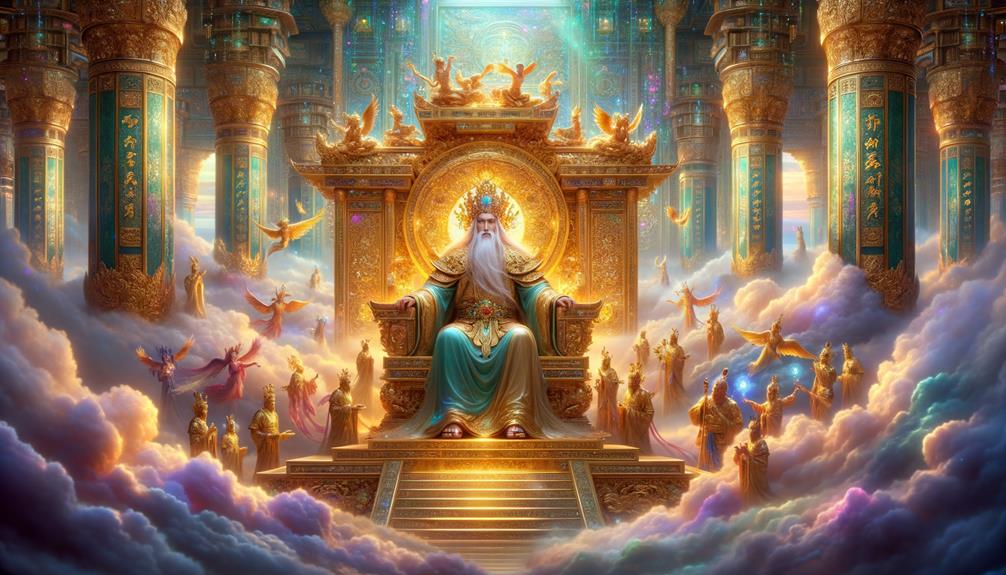
The Jade Emperor, commonly called Yuhuang or Yuhuang Dadi, is one of the best-known sovereign deities in Chinese popular religion. He presides over a heavenly court whose offices, reports, ranks, and punishments echo the institutions of imperial government. That familiar image is influential, but it should not be mistaken for a single, universal Chinese theology: the Jade Emperor is not a creator god in every account, and many Daoist systems place more transcendent divinities, including the Three Pure Ones, above him.
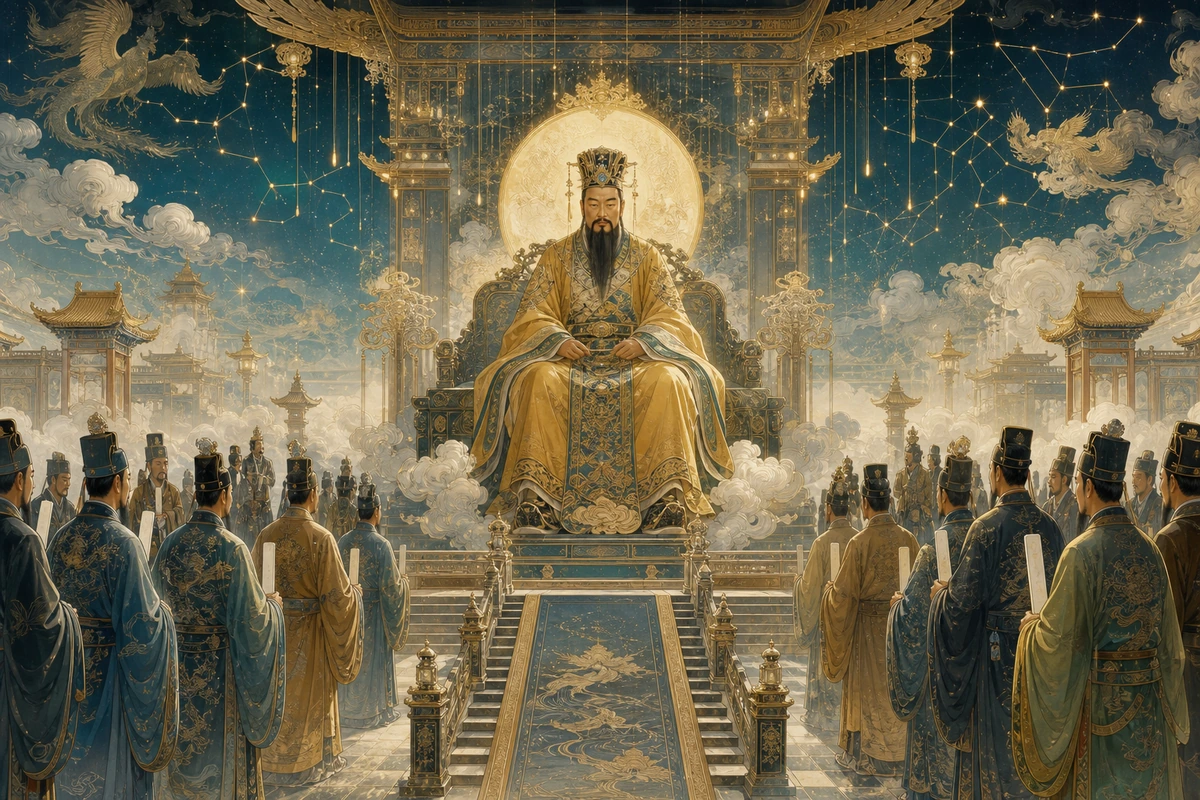
A ruler of the heavenly administration
In a widely shared model of Chinese religion, the cosmos contains overlapping heavenly, earthly, and underworld jurisdictions. Gods may oversee cities, households, weather, stars, professions, or the dead. The Jade Emperor stands at the apex of this administration in popular religion, comparable to an emperor receiving memorials from officials. The analogy is useful precisely because it makes divine power intelligible through familiar institutions: responsibility is distributed, records are kept, and local gods communicate with higher authorities.
The Kitchen God, for example, is often imagined reporting on a household, while City Gods govern local spiritual jurisdictions. Such arrangements vary by region, temple, liturgical tradition, and historical period. Chinese religion is not a fixed organization chart, and individual deities can occupy different ranks in different communities.
Popular religion and Daoist pantheons
Scholars distinguish the Jade Emperor’s position in popular worship from the more complex hierarchies of formal Daoist theology. The Stanford Encyclopedia of Philosophy notes that the Jade Sovereign was the highest god of popular religion before his incorporation into the Daoist pantheon during the Song period. Daoist liturgy honors him as an august administrator, yet the Three Pure Ones and other representations of the Dao may occupy more transcendent positions.
This distinction corrects two common simplifications. The Jade Emperor is neither “the Chinese Zeus” nor an all-purpose creator. He is better understood as a divine sovereign whose authority belongs to a particular religious and administrative imagination.
History, worship, and the ninth day
The Jade Emperor’s cult gained major official recognition during the Song dynasty. An entry in the Encyclopedia of Religion records that a state cult was instituted in 1017. In many Chinese communities, his birthday is observed on the ninth day of the first lunar month, though the scale and form of celebration differ considerably. Offerings, petitions, and temple rites can emphasize gratitude, moral order, family well-being, or communal protection.
The Jade Emperor in literature
Vernacular fiction made the celestial court vivid for generations of readers. In Journey to the West, Sun Wukong’s rebellion brings the Monkey King into conflict with the Jade Emperor’s officials and exposes the heavenly bureaucracy to comedy as well as awe. The novel is a literary world, however, not a complete handbook of Daoist doctrine. Its memorable episodes should be read alongside ritual practice and historical scholarship.
The Jade Emperor’s lasting importance lies in this ability to connect cosmic order with recognizable forms of responsibility. He rules a heaven that is grand, but also procedural—filled with offices, petitions, promotions, and the possibility that even divine government can be scrutinized through story.