Accuracy note: Tu Di Gong is a title for local land or earth gods in Chinese popular religion, not one universal deity ruling every place. Practices, feast days, stories, and divine biographies differ among communities.
Tu Di Gong (土地公), literally “Lord of the Soil,” is among the most familiar divine figures in Chinese communities. A Tu Di Gong protects a particular locality: a village, neighborhood, field, mountainside, business district, or grave area. The British Museum describes the office as responsible for the well-being of small territories and sometimes connected with fertility and crops. This local scale is essential. The name identifies a kind of sacred office rather than one supreme earth god governing all land.
A Guardian Close to Everyday Life
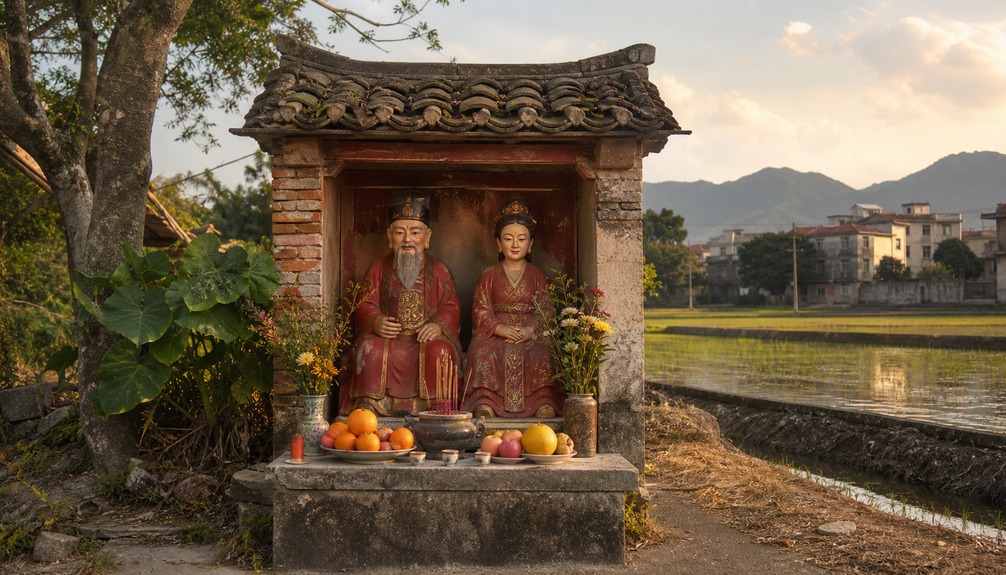
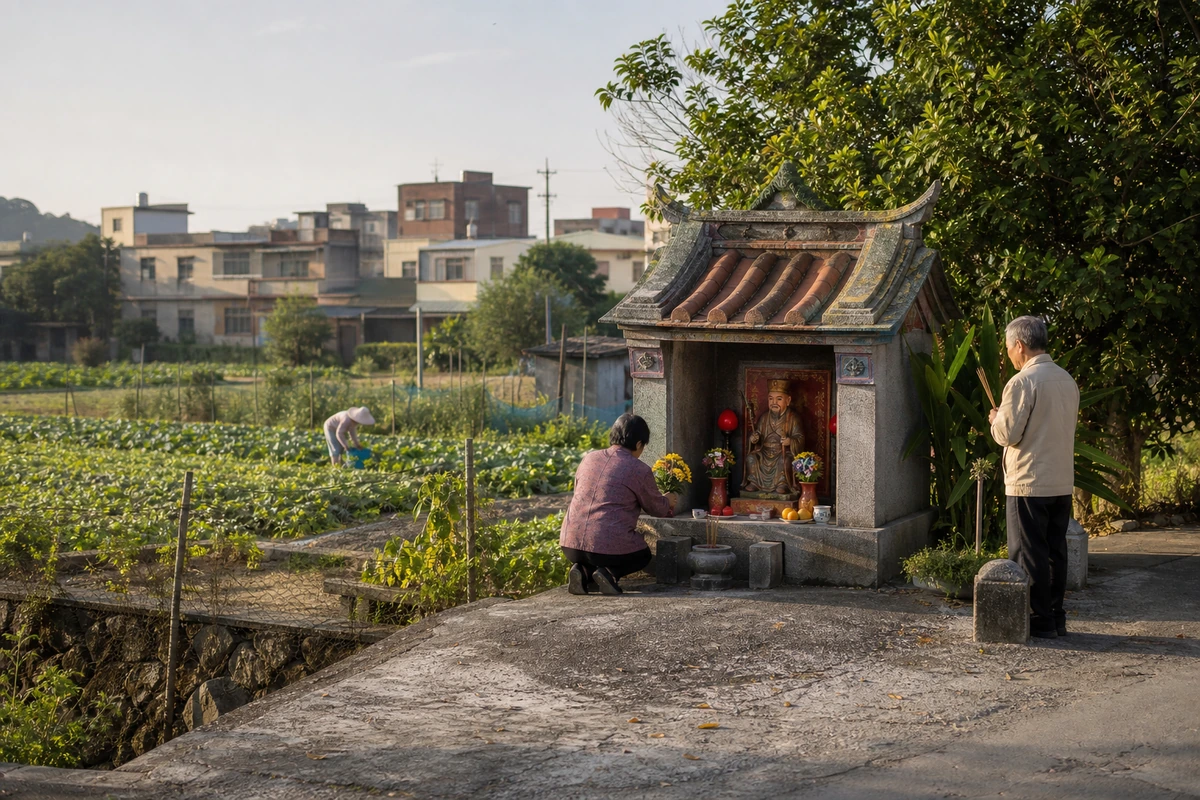
Tu Di Gong shrines often stand where ordinary life and a particular patch of land meet. They may appear beside fields, at the edge of settlements, near shops, or within larger temples. The shrine can be modest because proximity matters more than monumental scale. Worshippers commonly seek protection, agricultural well-being, peaceful community life, or prosperity in work and business.
Taiwan’s government-supported religious heritage records show how local this worship can be. The historic Tu Di Gong shrine at Qing’an Temple in Ruisui is a small stone structure housing both Tu Di Gong and Tu Di Po, an Earth Goddess. A national open-data collection separately maps major Earth God temples across northern Taiwan. Together, these records document a widespread tradition made up of many distinct community shrines rather than a single central sanctuary.
Why He Is Shown as an Elderly Official
Images usually portray Tu Di Gong as a kindly older man in an official’s robe and hat, sometimes holding a staff, a gold ingot, or another sign of authority and blessing. A twentieth-century woodblock print in the University of Michigan Museum of Art places the robed god at the center of an offering scene. A carved figure in the British Museum similarly shows him seated, bearded, and dressed as an official.
This appearance reflects a widespread way of imagining the divine world through the language of administration. Tu Di Gong is often compared with a low-ranking local official who knows the people and conditions within his jurisdiction. “Low-ranking” does not mean unimportant. His closeness makes him one of the most accessible gods in everyday religious life.
Older Soil Worship and the Name Fude Zhengshen
Another common title is Fude Zhengshen (福德正神), usually translated as the Upright God of Fortune and Virtue. Taiwan’s official Dictionary of Folk Cultural Artifacts connects Tu Di Gong worship with older traditions honoring the soil and the she, or local gods of the land. Modern worship is therefore not explained by one origin story alone; it developed from long histories of territorial ritual, agriculture, settlement, and local community organization.
Popular lore sometimes identifies the god with a benevolent official named Zhang Fude. In that story, gratitude for the official’s care after his death leads to his deification. Taiwan Panorama records this account while also presenting it as popular tradition. It should not be treated as the documented biography of every Tu Di Gong. Some shrines preserve local stories about a particular deified person, while others emphasize the office of land guardian without one mortal identity.
Festivals, Offerings, and Agricultural Time
Seasonal worship connects the god with the working landscape. Taiwan Panorama describes spring prayers for successful crops and autumn thanksgiving after harvest. In many Taiwanese communities, the second day of the second lunar month is celebrated as Tu Di Gong’s birthday. The official folklore dictionary also describes recurring observances on the second and sixteenth days of lunar months and the year-end weiya, which developed a strong association with merchants and employee banquets.
These customs are not identical everywhere. Dates, offerings, temple organization, and names vary by region and community. Hakka communities, for example, may call the land god Bogong. The variation does not make one form false; it shows how a local divine office becomes rooted in different histories and landscapes.
Tu Di Gong, Hou Tu, and the Kitchen God
Tu Di Gong should not be confused with every Chinese deity connected with earth or place. Hou Tu belongs to traditions of a far more elevated earth power associated with the totality of the land, state ritual, and later religious systems. A local Tu Di Gong instead serves a bounded territory.
He also differs from Zao Jun, the Kitchen God. Zao Jun’s sphere centers on the household and its moral life, while Tu Di Gong’s jurisdiction is territorial. The two may both be close to ordinary families, but their offices are not interchangeable.
A Sacred Map Made of Local Places
Tu Di Gong worship turns lived geography into sacred geography. A field, lane, market, village, or hillside is not merely anonymous space; it can be understood as a place with a guardian and a relationship to maintain. Shrines also preserve community memory. Government cultural records in Taoyuan note that settlers established Earth God temples as new communities took shape, so the location and history of a shrine can reveal patterns of migration and settlement.
The tradition’s durability comes from that intimacy. Tu Di Gong is not distant from work, harvest, commerce, burial, or neighborhood life. He represents the idea that divine responsibility begins with a particular place and with the people who depend upon it.
Sources and Further Reading
- British Museum: Tu Di Gong figurine
- University of Michigan Museum of Art: True God of the Earth
- Taiwan Panorama: “The Earth God: Guardian of Home and Harvest”
- Taiwan Religious Culture Map: Tu Di Gong Temple at Qing’an Temple
- Taiwan Dictionary of Folk Cultural Artifacts: Fude Zhengshen (Tu Di Gong)
- Taiwan Government Open Data: Earth Deity temples in northern Taiwan