

Accuracy note: The only complete ancient narrative of Cupid and Psyche is embedded in Apuleius’s Latin novel Metamorphoses (also called The Golden Ass), written in the second century CE. “Eros and Psyche” is a familiar modern title, but the surviving story is Roman-era literature, not a tale told by Homer or Hesiod.
Cupid and Psyche is a story about forbidden knowledge, divine power, hostile family relationships, impossible labor, and the transformation of a mortal woman. Its famous romance belongs to a larger, often comic and unsettling novel in which an old woman tells the tale to a kidnapped bride.
Psyche’s beauty and Venus’s anger
Psyche is the youngest of three royal daughters. Her beauty draws crowds who neglect the worship of Venus and honor the mortal girl as if she were the goddess. Venus orders her son Cupid to make Psyche fall in love with the lowest and most miserable man he can find. Instead, Cupid wounds himself with his own weapon and falls in love with her.
Psyche’s beauty brings admiration but no marriage. An oracle tells her family to expose her on a mountain for a monstrous bridegroom. A funeral-like procession leads her away, but the West Wind carries her to a hidden palace where invisible servants meet every need.
The unseen husband and the lamp
Psyche’s husband visits only at night and forbids her to see him. Her jealous sisters persuade her that he must be a serpent who will eventually devour her. Psyche prepares a lamp and knife, but when she illuminates the bed she sees the beautiful winged Cupid.
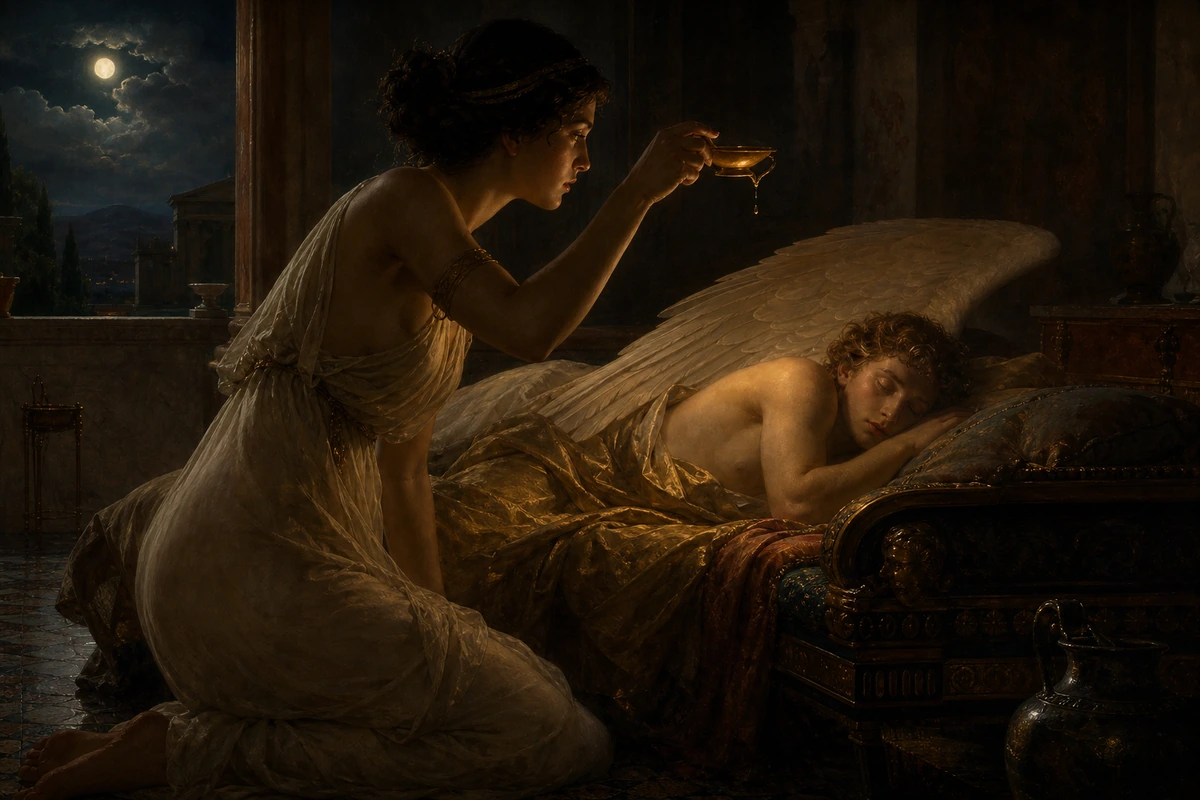
A drop of hot oil falls from the lamp and wakes him. Cupid leaves, criticizing her fear and disobedience, and the palace disappears. The scene has often been reduced to a lesson about female curiosity, but Apuleius also makes Psyche isolated, deliberately deceived by her sisters, and denied basic knowledge about her marriage.
Venus’s four tasks
Psyche searches for Cupid and finally submits to Venus, who beats and humiliates her before assigning a sequence of impossible jobs:
- Sorting mixed seeds: ants separate an enormous heap before the deadline.
- Gathering golden wool: a speaking reed warns her not to approach the dangerous rams at midday and tells her to collect wool caught on branches.
- Fetching water: an eagle fills a vessel from a perilous source associated with the Styx.
- Going to the underworld: Psyche must ask Proserpina for a portion of beauty in a sealed container.
A tower gives Psyche detailed instructions for the descent, including how to pass Cerberus and Charon and how to refuse pleas that would distract her. Proserpina fills the box, but Psyche opens it on the return journey, hoping to restore her own beauty. It contains Stygian sleep, and she collapses.
Immortality and the divine wedding
Cupid escapes confinement, removes the sleep from Psyche, and appeals to Jupiter. Jupiter summons the gods, gives Psyche ambrosia, and makes her immortal. The divine marriage can then be recognized publicly rather than hidden at night. Their daughter is Voluptas, Pleasure.
The ending resolves Venus’s opposition through divine authority, but it does not erase the story’s unequal relationships. Psyche gains status only after repeated suffering and a ruling by Jupiter. That tension is part of why the episode supports many readings rather than one simple moral.
What does Psyche’s name mean?
The Greek word psychē can mean breath, life, or soul, and later art often gives Psyche butterfly wings. The tale has therefore invited allegorical readings about the soul disciplined by trials and united with love. Apuleius never supplies a single explanatory key, however, and the story also functions as entertainment, embedded narrative, social satire, and literary fairy tale.
Greek names versus Roman names
| Apuleius’s Latin context | Common Greek equivalent |
|---|---|
| Cupid | Eros |
| Venus | Aphrodite |
| Jupiter | Zeus |
| Proserpina | Persephone |
Substituting Greek names can be convenient, but it should not make the second-century Latin novel look like an unchanged archaic Greek source.