
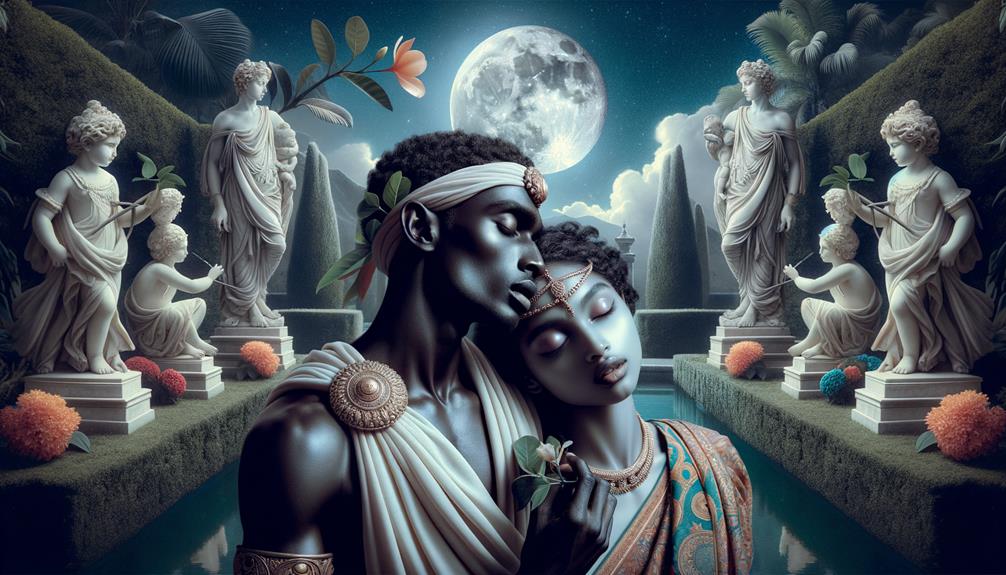
The fullest surviving ancient story of Cupid and Psyche is not an early Roman creation myth. It is a long inset tale in Books 4–6 of Metamorphoses, also called The Golden Ass, written by Apuleius in the second century CE. Within the novel, an old woman tells the story to a kidnapped young bride. That literary frame matters: comedy, danger, sensuality, and consolation coexist throughout the episode.
The tale follows a mortal princess whose beauty provokes worship normally offered to Venus. The goddess tries to punish her through Cupid, but desire escapes Venus’s control. A secret marriage, a forbidden act of seeing, four impossible tasks, a journey to the underworld, and divine negotiation eventually transform Psyche from mortal bride to immortal wife.
Why Venus opposes Psyche
Psyche is the youngest of three royal daughters. Her beauty draws crowds, but it does not bring an ordinary marriage; admirers treat her like a sacred image rather than approaching her as a woman. Venus is angered because people neglect her shrines and direct divine honors toward a mortal.
Venus orders her son Cupid to make Psyche desire the most degraded possible husband. Apuleius does not linger over exactly how Cupid first falls in love. Later retellings often add the neat detail that he accidentally scratches himself with an arrow. The Latin narrative establishes the reversal without making that accident the center of the scene.
The oracle, the mountain, and the unseen husband
When Psyche’s parents consult Apollo’s oracle, they are told to expose her on a mountain for a terrifying, nonhuman bridegroom. The command is staged like a funeral. Yet the West Wind, Zephyrus, carries Psyche gently to a hidden palace. Invisible servants provide music, food, and every luxury.
Her husband comes only at night and forbids her to look at him. Psyche experiences tenderness, but she does not know his face or name. The arrangement therefore combines protection with a severe imbalance of knowledge. Trust is demanded before informed trust is possible.
The lamp and the break in trust
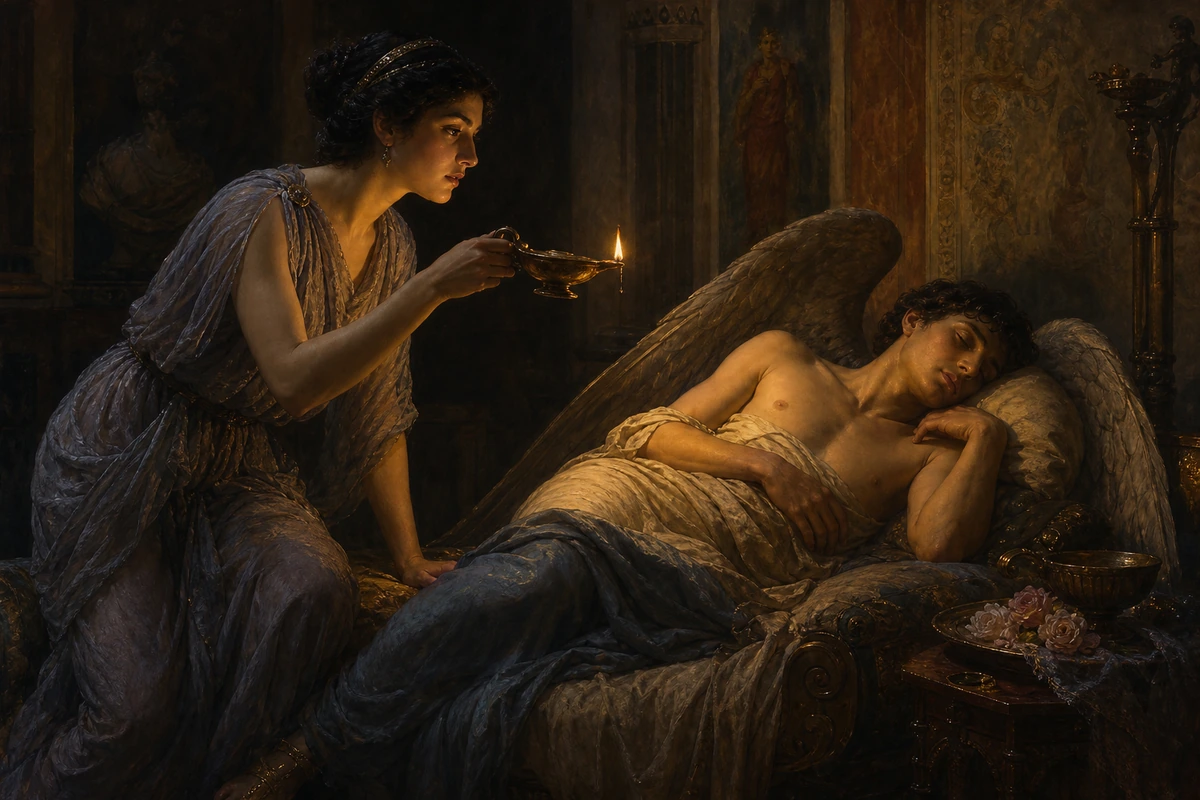
Psyche’s sisters visit the palace and become envious. They persuade her that the hidden husband must be the serpent-like monster foretold by the oracle and urge her to kill him. Psyche prepares a lamp and blade. When she raises the light, she discovers Cupid instead.
As she examines his bow and arrows, Psyche pricks herself and feels desire intensify. A drop of hot oil falls from the lamp onto Cupid’s shoulder and wakes him. He leaves, and the marvelous palace disappears. The scene is often summarized as a simple moral about feminine curiosity, but Apuleius makes it more unstable: Psyche has been deceived by her sisters, yet Cupid has also required intimacy under enforced anonymity.
The four tasks imposed by Venus
Psyche eventually submits herself to Venus, who sets a sequence of impossible labors. Each task is completed with help, undercutting the idea that Psyche succeeds through individual willpower alone.
| Task | What Venus demands | Who or what helps |
|---|---|---|
| Sorting the heap | Separate an enormous mixture of grains and seeds before evening | An army of ants sorts the pile |
| Golden fleece | Bring wool from deadly, violent sheep | A reed advises her to wait and collect fleece caught on branches |
| Water from the height | Fill a vessel from a perilous spring associated with the infernal rivers | Jupiter’s eagle reaches the inaccessible water |
| The underworld box | Ask Proserpina for a portion of beauty and bring the closed box back | A speaking tower gives Psyche precise instructions for the descent |
The descent to Proserpina
The final task is not merely “fetching beauty cream.” Psyche must enter the underworld alive, resist distractions, pay Charon, pass Cerberus, and return with a sealed box from Proserpina. The tower’s instructions teach her when to refuse pity as well as how to survive. Obedience, not combat, is the essential skill.
On the return journey Psyche opens the box, hoping to improve her beauty for Cupid. It contains no cosmetic but an infernal sleep, which overwhelms her. Cupid escapes confinement, removes the sleep from Psyche, and returns it to the box. Her repeated act of looking or opening is dangerous, but it is also what moves the plot from ignorance toward a changed relationship.
Immortality and the marriage of unequal partners
Cupid appeals to Jupiter. Jupiter convenes the gods, orders Venus to accept the marriage, and has Mercury bring Psyche to heaven. Psyche drinks ambrosia and becomes immortal, removing the legal and cosmic inequality between a mortal woman and a god. The wedding is celebrated among the gods, and the couple’s child is named Voluptas—Pleasure.
The ending restores social order, but Apuleius keeps his comic edge. Jupiter’s speech treats divine misconduct with amused self-interest, and Venus is managed rather than morally converted. The story’s resolution is negotiated through power as well as achieved through love.
Does Psyche “represent the soul”?
The Greek word psychē can mean breath, life, or soul, while Cupid embodies desire. Ancient and later readers naturally found allegorical possibilities in a union of Love and Soul. Psyche’s butterfly wings in later art reinforce the association because the butterfly was also linked with the soul.
Still, the tale should not be reduced to one timeless code in which every task equals a stage of spiritual growth. Apuleius wrote a sophisticated Latin novel full of embedded stories, social reversals, magic, religion, and humor. Neoplatonic, Christian, psychoanalytic, and fairy-tale readings reveal different features, but none is the uncontested master key.
Artistic afterlife
Renaissance artists used the tale for major decorative cycles, including designs associated with Raphael at the Villa Farnesina. Antonio Canova’s late eighteenth-century sculptures made the awakening embrace one of the most recognizable Neoclassical images of the couple. John Keats’s “Ode to Psyche” turned the neglected goddess into the focus of a new poetic sanctuary.
Later works often select one mood—innocent romance, forbidden curiosity, trials before marriage, or the union of love and soul. Those adaptations show the tale’s flexibility, but comparisons should be based on evidence. Claims that unrelated horror films or modern short stories “draw from” Cupid and Psyche require a documented creative connection, not just a loose resemblance.
Key takeaways
- The complete ancient narrative survives inside Apuleius’s second-century Roman novel.
- Psyche’s four tasks are completed through guidance and aid, not solitary heroism.
- The underworld box contains a deathlike sleep, not a beauty potion.
- The familiar allegory of Love and Soul is meaningful but does not exhaust the tale’s literary complexity.