
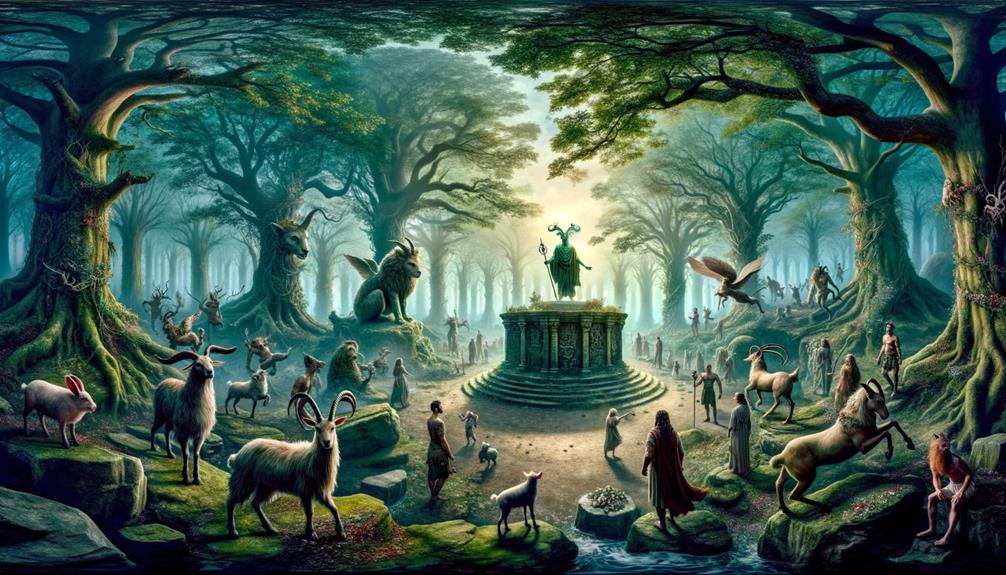
Accuracy note: Faunus is an old Italian and Roman rural deity associated with flocks, woodland, prophecy, and ancestral Latin kingship. His later identification with the Greek Pan influenced art and literature, but the singular god Faunus is not simply a generic half-goat “faun.”
Faunus stands at the meeting point of Roman religion, rural life, poetic myth, and Greek influence. Ancient authors know him as a god of uncultivated or pastoral land, a source of oracles, and an ancestor in stories about early Latium. Only later does the word “faun” become a broad label for a type of goat-featured woodland being.
A native Italian rural god
Faunus belongs to the religious landscape of Latium. Flocks, grazing land, woods, and the uncertain boundary between settlement and wilderness define much of his sphere. Latin literature can also connect him with Fauna or Fatua, with the prophetic adjective fatuus, and with the ancestral king Picus. The genealogies are literary traditions, not one stable creed.
His name appears in the plural fauni for woodland powers, while the singular Faunus remains an individual god. Translating both uses as the same fantasy “faun species” reverses the historical development.
The oracle of Faunus in the Aeneid
Virgil’s Aeneid Book 7 gives the clearest literary scene. King Latinus is troubled by omens surrounding his daughter Lavinia. He consults the oracle of his father Faunus in a sacred grove at Albunea. After sacrifice, the inquirer lies on the skins of slaughtered sheep and receives voices or visions in sleep.
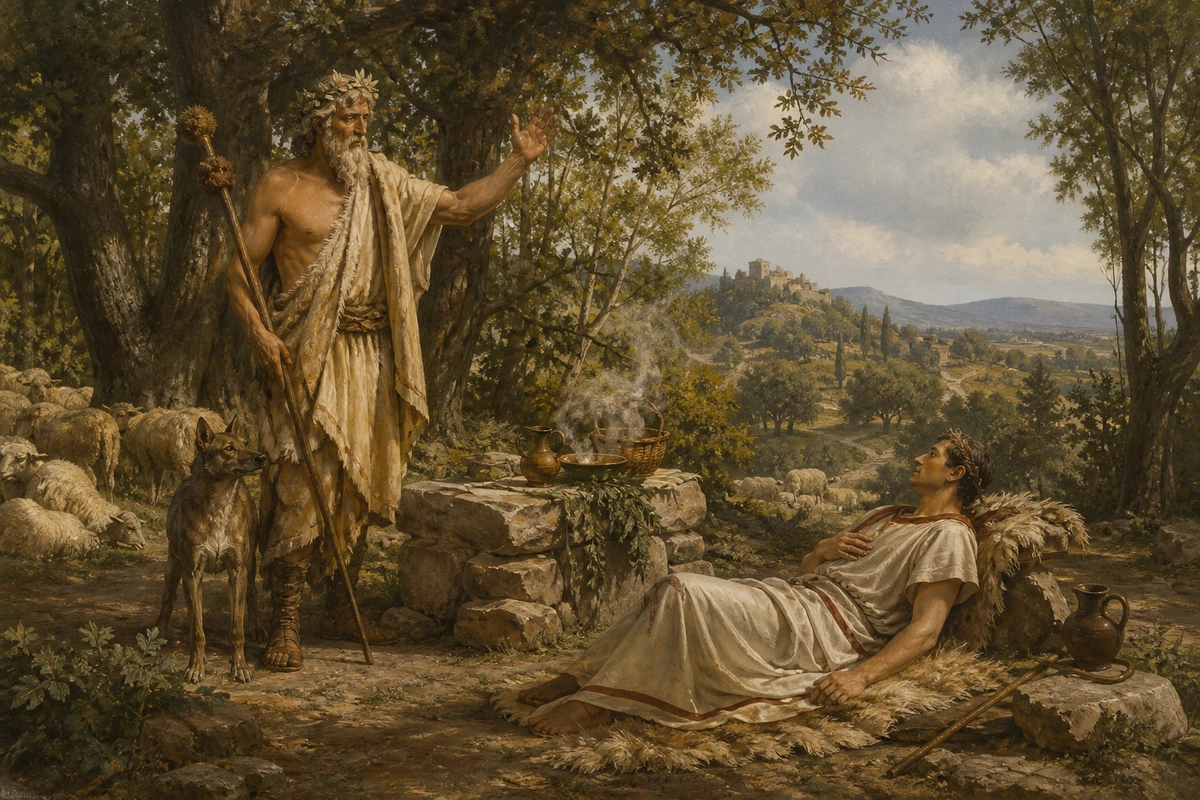
The oracle warns Latinus not to marry Lavinia to a Latin suitor and foretells a foreign marriage whose descendants will rule widely. This episode makes Faunus an ancestral and prophetic authority within Virgil’s story of Roman origins. It does not prove that every Roman oracle of Faunus followed exactly the same ritual.
Faunus and Pan
Roman poets increasingly identify Faunus with Pan, the Greek god of shepherds and wild places. That comparison encourages goat legs, horns, pipes, and erotic pursuit in later images. Yet equivalence in poetry does not erase Faunus’s Italian history or make every trait of Pan original to Roman Faunus.
Ovid’s account of the Lupercalia moves easily between Faunus and Arcadian Pan. That literary syncretism is itself evidence: by the Augustan period, educated Romans could interpret an old Roman festival through Greek myth. It is not proof that the festival always and everywhere belonged to Faunus alone.
Was Faunus the god of the Lupercalia?
Ancient and modern explanations associate the Lupercalia with Pan Lycaeus, Inuus, Lupercus, Faunus, and other figures. Ovid names Faunus; Livy uses Inuus in a Greek-Pan framework. The evidence is complicated enough that a careful article should say Faunus was associated with the festival, not that every detail of the rite straightforwardly honored him.
The Luperci’s goatskins and running ritual should also not be converted into a generic story of priests “driving away evil spirits.” The ceremony had purification and fertility interpretations, but ancient authors disagreed about its origins.
Faunalia and rural worship
Horace’s Odes 3.18 addresses Faunus as a visitor to the poet’s sunny fields. The poem imagines a yearly offering, wine, an old altar, released cattle, resting villagers, and dancing at the return of the December Nones. It is valuable evidence for the literary picture of Faunus protecting flocks and sharing a rustic holiday.
Later calendars and antiquarian writing also associate Faunus with a temple on Tiber Island dedicated in February. The rural December celebration and the urban temple date should not be blended into one continuous modern festival script.
Prophecy without invented folktales
Faunus’s oracular character is well attested, but generic modern anecdotes about an unnamed farmer receiving guaranteed harvest advice are not ancient myths unless a source can be identified. Virgil’s Latinus episode provides a much stronger, traceable example of dream incubation and divine warning.
How Faunus became the modern faun
Greek-Roman artistic blending, medieval reception, Renaissance classicism, and modern fantasy gradually popularized the horned, goat-legged faun. That figure is an important afterlife, but it should be labeled as reception history. The Roman god’s rural, prophetic, and ancestral roles came first.
Key distinctions
- Faunus: an individual Italian/Roman deity and prophetic ancestor.
- Fauna/Fatua: a related female divine name or figure in Roman sources.
- Fauni: plural woodland powers in later Latin usage.
- Pan: the Greek god with whom Faunus was increasingly identified.
- Modern faun: a later artistic and fantasy creature type.