
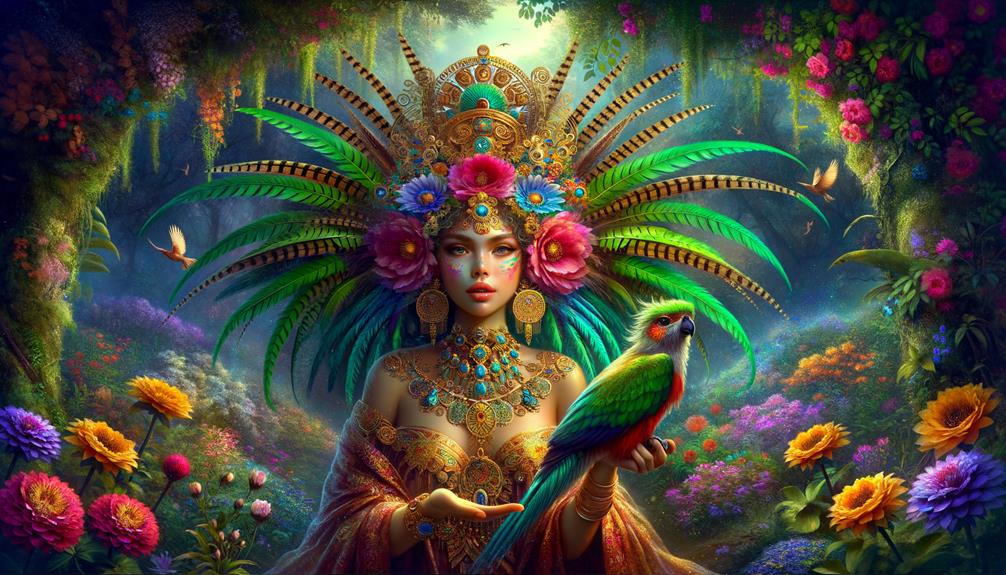
Accuracy note: Xochiquetzal appears in late pre-Hispanic imagery and colonial-period accounts with overlapping associations—flowers, sexuality, fertility, weaving, luxury arts, and young women. Specific marriages, festivals, and rites vary by source; broad statements about what “the Aztecs” believed should be narrowed to evidence.
Xochiquetzal, whose name is commonly translated as “Precious-Feather Flower” or “Quetzal-Flower,” is one of the most visually distinctive female deities of Central Mexican religion. She is closely associated with flowers, fine textiles, skilled female arts, erotic attraction, and reproductive abundance, yet she cannot be reduced to a generic “goddess of love.”
What her name and image communicate
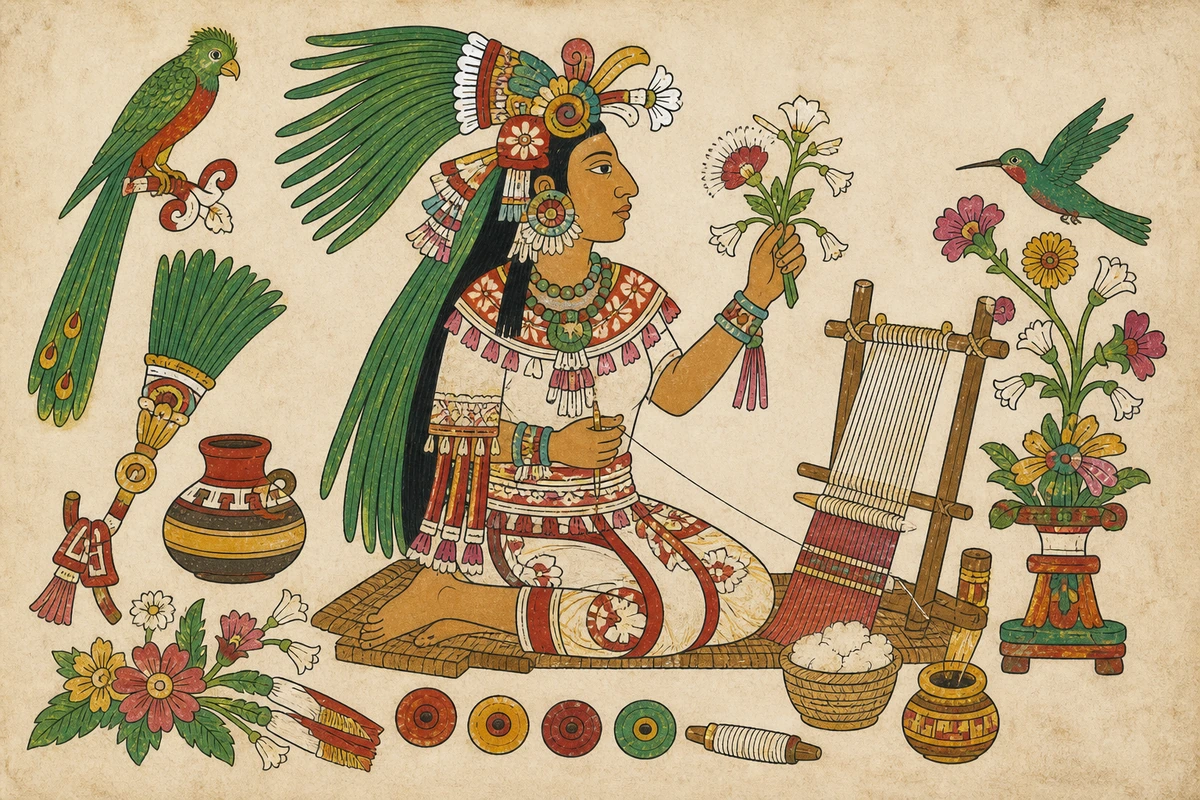
Xōchitl means flower, while quetzalli can refer to precious quetzal feathers and, more broadly, preciousness. Colonial-era codices often present Xochiquetzal as a young, richly ornamented woman. Flowers, feathers, jewelry, and woven garments signal beauty and precious manufacture rather than a modern beauty ideal.
Flowers, sexuality, and fertility
Nahua religious categories overlap. Flowers can evoke beauty, fragrance, song, pleasure, fertility, and elite display. Xochiquetzal’s erotic associations are real, but they should not be recast as evidence that Mexica society celebrated sexuality “without judgment.” Social class, gender, marriage, ritual obligation, and political order all shaped sexual norms.
She is linked with fertility and motherhood in some sources and archaeological interpretations. Other deities—including Tlazolteotl, Cihuacoatl, and Toci—also govern aspects of sexuality, childbirth, purification, or maternity. Assigning every female religious function to Xochiquetzal obscures that larger system.
Weaving and women’s skilled work
Textile production was economically and ritually important. Colonial commentary on the Codex Telleriano-Remensis calls Xochiquetzal the first woman to spin and weave, and describes textile workers celebrating her. Spindle whorls, backstrap looms, cotton, dyeing, and patterned cloth belong at the center of her story—not as decorative additions but as evidence of specialized knowledge and labor.
INAH research at Xochitécatl discusses female figurines, flower imagery, and hundreds of spindle whorls in relation to long-lived ritual practices connected with Xochiquetzal and Tlazolteotl. Archaeologists do not assume that every female figurine is a portrait of one named goddess; context and repeated iconographic patterns guide interpretation.
Tamoanchan and divine relationships
Colonial accounts place Xochiquetzal in Tamoanchan and give her relationships with figures including Tláloc, Tezcatlipoca, and Xochipilli. These narratives are not consistent enough to build one definitive family tree. The story that Tezcatlipoca carries her away from Tláloc is attested in a colonial source, but describing it as a parallel to Adam and Eve adds a comparison that the Nahua story does not require.
Festivals: what can be said safely
Sources connect Xochiquetzal with several calendrical observances, textile specialists, flowers, and female ritual roles. Names and emphases can differ across manuscripts and modern reconstructions. The claim that her festivals routinely featured unspecified “sexual rites” is too strong without a precise passage and context.
A better approach is to describe the evidence source by source: which calendar period is named, who participated, what offerings or impersonations are reported, and whether the account was written by a Nahua informant, a Spanish friar, or a later scholar.
Distinguishing related deities
| Deity | Strong associations | Caution |
|---|---|---|
| Xochiquetzal | Flowers, weaving, precious arts, sexuality, fertility | Not the sole goddess of women or motherhood |
| Tlazolteotl | Sexual transgression, purification, confession, fertility | Not simply another name for Xochiquetzal |
| Xochipilli | Flowers, song, dance, games, pleasure | Relationship to Xochiquetzal varies by source |
| Cihuacoatl | Childbirth, war, earth, and a major political office | Do not merge all childbirth symbolism |
Why the evidence is layered
Much written information about Mexica religion comes from the sixteenth century, after conquest, while sculptures, ceramics, codices, and excavated objects supply different kinds of evidence. Xochiquetzal also has deeper Central Mexican antecedents, but identifying earlier female images by her later Mexica name can be debated. Dates and cultural setting matter.