
Accuracy note: Tāwhaki is known across Māori and wider Polynesian traditions, but genealogies, companions, routes to heaven, and the knowledge obtained differ by community and source. This article foregrounds variant Māori accounts rather than blending them into one universal plot.
Tāwhaki is an ancestral hero whose adventures connect earth and the heavens. A famous Māori sequence sends him and his brother to their grandmother Whaitiri and then upward by a sacred route. The story is not a simple “quest for enlightenment”: it concerns genealogy, correct ritual knowledge, danger, kinship, and access to celestial authority.
Why there is no single Tāwhaki story
Oral traditions belong to particular iwi and regions. Nineteenth- and twentieth-century collectors recorded accounts with different names and narrative emphases, and cognate heroes appear elsewhere in Polynesia. A responsible summary identifies the version being described and avoids treating differences as errors.
In some Māori accounts Tāwhaki seeks his wife and child in the heavens; in others the ascent brings ritual knowledge or contact with celestial beings. Tainui tradition can connect him with the three baskets of knowledge, while other influential traditions give the ascent for the baskets to Tāne. Both should be reported without forcing one to cancel the other.
Whaitiri at the foot of the ascent
One recorded narrative sends Tāwhaki and his younger brother Karihi to the place where their blind grandmother Whaitiri lives, counting her kūmara. The brothers initially disturb her count before revealing themselves. After the recognition and restoration of her sight, Whaitiri gives them the knowledge needed for the ascent.
This is more specific than calling her a generic “storm guide.” She is a powerful ancestor whose relationship to the brothers provides orientation and correct procedure. The kūmara, the act of counting, and the recognition scene root the cosmic journey in kinship and cultivated life.
The two vines
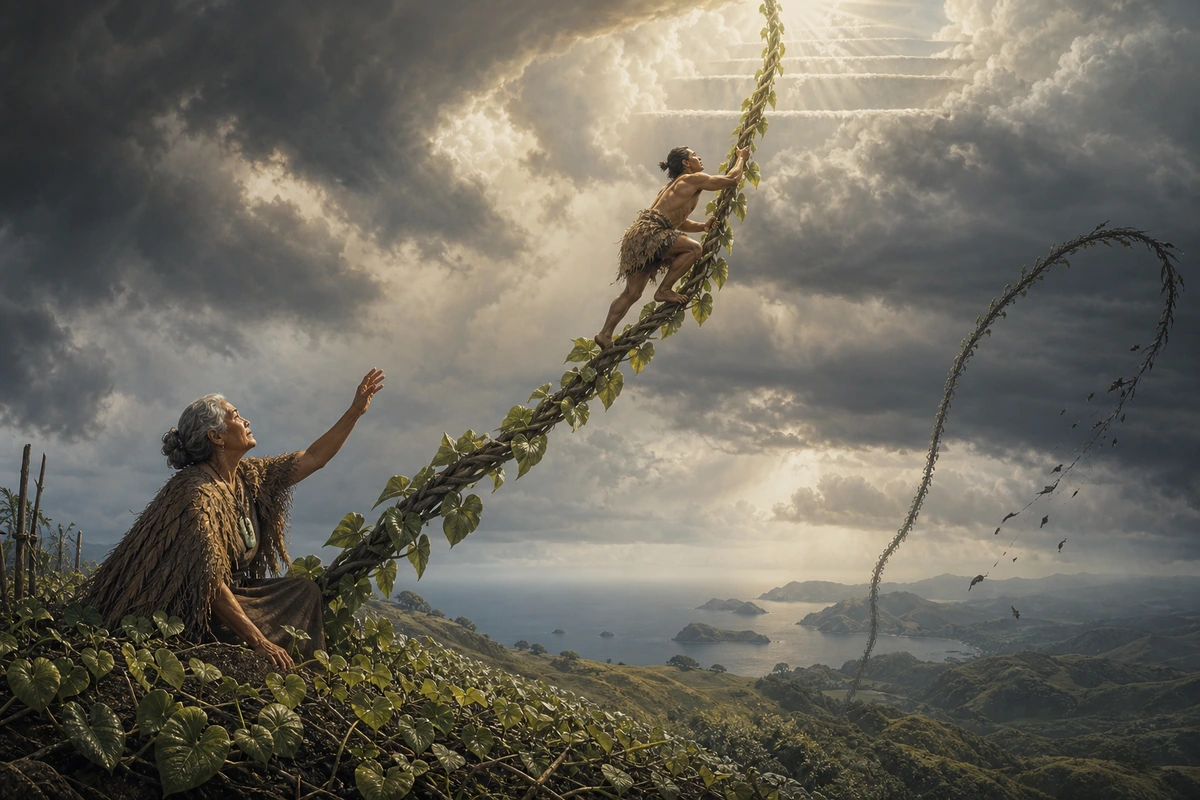
Whaitiri warns the travelers about two routes. The aka taepa, a hanging vine, is unstable; the aka matua, the parent vine, is the correct path. Karihi climbs the wrong vine, is thrown about by the winds, and falls. Tāwhaki uses the parent vine and recites the proper karakia as he climbs.
The contrast is not evidence for invented lists of “intergenerational curses” or modern comparisons with ayahuasca and Dionysus. It is a narrative about receiving instruction, recognizing the right route, and maintaining ritual competence under extreme conditions.
What happens in the upper heavens?
In the account summarized by Te Ara’s historical encyclopedia, Tāwhaki reaches the uppermost of ten heavens, receives karakia from Tama-i-waho, and marries Hāpai—or, in another version, Maikuku-makaka. Other traditions arrange the heavens differently or give Tāwhaki another aim.
Te Ara also records a kite tradition in which Tāwhaki rises toward the heavens on an aute-bark kite while competing karakia cause ascent and fall. This variant is a reminder that the climbing vine is famous but not exclusive.
Lightning and celestial imagery
Tāwhaki has associations with radiance, thunder, or lightning in some traditions, but claims such as lightning literally flashing from his armpits should not be presented as a universal Māori belief without a traceable source. Celestial imagery can mark supernatural mana while still varying among communities.
The baskets of knowledge question
Modern summaries often state that Tāwhaki always retrieves the three baskets of knowledge. Te Ara notes this in Tainui tradition. In other well-known Māori accounts, Tāne ascends to obtain the baskets. The safest wording is therefore “in some traditions,” followed by the community or source when known.
Wider Polynesian relationships
Names related to Tāwhaki appear in several Polynesian societies, but the characters are not interchangeable. Comparative study can reveal shared inheritance and later local development; it should not erase the authority of particular Māori, Hawaiian, Samoan, Tahitian, or Cook Islands narratives.
How to read the story well
- Treat variation as evidence of living regional traditions.
- Identify whether a claim comes from an iwi account, a collector, or a modern retelling.
- Keep Tāwhaki distinct from Tāne when sources assign them different celestial journeys.
- Avoid importing unrelated spiritual systems as explanations for the sacred vines.