

Jason is the leader of the Argonaut expedition for the Golden Fleece, but no surviving source gives one definitive biography. Earlier poems and art preserve fragments; Apollonius of Rhodes supplies the only complete surviving Greek epic of the voyage; and Euripides’ Medea reshapes its disastrous aftermath. Across them, Jason’s success depends on a crew, divine sponsorship, and Medea’s decisive help.
The one-sandalled man
Pelias rules at Iolcus after displacing Jason’s family. Warned to beware a man wearing one sandal, he meets Jason, who has lost a sandal while crossing a river—often while carrying an old woman who is Hera in disguise. Pelias sends the young claimant to retrieve the Golden Fleece from distant Colchis, expecting the journey to kill him.
Jason’s family and upbringing
Jason is usually the son of Aeson, but his mother’s name and the details of his rescue from Pelias vary. Later accounts say he was raised by the centaur Chiron. The familiar childhood narrative is assembled from mythographic sources rather than told at length in Apollonius’s epic.
The Argo and its crew
Argus builds the Argo with Athena’s help, and a piece of prophetic oak from Dodona is fitted into the ship in Apollonius. Crew lists vary widely but can include Heracles, Orpheus, Castor and Polydeuces, Peleus, Telamon, the seer Idmon, the winged sons of Boreas, and Atalanta in some later traditions. “The Argonauts” were never a fixed franchise roster.
Leadership on the outward voyage
Jason organizes a remarkable coalition, yet other Argonauts repeatedly supply strength, prophecy, music, navigation, or local knowledge. Heracles dominates some early episodes before leaving the expedition; Orpheus counters the Sirens; Polydeuces wins a boxing match; Phineus and the Boreads help open the route. Jason’s leadership is collaborative and sometimes anxious rather than effortlessly supreme.
Aeëtes and the impossible tasks
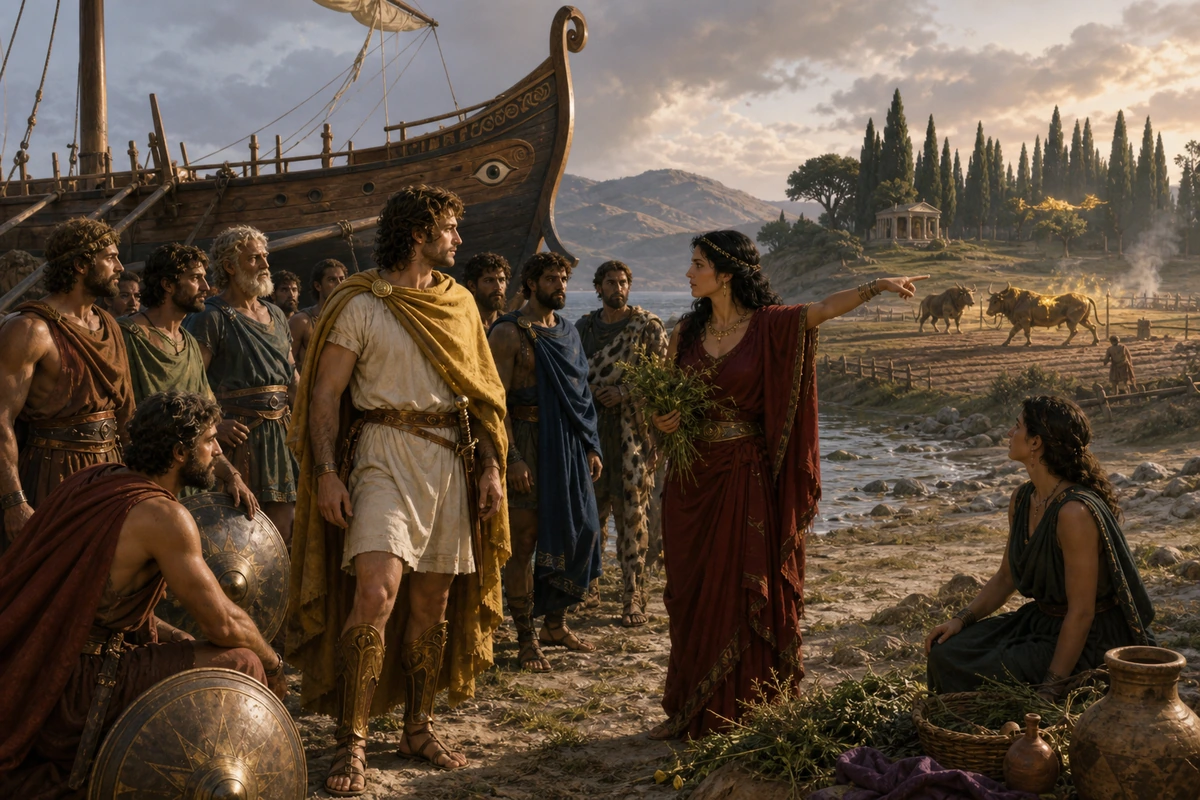
King Aeëtes of Colchis will not simply surrender the Fleece. He orders Jason to yoke fire-breathing, bronze-footed bulls, plough a field, sow dragon’s teeth, and survive the armed men who spring from the soil. Hera and Athena persuade Aphrodite to make Aeëtes’ daughter Medea fall in love with Jason.
Medea makes victory possible
Medea gives Jason a protective drug and instructions for defeating the earthborn warriors. In Apollonius, she later drugs the serpent guarding the Fleece so Jason can take it. Some art and texts redistribute the action, but a retelling that credits Jason alone erases the person who solves the central trials and accepts the greatest personal risk.
Promises and the flight from Colchis
Jason promises marriage and protection, and Medea leaves her family. The escape involves the death of her brother Apsyrtus, but sources disagree sharply: in some he is a child killed and scattered by Medea; in Apollonius he is an adult ambushed in a plot involving both Jason and Medea. Their return route likewise changes across authors.
The return to Iolcus
Possessing the Fleece does not restore Jason through a simple coronation. Medea engineers Pelias’s death by convincing his daughters that they can rejuvenate him through dismemberment and boiling. The deception forces Jason and Medea into exile. Traditions vary about where they go and who rules Iolcus afterward.
Jason in Euripides’ Medea
At Corinth, Euripides presents Jason abandoning Medea to marry the king’s daughter. He defends the match as prudent advancement; Medea exposes the oaths and sacrifices that made his success possible. Her revenge kills the new bride, Creon, and—uniquely influential though not universal in earlier tradition—the children she had with Jason.
Hero, opportunist, or failed leader?
Ancient sources allow all three readings. Jason can persuade a crew and endure a dangerous voyage, but he benefits from Hera’s favour, colleagues’ talents, and Medea’s magic. His later betrayal makes earlier promises look politically convenient. The tension between charismatic leadership and dependence is one reason the myth remained productive for epic and tragedy.
Sources and further reading
- Apollonius of Rhodes, Argonautica, Project Gutenberg translation
- Apollodorus, Library, Argonautic narrative
- Euripides, Medea, for the Corinthian aftermath
- Pindar, Pythian Ode 4, an important pre-Apollonian account of Jason and Medea