
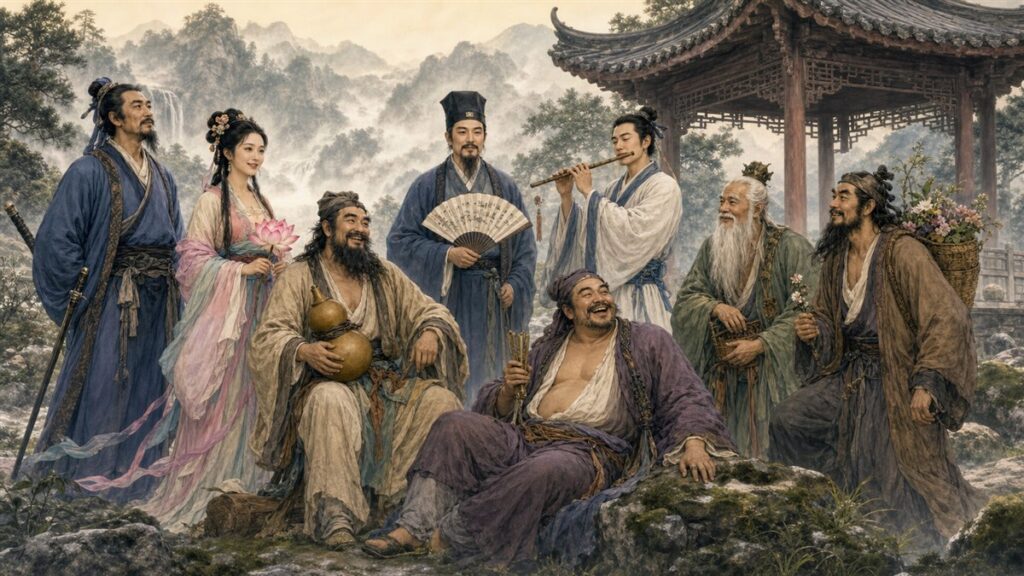
The Eight Immortals—Ba Xian in Chinese—are a celebrated company of legendary figures in Daoist and Chinese popular tradition. Artists identify them through distinctive objects: an iron crutch and gourd, a fan, a sword, a bamboo-tube instrument, court tablets, a flute, a flower basket, and a lotus or peach. Their appeal comes from the ensemble. Different ages, social roles, temperaments, and legendary biographies gather into one auspicious group.
Accuracy note: Some individual immortals have much older stories, but the familiar group of eight became prominent in the later imperial period. Their biographies, genders, attributes, and routes to transcendence vary among texts, drama, temple traditions, and works of art.
When did the group take shape?
The Eight Immortals were not a fixed fellowship in the earliest Daoist writings. Immortal figures had appeared in Chinese literature and religion for centuries, but the roster familiar today emerged gradually. The Metropolitan Museum of Art notes that the group became popular by the twelfth century and was recognizable by the early thirteenth. Yuan and Ming drama, fiction, painting, porcelain, textiles, and print culture helped stabilize their identities.
This history explains why a simple “Han dynasty origin” timeline is misleading. A legendary member may be associated with a historical person from an earlier dynasty, while the standardized ensemble is later. Date the individual tradition, the group, and the artwork separately instead of assigning all three to one era.
Who are the Eight Immortals?
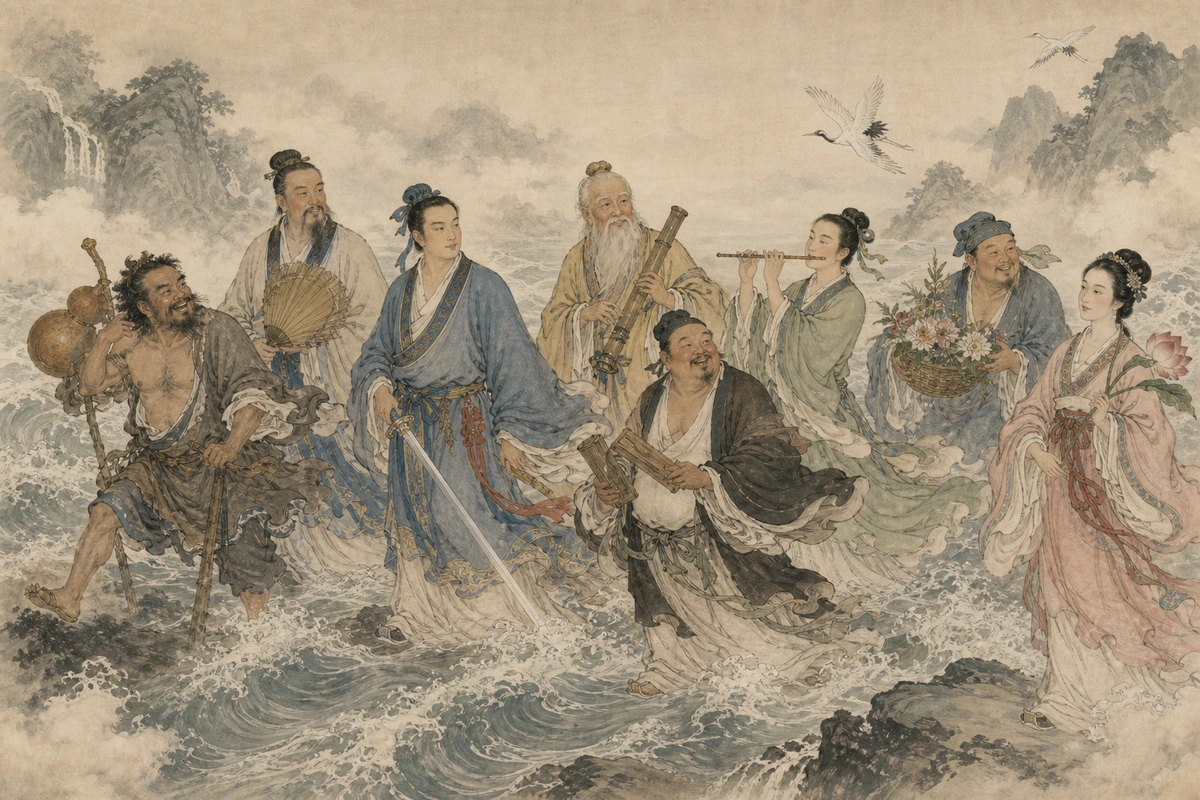
Li Tieguai is usually an unkempt wanderer leaning on an iron crutch and carrying a gourd. His damaged body and spiritual power create a deliberate contrast between outward poverty and inward attainment. The gourd can release vapor, spirits, or medicine in visual and popular traditions.
Zhongli Quan appears as a robust, bearded elder and commonly carries a fan. Some later stories call him a military man who abandoned worldly ambition. Lü Dongbin, perhaps the most individually famous of the group, is shown as a scholar with a sword and sometimes a fly whisk. His legends connect literary education, spiritual training, demon-quelling, and instruction from Zhongli Quan.
Zhang Guolao is an elderly eccentric whose emblem is a fish drum or bamboo-tube instrument called a yugu. Popular scenes may show him riding a donkey backward. Cao Guojiu wears court dress and holds court tablets, clappers, or castanets. His cultivated appearance links him to elite status, while his legends turn withdrawal from court into a spiritual choice.
Han Xiangzi carries or plays a flute and is associated with musicians. Lan Caihe bears a basket of flowers and is depicted with unusually variable gender presentation and dress; forcing Lan into a single modern category can flatten the deliberate ambiguity of the tradition. He Xiangu, the woman most consistently included in the group, commonly holds a lotus, peach, flower, or basket and is linked with purity, longevity, and household devotion.
| Immortal | Common identifying attribute | Typical visual or legendary emphasis |
|---|---|---|
| Li Tieguai | Iron crutch and gourd | Power concealed by a beggar’s appearance |
| Zhongli Quan | Fan | Elder, teacher, and transformation |
| Lü Dongbin | Sword and fly whisk | Scholarship, spiritual discipline, demon-quelling |
| Zhang Guolao | Bamboo-tube fish drum | Eccentric age and reversal of convention |
| Cao Guojiu | Court tablets or clappers | Elite rank relinquished for cultivation |
| Han Xiangzi | Flute | Music and inspired freedom |
| Lan Caihe | Flower basket | Itinerancy and gender ambiguity |
| He Xiangu | Lotus, peach, or flower | Purity, longevity, and auspicious blessing |
What does “immortal” mean here?
The Chinese term xian is often translated as “immortal,” but it does not simply mean a person who cannot die. Depending on period and context, a xian may be a transcendent being, perfected practitioner, mountain recluse, wonder-worker, deity, or auspicious figure associated with longevity. Stories explain attainment through discipline, instruction, alchemy, moral change, divine favor, or sudden transformation.
The Eight are therefore not best described as eight people who followed one formal curriculum to “enlightenment.” That wording imports a single system where the legends offer many routes. Some stories are comic, some devotional, some theatrical, and some morally didactic. Daoist religion, popular worship, literature, and secular decorative art all contributed to their afterlives.
“Crossing the sea, each showing a special power”
The best-known group adventure sends the Eight Immortals across the sea. Rather than board an ordinary vessel, each uses a personal attribute or ability. The episode is remembered in the saying “The Eight Immortals cross the sea; each displays a divine power,” which now describes people solving the same problem in different ways.
Versions vary in sequence, obstacle, and antagonist. Some become a contest of skill; others provoke conflict with the Dragon Kings of the sea. The stable idea is not a technical inventory of supernatural powers. It is coordinated difference: the group reaches a shared destination without erasing the identity of any member.
How to identify them in art
An artwork may show all eight people, only a selection, or merely their attributes. A gourd and crutch can stand for Li Tieguai; a flute for Han Xiangzi; a flower basket for Lan Caihe; a lotus for He Xiangu. Sets of these objects are known as the “attributes of the Eight Immortals” and can appear on textiles, porcelain, furniture, carvings, birthday gifts, and architectural decoration.
Attributes are not perfectly fixed. He Xiangu may carry a peach in one object and a lotus in another; Lü Dongbin may have a sword, whisk, or both. Identification should combine object, costume, companions, inscription, and museum record. A generic old man with a fan is not automatically Zhongli Quan, just as every flute player is not automatically Han Xiangzi.
Social variety without a modern census
The group is often praised for representing rich and poor, old and young, elite and marginalized, male and female. That is a useful account of their visual variety, but it should not become the claim that the Eight were designed as a mathematically complete cross-section of Chinese society. Patronage labels also vary by museum and regional tradition.
Their diversity works symbolically. The ragged Li Tieguai can stand beside the courtly Cao Guojiu; the scholarly Lü Dongbin beside the flower-bearing Lan Caihe; elders beside youthful figures. Attainment is not restricted to one appearance or social station, while the objects keep every personality recognizable within the fellowship.
Auspicious presence in everyday life
By the Ming and Qing periods, the Eight Immortals had become major subjects in decorative art associated with longevity, prosperity, celebration, and good fortune. A cup, screen, robe, porcelain vessel, or birthday painting could invoke them without functioning as a formal theological diagram. Sacred and secular uses overlap rather than excluding one another.
That broad presence explains their continuing popularity in opera, television, comics, games, temple festivals, and household imagery. Modern adaptations can invent new adventures, but historically responsible retellings preserve the difference between a variable body of legends and a single canonical superhero team.