
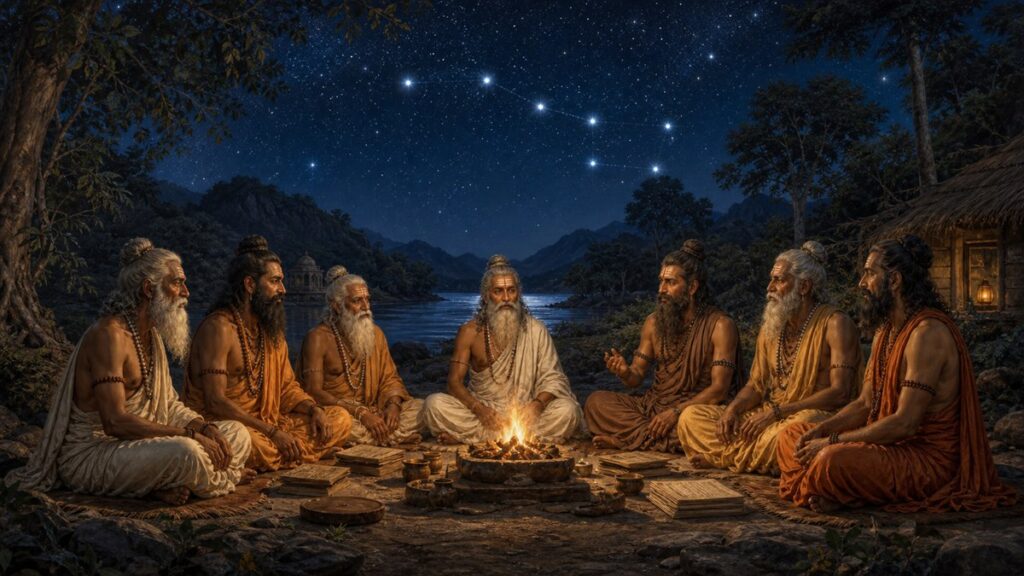
Accuracy note: Sapta Rishi means “Seven Sages,” but the roster is not identical in every Hindu text. Lists change across Vedic, epic, astronomical, and Purāṇic sources, and Purāṇic cosmology can assign a different group to each manvantara.
The Sapta Rishis are not seven characters with one shared adventure. They are a recurring way of organizing sacred authority: ancient seers, lineage ancestors, teachers, and cosmic witnesses whose names connect texts, ritual families, astronomy, and later cycles of creation. A responsible account begins with the variation rather than hiding it.
What is a rishi?
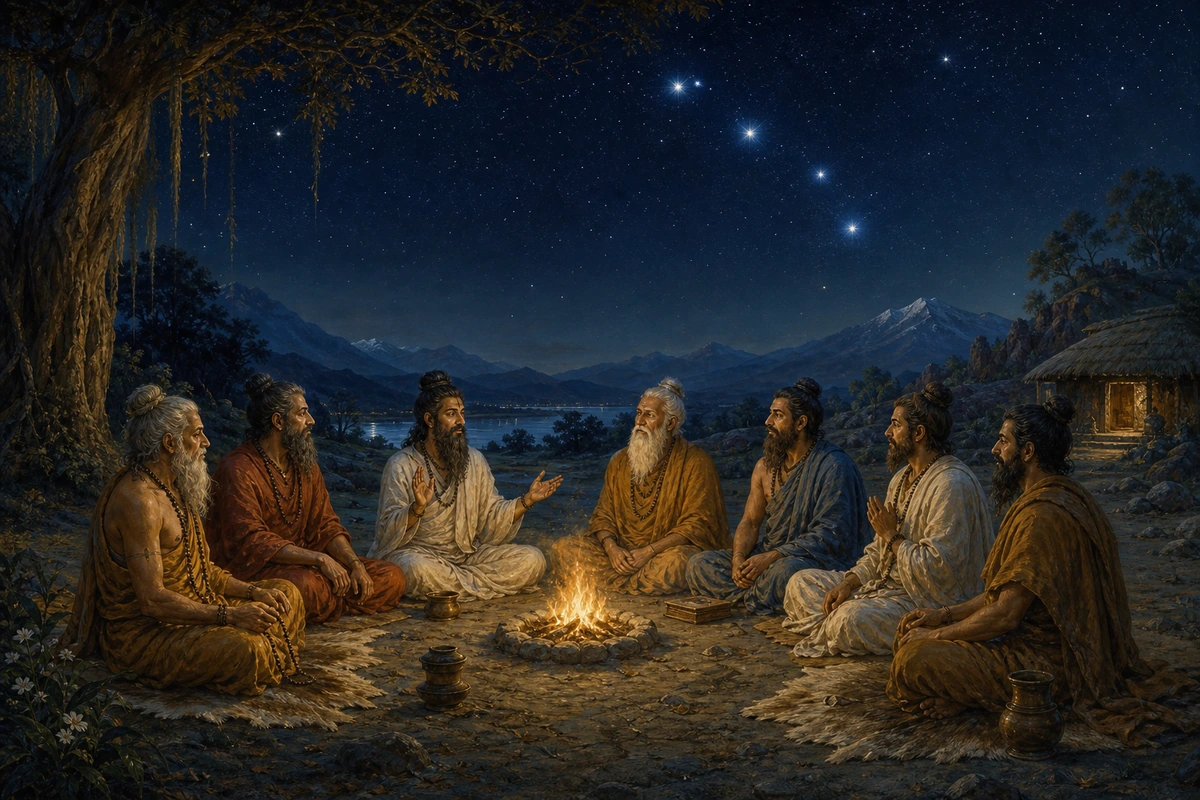
The Sanskrit word ṛṣi is commonly translated “seer” or “sage.” In Vedic tradition, rishis are associated with the revealed hymns and with the families through which those hymns were transmitted. Later literature expands the category to include exemplary teachers, ascetics, lawgivers, royal sages, divine sages, and ancestors of social and ritual lineages.
Calling a rishi simply a “wizard” or “priest” is too narrow. The term can involve inspired seeing, disciplined knowledge, poetic authority, austerity, and descent. The group of seven therefore signifies concentrated authority, not a superhero team assigned to police the universe.
Why do the seven names change?
Different genres use the group for different purposes. An early Upaniṣadic passage names seven rishis while mapping them to features of the human head. Epic and Purāṇic genealogies may list mind-born sons or progenitors connected with Brahmā. Astronomical writing identifies the seven with stars. Later Purāṇic cosmology places successive groups in different world ages.
One widely cited epic and Purāṇic roster is Marīci, Atri, Aṅgiras, Pulastya, Pulaha, Kratu, and Vasiṣṭha. Another influential group contains Atri, Bharadvāja, Gautama, Jamadagni, Kaśyapa, Vasiṣṭha, and Viśvāmitra. The second set is familiar in ritual contexts today. Neither list makes the other a mistake.
The sages and the manvantaras
A manvantara is the period governed by one Manu within a much larger cosmic cycle. Purāṇic texts organize each manvantara with its own Manu, gods, Indra, and seven rishis. This system explains how more than seven authoritative sages can all belong to a legitimate Sapta Rishi group: the office or grouping recurs while its members change.
Modern summaries sometimes say the seven are immortal in exactly the same bodies through every creation. Hindu texts offer more varied models, including rebirth, recurring offices, descendants, and new rosters. The specific Purāṇa and manvantara should be named before making a fixed claim.
The Saptarishi constellation
The seven bright stars of the asterism known internationally as the Big Dipper or Plough, part of Ursa Major, are the Saptarṣi-maṇḍala. Varāhamihira’s sixth-century Bṛhat Saṃhitā gives an ordered roster of Marīci, Vasiṣṭha, Aṅgiras, Atri, Pulastya, Pulaha, and Kratu. Astronomical and astrological texts track the group’s position and use it in chronology.
Vasiṣṭha is associated with the visible star Mizar and his wife Arundhatī with its close companion Alcor. In Hindu wedding practice, the pair can be shown to newly married partners as a model of companionship. This does not make Arundhatī an “eighth Saptarishi”; it connects a married sage and his equally respected wife with a recognizable double star.
Common rosters compared
| Context | Representative names | Why it differs |
|---|---|---|
| Epic/Purāṇic progenitors | Marīci, Atri, Aṅgiras, Pulastya, Pulaha, Kratu, Vasiṣṭha | Genealogy and creation |
| Another early/ritual group | Atri, Bharadvāja, Gautama, Jamadagni, Kaśyapa, Vasiṣṭha, Viśvāmitra | Different textual and lineage setting |
| Bṛhat Saṃhitā constellation | Marīci, Vasiṣṭha, Aṅgiras, Atri, Pulastya, Pulaha, Kratu | Ordered mapping to stars |
| Later manvantaras | New groups named for successive ages | Recurring cosmic office |
Do the sages “safeguard universal order”?
That phrase can summarize their authority, but it is not a single job description found in all sources. The sages preserve knowledge, establish lineages, counsel rulers and gods, perform austerities, participate in creation stories, and reappear in new cosmic periods. Their actions can also create conflict: rishis curse, argue, compete, and make consequential mistakes.
The variety is the point. The Sapta Rishis provide continuity without requiring a single unchanging cast. They link human teaching lineages to a cosmic scale while remaining embedded in distinct narratives and living ritual traditions.
Sources and further reading
- Varāhamihira, Bṛhat Saṃhitā, chapter 13: the seven sages as a constellation
- Brahmāṇḍa Purāṇa selection: sages and changing manvantaras
- K. M. Ganguli’s public-domain Mahābhārata translation: epic genealogical material