
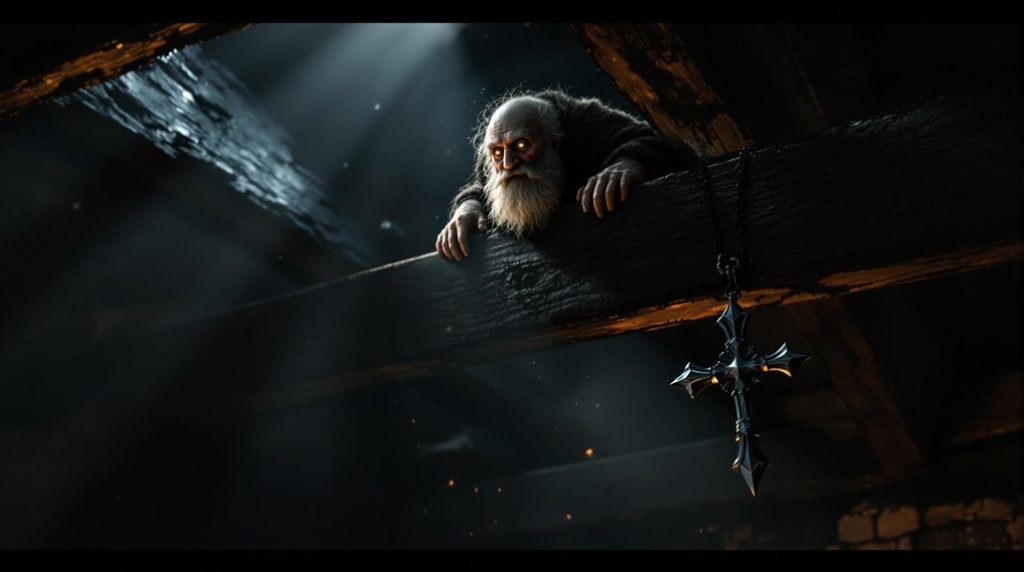
The domovoi is an East Slavic household spirit, especially prominent in Russian, Ukrainian, and Belarusian folklore. It is not a Norse being and does not have one standardized appearance or moral alignment. Recorded traditions describe a hidden house-master who protects family and livestock, enforces domestic expectations, gives omens, and can become frightening when angered.
What the name means
Russian domovoi derives from dom, “house.” Related names across Slavic languages often mean house-master, grandfather, old man, or owner. The familiar English spelling “domovoi” can therefore conceal a broad family of local household-spirit traditions rather than a single pan-Slavic character.
Where the evidence comes from
Most detailed descriptions were collected by ethnographers in the nineteenth and early twentieth centuries from Christian rural communities. Those accounts may preserve older practices, but they are not direct transcripts of an untouched pre-Christian religion. Folklore continued to change as families, houses, farming, and religious life changed.
Ancestor, spirit, or house-master?
People called the domovoi “grandfather” and sometimes imagined it in the likeness of a dead or living household head. This has encouraged interpretations based on ancestor veneration. Other accounts treat the spirit as belonging to the building, land, or domestic order without naming a human origin. The evidence supports overlap, not one universal genealogy.
Where the domovoi lives
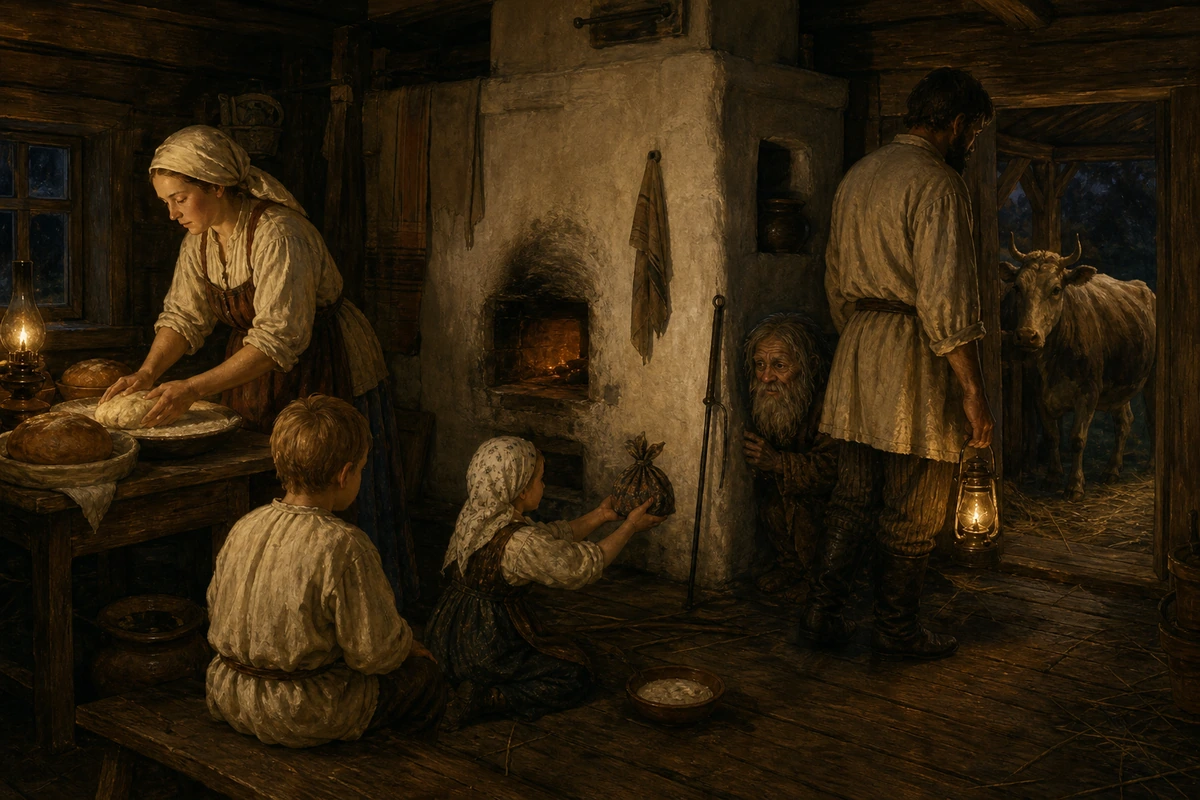
The stove is the best-known dwelling place because it organized warmth, food, sleep, and work in the peasant house. Folklore also locates the spirit under the threshold, in the attic or cellar, and near cattle in the stable or barn. These are boundary and subsistence spaces where household well-being could visibly succeed or fail.
Appearance and invisibility
The domovoi is often unseen. When visible, it may look like a small hairy old man, the family’s master, a deceased relative, or an animal such as a cat, dog, or snake. Descriptions vary by region and occasion. The modern red-capped “Slavic gnome” is only one artistic convention, not an ethnographic uniform.
Protection and household order
A well-disposed domovoi guards property, tends preferred livestock, and warns the family of danger. An offended one may make noises, hide objects, disturb sleep, tangle animals’ manes, or trouble cattle. Stories use the spirit to express expectations about cleanliness, hospitality, quarrelling, care for animals, and respect within the household.
Omens in touch and sound
Nighttime pressure, a furry touch, laughter, weeping, knocking, or an apparition resembling a family member could be interpreted as an omen. Warm or gentle contact might promise good fortune; cold, painful, or mournful signs could warn of illness or death. Folklore collections do not agree on a fixed code, and local interpreters supplied the meaning.
Moving to a new house
Families could invite the domovoi to accompany them when they moved, sometimes using bread, porridge, a shoe, a sack, a coal from the old hearth, or a spoken invitation. The ritual treated the household as more than a building. Continuity had to be carried and welcomed into the new dwelling.
Christian coexistence and modern revival
Domovoi belief persisted alongside Orthodox Christianity, sometimes reinterpreted as superstition or a troublesome spirit and sometimes woven into ordinary domestic custom. Contemporary fiction and modern Slavic religious movements have created new practices. Those living traditions deserve description, but they should be distinguished from nineteenth-century collections and from medieval speculation.
Sources and further reading
- “The Domovoy: Benevolent House Spirit or Overbearing Grandpa?” The Ethnograph, University of British Columbia
- “Slavic Religion,” Encyclopedia of Religion
- Linda J. Ivanits, Russian Folk Belief
- W. R. S. Ralston, The Songs of the Russian People