
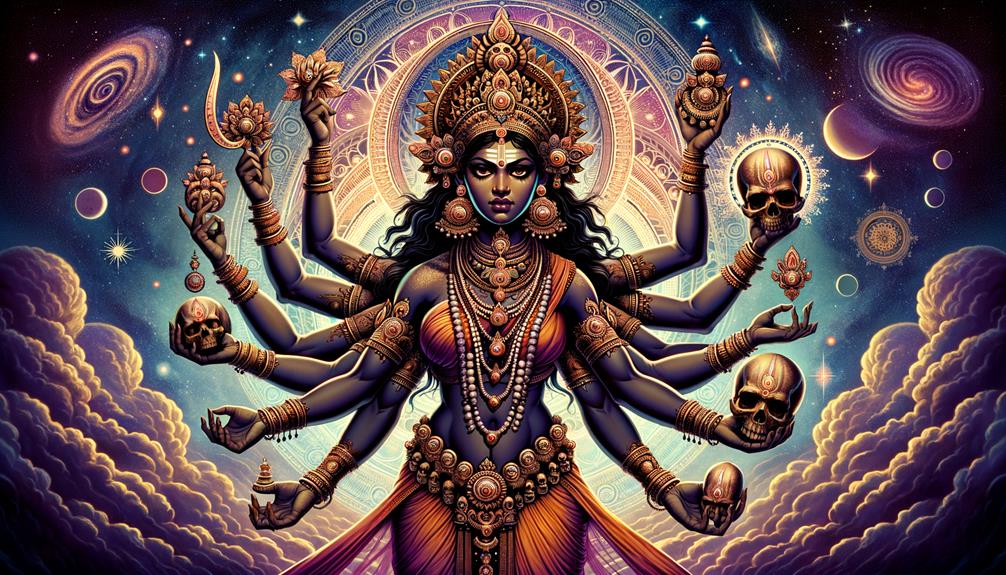
Kali is a major Hindu goddess whose fierce appearance can express protection, time, death, power, and liberation. She is especially prominent in Shakta and Bengali traditions, where devotees also approach her as Mother. No single myth or symbol explains every form of Kali.
Kali in the Devi Mahatmya
One of Kali’s earliest major appearances is in the Devi Mahatmya, composed around the middle of the first millennium CE. During battle, she emerges from the forehead of the enraged goddess Ambika or Durga. Dark, emaciated, and terrible, she defeats the demons Chanda and Munda and receives the name Chamunda.
In the battle against Raktabija, each drop of the demon’s blood that reaches the ground produces another fighter like him. Kali opens her mouth and consumes the blood and the duplicates, allowing the other goddess forms to wound and defeat him. The story presents her violence as a force used against a threat that multiplies through ordinary attack.
What Does Kali’s Name Mean?
Kālī can mean “the black one” or “the dark one.” It is also related to kāla, a word associated with time and death. Hindu texts and later theology develop both meanings. The name does not reduce Kali to a goddess of evil or chaos.
Kali’s Iconography
Common images give Kali dark blue or black skin, loose hair, several arms, a sword, a severed head, a garland of heads, a skirt of arms, and an extended red tongue. She may stand on a still or corpse-like Shiva in a cremation ground. Details differ across periods and forms.
- Sword: Can represent the force that cuts through demons, ignorance, or attachment.
- Severed head: Refers directly to her battle imagery; devotional interpretations can also connect it with ego.
- Garland and skirt: Display mastery over death and the consequences of violent action. Some Tantric interpretations connect the heads with sounds or letters, but that reading is not universal.
- Open hands: Other hands may grant fearlessness and blessings, balancing the weapons she carries.
Why Does Kali Stand on Shiva?
A widely told later story says Kali’s battle dance becomes uncontrollable. Shiva lies among the bodies, and when she steps on him she recognizes him and stops. Some images show him as conscious, others as corpse-like. The scene has been interpreted as the relationship between dynamic power, Shakti, and pure consciousness, Shiva.
The image did not have one unchanged meaning from the earliest texts onward. It became especially prominent in later Tantric and Bengali art.
Why Is Kali’s Tongue Extended?
In the Raktabija episode, her mouth and tongue collect the demon’s blood. In the popular story of stepping on Shiva, the tongue can signal sudden recognition or shame. Other ritual and artistic traditions read it as ferocity, appetite, or power. It is inaccurate to insist on only one explanation.
Kali as Mother and Protector
Devotional traditions praise Kali as a compassionate mother who destroys fear and grants liberation. This is not a modern attempt to soften a violent goddess. Fierce protection and maternal grace have long coexisted in Kali worship. Bengali poets such as Ramprasad Sen addressed her through intimate, sometimes argumentative songs of devotion.
Kali Puja is a major festival in West Bengal and neighboring regions, often held on the new-moon night that coincides with Diwali elsewhere. Practices differ, and descriptions of one temple should not be treated as rules for every devotee.
Frequently Asked Questions
Is Kali the wife of Shiva?
Many traditions connect Kali with Shiva and understand her as a form of the Great Goddess, who also appears as Parvati or Durga. The exact relationship changes with the text and theology.
Is Kali a goddess of death?
She is associated with time and death, but also protection, knowledge, motherhood, and liberation. The short label leaves out most of her religious meaning.
Do all Kali worshippers practice animal sacrifice?
No. Rituals vary greatly. Some temples maintain sacrificial traditions, while many devotees offer flowers, food, light, prayer, and other non-animal offerings.