Amaterasu Omikami is the sun kami and one of the central figures in Japan’s earliest surviving mythic chronicles. The Kojiki, completed in 712, and the Nihon Shoki, completed in 720, preserve related but not identical accounts of her birth, conflict with Susanoo, withdrawal into a rock cave, and connection with imperial rule.
Birth of Amaterasu
In the Kojiki, Izanagi washes after returning from the land of the dead. Amaterasu is born when he cleanses his left eye, Tsukuyomi from his right eye, and Susanoo from his nose. Izanagi gives Amaterasu authority over Takamagahara, the Plain of High Heaven.
The Nihon Shoki includes multiple versions. In one, Izanagi and Izanami together produce the sun deity; another more closely resembles the purification account. These variant narratives are part of the source, not errors that can be combined into one fixed genealogy.
Amaterasu and Susanoo
Before leaving for the underworld, Susanoo goes to Takamagahara. Amaterasu arms herself because she suspects hostile intent. The two perform an oath ritual that produces deities from exchanged objects, but their dispute continues. Susanoo damages fields, disrupts sacred rites, and throws a flayed horse into the weaving hall.
The episode should not be reduced to a simple sibling prank. It violates agricultural, ritual, and social order and leads directly to Amaterasu’s withdrawal.
The Heavenly Rock Cave
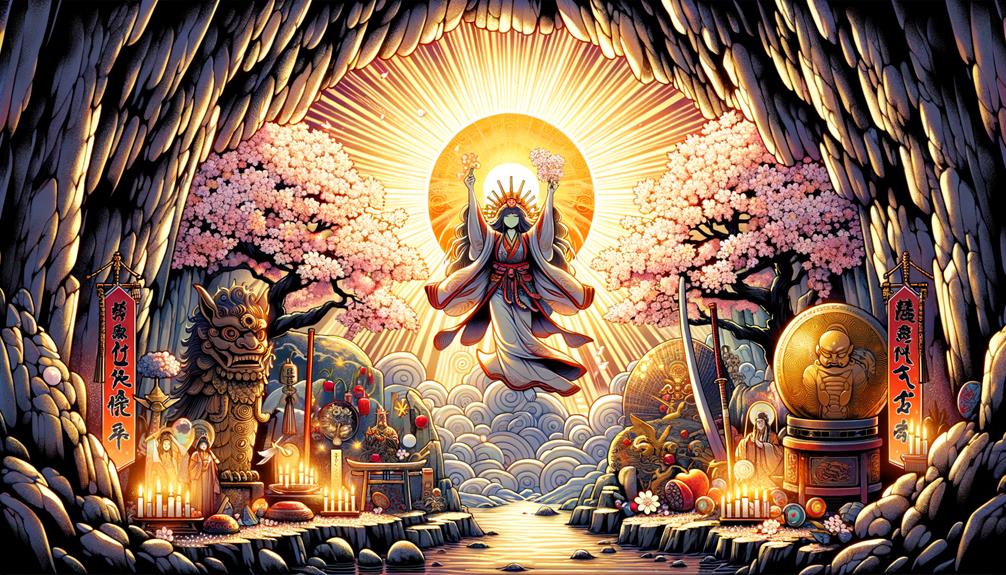
Amaterasu shuts herself inside Ama no Iwato, the Heavenly Rock Cave, and light disappears. The assembled kami devise a plan. Roosters call, jewels and a mirror are hung from a sacred tree, and Ame no Uzume performs a comic and provocative dance that makes the gods laugh.
Curious, Amaterasu opens the cave and sees her reflection in the mirror. Ame no Tajikarao draws her outside, and a sacred rope prevents her return. Light is restored. The episode joins ritual performance, laughter, cooperation, and sacred objects rather than presenting one hero who rescues the sun.
Amaterasu and the Imperial Myths
Amaterasu sends her grandson Ninigi to rule the earthly land. The regalia associated with his descent include a mirror, jewels, and a sword. Later genealogy connects Ninigi’s descendants to Jimmu, the first emperor in the traditional chronicle.
This is the mythic and ritual basis for calling Amaterasu the ancestral kami of the imperial house. It is a sacred genealogy and a statement of political legitimacy, not a lineage that modern historical methods can verify back to the age of the gods.
Ise Jingu
Amaterasu is enshrined at the Inner Shrine, Naiku, of Ise Jingu in Mie Prefecture. The sacred mirror is associated with her presence but is not displayed publicly. The shrine’s buildings are periodically reconstructed in the Shikinen Sengu ceremony, which transmits ritual skills and sacred continuity through renewal.
Amaterasu is also worshipped at many other shrines. Shinto has no single weekly service or universal household practice, so descriptions of Ise should not be treated as the only form of her worship.
Name and Gender
Amaterasu is conventionally described as a goddess in English because the chronicles portray her as female. Kami, however, is not simply the Japanese equivalent of a Western god or goddess. The full name Amaterasu Omikami can be understood as the great august kami who shines in heaven.
Frequently Asked Questions
Is Amaterasu the ruler of all Shinto kami?
She rules the heavenly plain in the early myths and has exceptional imperial importance. Shinto traditions include many kami and do not operate through one universal hierarchy.
Is Tsukuyomi Amaterasu’s husband?
The early chronicles call Tsukuyomi her sibling. Some accounts pair their heavenly domains, but the texts do not give one stable marital biography.
Is the mirror at Ise the same mirror from the cave story?
Shrine tradition identifies the sacred mirror with Amaterasu’s regalia. Because it is not publicly displayed or tested, that identity belongs to religious tradition rather than archaeological verification.