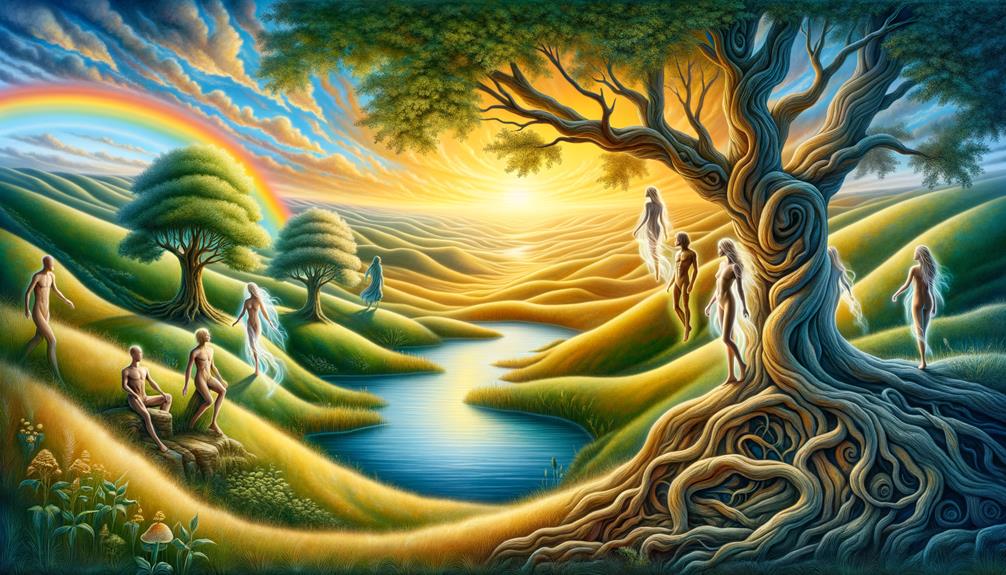
Tír na nÓg means “Land of the Young” or “Land of Youth.” It is one name for an Irish Otherworld where age, sickness, hunger, and ordinary time may work differently. The best-known modern story sends Oisín there with Niamh of the Golden Hair, but Irish literature contains many Otherworld names and many versions of travel beyond the human world.
The Irish Otherworld Is Not One Map
Early and medieval tales use names including Tír na nÓg, Tír Tairngire, Mag Mell, Emain Ablach, and lands beneath lakes or inside mounds. These places overlap in qualities but are not always interchangeable. They may lie west across the sea, underground, under water, or beside the human world but normally hidden.
The Otherworld is not simply the afterlife for every dead person. Living heroes can visit and return, while immortal or long-lived beings may enter the human world. Calling it the Irish version of heaven removes the stories’ distinctive rules.
Were the Tuatha Dé Danann Driven to Tír na nÓg?
Some later summaries say the Tuatha Dé Danann retreated to Tír na nÓg after the Milesians defeated them. Medieval traditions more often divide the síd, the supernatural mounds, among them or describe several Otherworld dwellings. There is no single text that relocates every member of the Tuatha Dé to one island paradise under that name.
Oisín and Niamh
Oisín is a poet and warrior of the Fianna, son of Fionn mac Cumhaill. In the familiar tale, Niamh Chinn Óir, Niamh of the Golden Hair, comes from Tír na nÓg on a white horse and invites him to return with her. He finds youth, beauty, music, and abundance there.
After what seems a short time, Oisín longs to see Ireland. Niamh lends him the horse and warns him not to touch the ground. He returns to find the Fianna gone and centuries passed. When he leans down to help people lift a heavy stone, the saddle or girth fails in many versions. He falls, becomes an aged man, and the horse returns without him.
A Tale with a Long and Changing History
The Oisín material belongs to a broad Fenian tradition carried through manuscripts, professional storytelling, oral folklore, and print. The specific Niamh and Tír na nÓg narrative best known today owes much to Laoi Oisín ar Thír na nÓg, an eighteenth-century Irish poem associated with Mícheál Coimín.
Later oral versions change names, durations, places, and the reason Oisín falls. Some give him three hundred years away. Others stress three years as he experiences them. A responsible retelling should name its source rather than claim one ancient original.
Oisín and Saint Patrick
Many Fenian poems frame Oisín as an old survivor who debates Saint Patrick. Oisín praises the courage, generosity, hunting, and feasting of the Fianna, while Patrick urges Christian belief. The exchange is sometimes comic, sometimes hostile, and sometimes sorrowful.
The frame places the heroic pagan past in conversation with Christian Ireland. It does not show that the historical Saint Patrick met a warrior preserved for centuries.
Time in the Otherworld
Time displacement appears in many Irish Otherworld tales. A feast or visit that seems brief can cover generations in the human world. The pattern creates loss as well as wish fulfillment. Oisín receives youth but cannot bring it safely home.
Frequently Asked Questions
How do you pronounce Tír na nÓg?
Irish pronunciation varies by dialect. An English approximation is “Teer na Nogue,” with nÓg rhyming roughly with “vogue.”
Does Oisín die as soon as he returns?
He ages when he touches the ground. Some versions then place him with Saint Patrick for a period before death rather than killing him at once.
Is Niamh a goddess?
She is an Otherworld woman and often a king’s daughter. Individual tellings do not always classify her with a fixed divine title.
Sources
- National Folklore Collection, “The Return of Oisin from Tír na nÓg”
- National Folklore Collection, “Oisín i dTír na nÓg”