
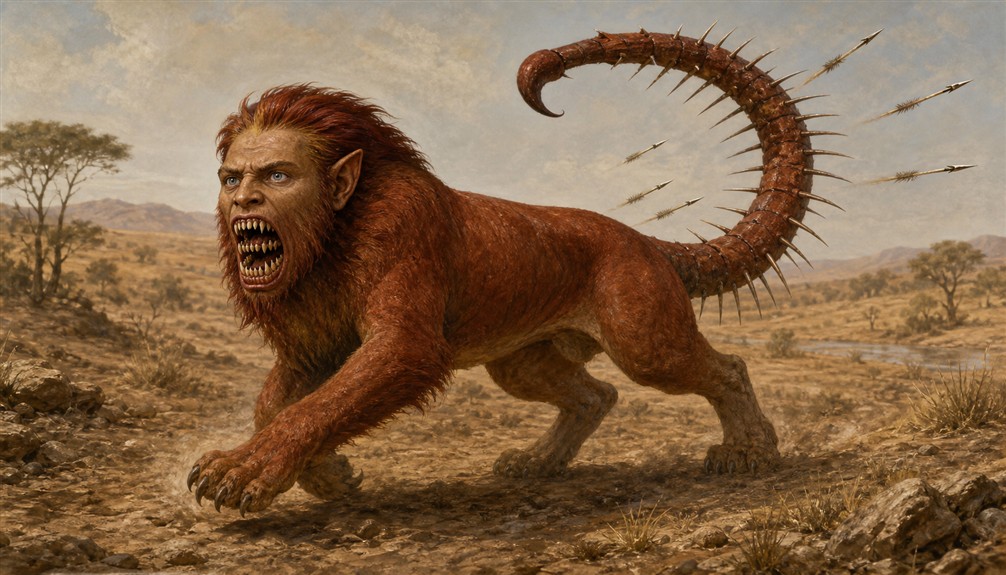
The manticore entered Greek literature as a reported animal from India, not as a creature from a Greek heroic myth. Its oldest surviving descriptions depend on the lost Indica of Ctesias, a Greek physician at the Persian court. Later writers repeated the report, questioned it, or reshaped it for Roman natural history and medieval bestiaries.
The Name and Ctesias’s Report
The name appears in Greek forms such as martichora and mantichora. Ancient writers understood it as meaning man-eater, based on an Iranian expression. That meaning matches the creature’s stated preference for human prey.
Ctesias’s own work survives only through quotations and summaries by later authors. In the fuller account preserved by Aelian, the beast is about the size of a large lion and red like cinnabar. It has a face and ears resembling a human’s, pale blue eyes, a hairy body, lionlike feet, and three rows of sharp teeth in each jaw.
The Tail That Shoots Spines
The early tail is more elaborate than the single scorpion stinger common in modern fantasy art. Aelian’s version gives it a terminal stinger and additional stings along both sides. The manticore can discharge these at a distance like missiles, and the spines grow back. Hunters are said to crush the tails of young animals before the weapons develop.
This detail is important because it distinguishes the ancient report from later pictures of a winged lion with a scorpion tail. Wings do not belong to the standard descriptions preserved from Ctesias, Aristotle, Aelian, or Pliny. A conventional human head, lion body, and simple stinger is already a reduced version of the older account.
Voice, Speed, and Prey
The manticore is described as swift as a deer. Its call combines sounds compared with a pipe and a trumpet. It hunts humans and can overcome more than one person. These traits made it both a marvel from a distant land and a direct threat rather than a passive heraldic hybrid.
Ancient authors did not all accept the story without reservation. Aelian repeats the claim that Ctesias saw a specimen brought to the Persian king, then openly questions whether he is a reliable authority. Pausanias suggests that fear and repeated storytelling had transformed a tiger into the fantastic man-eater. That proposal is an ancient skeptical explanation, not proof that every detail began with one observed tiger.
From Natural History to Bestiary
Aristotle mentions the creature while signaling doubt about Ctesias. Pliny places the manticora among reports of distant animals and repeats its human face, triple teeth, red lionlike body, scorpion tail, unusual voice, speed, and appetite for human flesh.
Medieval bestiaries inherited the manticore through this natural-history tradition. Artists varied its color, face, tail, posture, and degree of humanity. The Getty’s survey of bestiary manuscripts notes examples with a human head and lion body, including a blue manticore in an English manuscript. Such images show how copying and interpretation altered the creature long before modern fantasy games added further traits.
What the Sources Support
No archaeological evidence establishes the manticore as a real species, and claims by modern excavators or eyewitnesses should not be inserted without verifiable records. The creature is best studied as a report that moved between Persian, Greek, Roman, and medieval textual settings.
A source-based depiction has a red lion-sized body without wings, a humanlike face and ears, three rows of teeth, blue or gray eyes, great speed, and a spine-armed tail capable of shooting darts. The familiar scorpion-tailed monster is part of its later visual history, but it is not a complete summary of the oldest surviving account.
Sources
- Aelian, On the Characteristics of Animals, Book 4
- Ctesias fragments, translated by Andrew Nichols
- Pliny the Elder, Natural History, Book 8
- J. Paul Getty Trust, medieval bestiary overview