
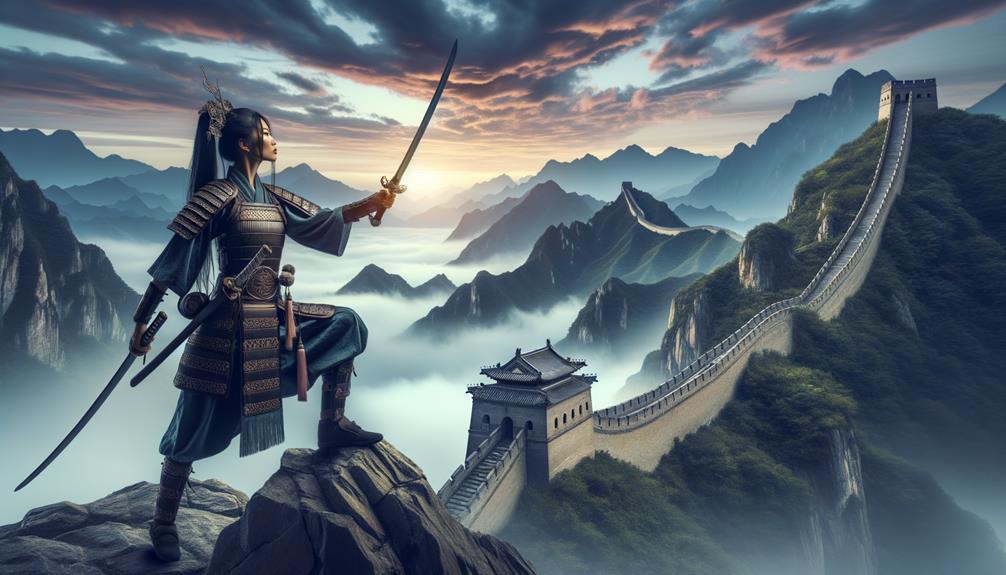
Mulan is the legendary woman warrior at the center of one of China’s most adaptable stories. She is best treated as a literary and folkloric figure, not as a securely documented historical soldier: no independent contemporary record confirms her life. The earliest evidence is a ballad, and each later retelling reshaped its heroine for a new audience. Even the familiar name “Hua Mulan” goes beyond the oldest poem, which calls her simply Mulan.
The Earliest Surviving Story
The oldest surviving account is the anonymous Ballad of Mulan, or Mulan shi. Scholars often associate the story with northern China during the Northern Dynasties, especially the Northern Wei period (386–534), although the exact date and development of the poem remain debated. The text now known survives in Yuefu shiji, a Song-dynasty anthology compiled by Guo Maoqian. Guo identified an earlier, now-lost musical record as his source, so the surviving poem preserves an older tradition through a later collection.
What Happens in the Ballad?
The ballad opens with Mulan at her loom, sighing because her father’s name appears on the military rolls and the household has no grown son to serve in his place. She decides to go herself. At four markets she buys a horse, saddle, bridle, and whip, then leaves her parents and rides toward the northern frontier.
Battle receives surprisingly little attention. The poem compresses years of campaigning into images of long distances, cold light on armor, and soldiers returning after heavy losses. One line says the survivors return after ten years; near the close, Mulan’s comrades say they traveled with her for twelve. When the ruler offers rewards and a high post, Mulan asks only for a swift mount to carry her home.
Back with her family, she changes out of her wartime clothes, arranges her hair, and meets her fellow soldiers. They are astonished to discover that she is a woman. The poem ends with a metaphor of male and female hares running side by side: in motion, their sex cannot readily be distinguished. The ballad contains no named love interest, talking dragon, magical powers, or detailed duel scenes, and it does not say that Mulan became a general.
A Northern Frontier Setting
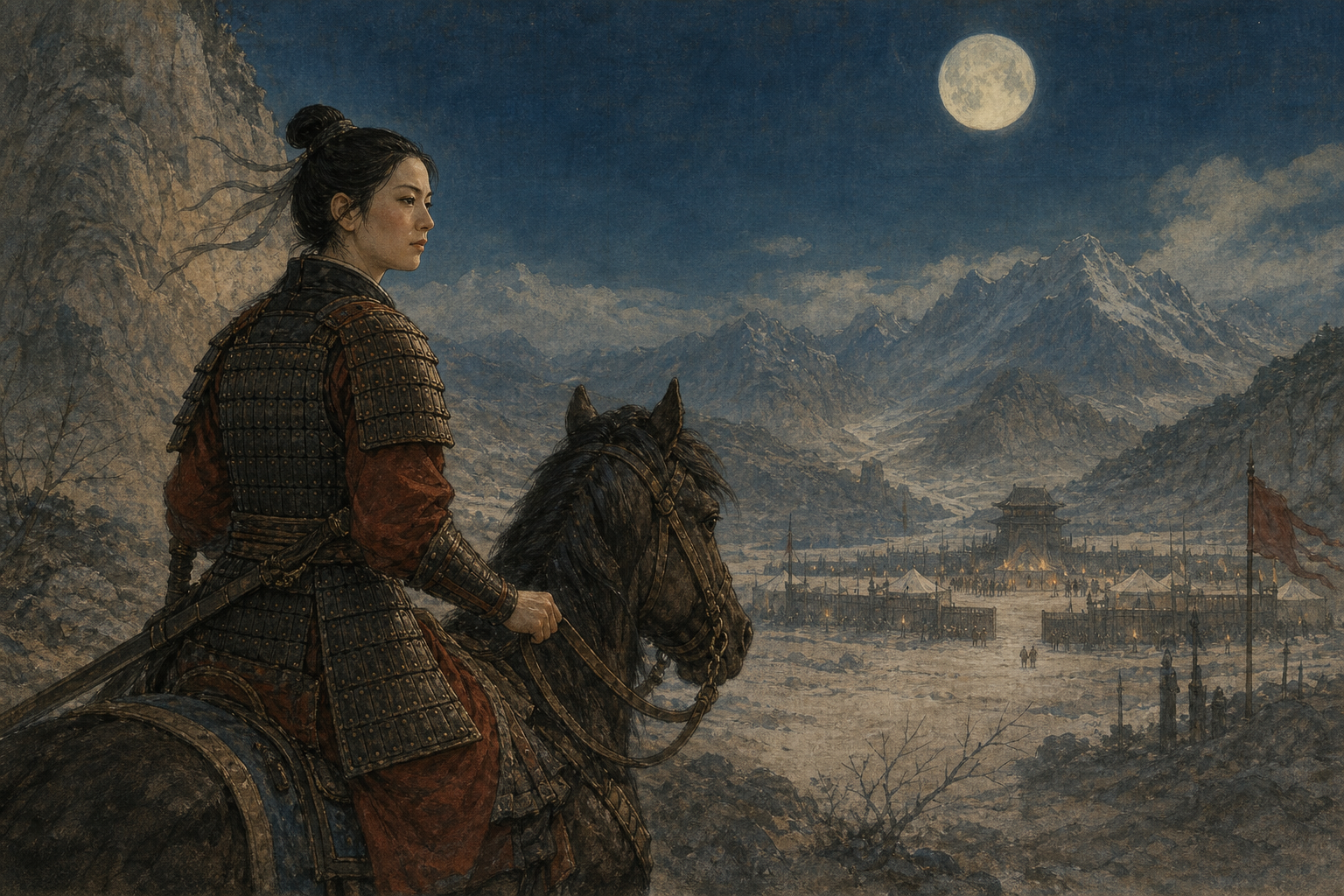
The poem calls the ruler both “Khan” and “Son of Heaven.” It also names the Yellow River, Black Mountain, and Yan Mountain, and evokes northern horses and frontier travel. Those features fit the culturally mixed world of northern China under dynasties founded by non-Han peoples. They do not, however, establish Mulan’s birthplace, ethnicity, or historical identity. The safest conclusion is that the ballad reflects a northern frontier setting whose precise time and place cannot be proved.
How Later Writers Changed Mulan
Mulan did not remain fixed in one form. A Tang-era “Song of Mulan” reframed the tale, and Ming playwright Xu Wei developed it into The Female Mulan Joins the Army in Place of Her Father. His play added martial training, bound feet, a fuller family story, and marriage—details that reflect Ming social concerns rather than the world of the early ballad. Seventeenth- and nineteenth-century novels introduced still more elaborate plots, including tragic endings, political loyalties, supernatural abilities, and romantic complications.
Modern stage and screen versions continued the process. The influential 1939 film Mulan Joins the Army emphasized national resistance in the context of its own era. Later international films created new companions, villains, romances, and supernatural elements. These works belong to Mulan’s long reception history, but they should not be presented as evidence for what the earliest poem said.
Why the Legend Endures
The original Mulan acts from responsibility to her family, survives military service, refuses a public career, and returns home on her own terms. That sequence has supported different readings of filial devotion, courage, gender, identity, and patriotism. The story’s brevity is part of its strength: because the ballad leaves Mulan’s battles and inner life largely undescribed, later communities have repeatedly imagined them anew. Mulan is therefore most accurately understood not as one unchanging biography, but as a legendary heroine whose meaning has evolved for more than a millennium.