
Accuracy note: The Morrígan is a complex figure in medieval Irish literature. Badb, Macha, Nemain, and Anand overlap with her in some texts but remain distinct in others. The popular formula of one goddess with three fixed “faces” is a modern simplification, not a rule consistently stated by the sources.
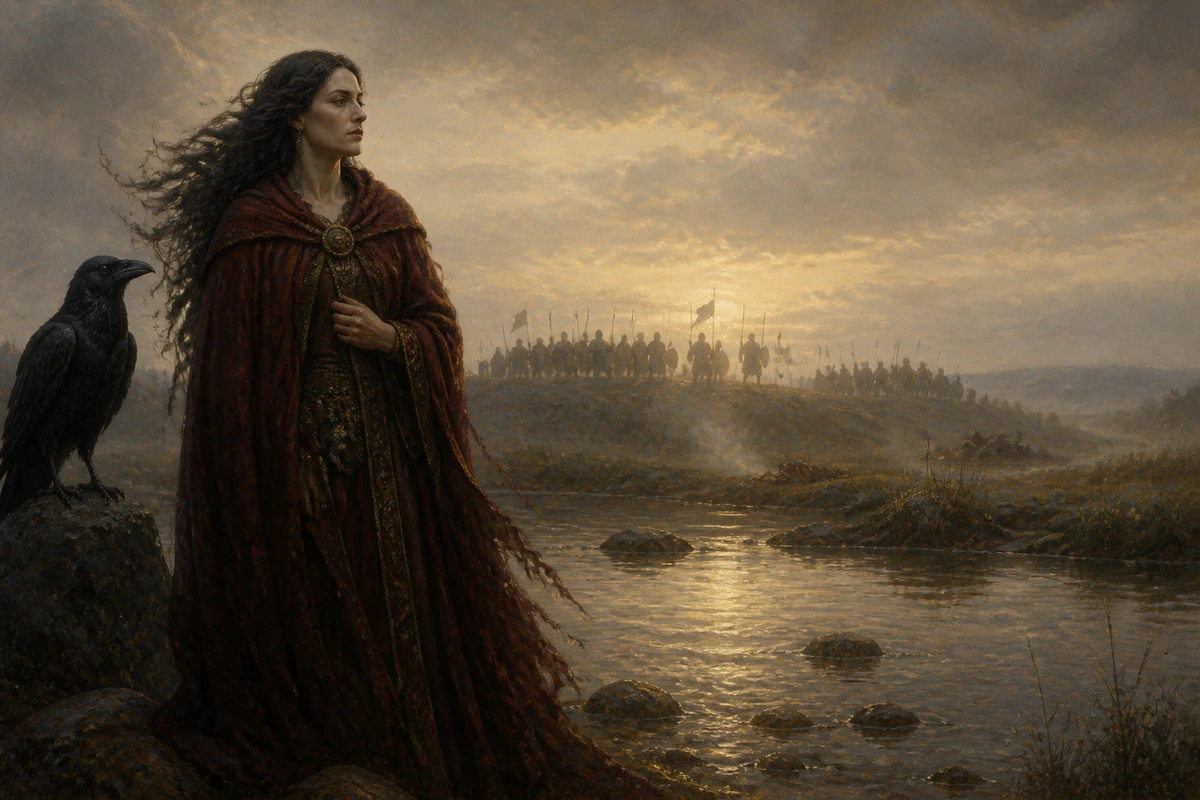
The Morrígan appears where battle, prophecy, cattle, kingship, and the fate of warriors meet. She can confront Cú Chulainn, alter her shape, influence combat, proclaim victory, and foretell social collapse. No surviving medieval text supplies a tidy biography, a standard set of three aspects, or a single iconography. Her power lies partly in that instability.
Her name and identity
The name appears in forms such as Morrígan and Mórrígan. “Great Queen” and “Phantom Queen” are both seen in modern translations because the first element has been interpreted in different ways. Presenting either translation as certain hides a real linguistic debate.
Medieval genealogical and battle texts do not agree on the relationships among the Morrígan, Badb, Macha, Nemain, and Anand. One passage may coordinate several names as separate women; another may use titles or explanatory glosses that bring them together. “The Morrígan” can also function like a title. It is therefore better to identify the text under discussion than to impose one universal family tree.
Badb, Macha, and the modern triple-goddess scheme
Badb is closely associated with battle fury, prophecy, and the crow. Macha is a name attached to several figures in Irish tradition, including women connected with sovereignty, warfare, and the landscape. Nemain represents panic or frenzy in battle. These connections make a triadic reading understandable, especially because Irish literature often uses groups of three.
Yet the membership changes. Some modern accounts confidently state that the Morrígan is a single deity whose three faces are always Badb, Macha, and Nemain; others substitute Anand. The manuscripts do not authorize that fixed chart. “Morrígan complex” is a useful modern description so long as it does not erase the contradictions that made the term necessary.
The Morrígan and Cú Chulainn
In Táin Bó Regamna, Cú Chulainn encounters a red woman driving a cow. Their hostile exchange ends with her revealing herself as the Morrígan and predicting that she will oppose him during the cattle raid. She describes attacking in animal forms. In the later combat episodes, she appears as an eel, a wolf, and a hornless red heifer while Cú Chulainn fights at a ford.
Cú Chulainn wounds each form. Later, the Morrígan approaches disguised as an old woman milking a cow and bears the corresponding injuries. The exhausted hero asks for milk and blesses her after each drink, inadvertently healing the wounds he had sworn not to cure. The episode makes their relationship adversarial but also reciprocal: threats, transformations, injury, hospitality, and binding speech all matter.
Some retellings say she offers Cú Chulainn romantic love and attacks only because he rejects her. That summary reflects one interpretation of difficult material, not an uncomplicated plot stated in every recension of the Táin.
Mag Tuired and prophetic speech
In Cath Maige Tuired, the account of the Second Battle of Mag Tuired, the Morrígan contributes to the Túatha Dé’s campaign against the Fomoire. After victory she announces the outcome across Ireland. A following prophetic poem, associated in the text with Badb, begins with peace and abundance before turning toward a damaged future marked by false judgments, failing seasons, and social disorder.
This combination is essential. The Morrígan does not merely embody the instant of killing. She interprets what battle means for the land and imagines the order—or disorder—that follows it.
Crows, ravens, cattle, and river fords
| Motif | What the texts support |
|---|---|
| Crow or raven | Badb and the Morrígan are repeatedly linked with carrion birds and battlefield omen |
| Cattle | Her Cú Chulainn narratives participate in a world where cattle signify wealth, status, and conflict |
| Shape-changing | Animal forms are tactical actions, not a decorative list of spirit animals |
| Ford or washing motif | Irish death-omen traditions connect female figures, water, and warriors’ approaching deaths, but details vary by tale |
Later folklore about the washer at the ford is often folded directly into descriptions of the Morrígan. The association can be illuminating, but medieval narrative, early modern folklore, and modern neopagan interpretation should be labeled rather than blended into one timeless belief system.
How to read the Morrígan responsibly
The safest approach is source-first: ask which name a passage uses, what action the figure performs, and how the manuscript explains—or fails to explain—the relationship. The Morrígan can be called a war goddess, but that phrase should include prophecy, sovereignty, cattle wealth, transformation, and the consequences of conflict.
Primary sources and related reading
- Táin Bó Regamna, CELT Project: the Morrígan’s confrontation with Cú Chulainn
- Cath Maige Tuired, CELT Project: the Second Battle and the victory prophecy
- The Tuatha Dé and the Second Battle of Mag Tuired on Mythology Vault