

Accuracy note: Rhiannon is a central woman in the First and Third Branches of the medieval Welsh Mabinogi. Connections with a pre-Christian horse goddess are scholarly interpretations based on her name and narrative motifs, not a biography preserved from an ancient cult.
Rhiannon enters Welsh literature on a white horse that seems to move gently yet cannot be overtaken. She chooses her husband, devises the plan that frees her from an unwanted marriage, survives a false accusation, and later endures another supernatural captivity. Calling these episodes vague lessons in “ancient wisdom” misses the precision of her actions and the injustice she faces.
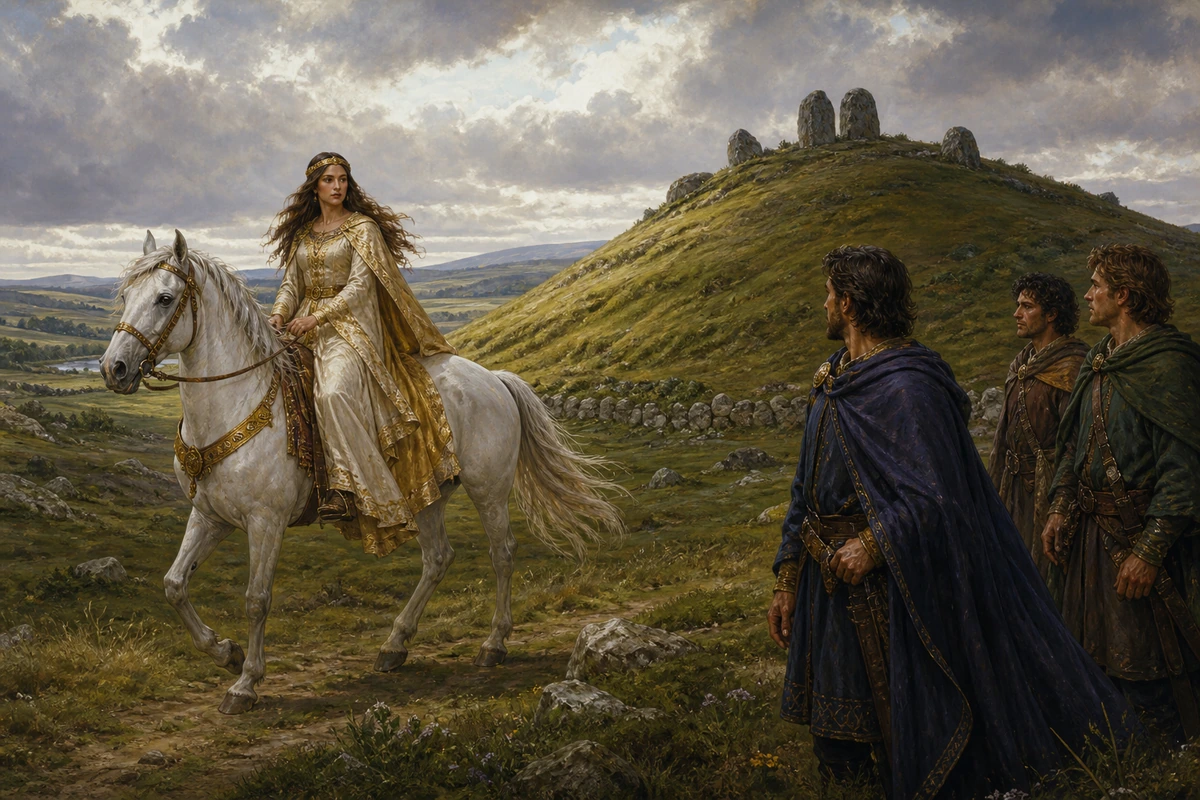
Rhiannon at the mound of Arberth
In the First Branch, Pwyll sits on the mound at Arberth, a place where a visitor may receive either blows or a marvel. He sees a woman in shining clothing riding a large white horse. Although her pace appears slow, Pwyll’s fastest riders cannot catch her. Only when he calls out and asks her to stop does she do so.
The scene is not a race that Pwyll wins through speed. It demonstrates that pursuit fails until he speaks to her directly. Rhiannon then explains that she has come because she prefers Pwyll to Gwawl, the man her family intends her to marry.
The promise to Gwawl
At their wedding feast a disguised petitioner asks Pwyll for a gift. Pwyll rashly promises to grant whatever is requested, and the petitioner reveals himself as Gwawl, who demands Rhiannon and the feast. Rhiannon prevents immediate disaster by arranging a second feast one year later.
She gives Pwyll a magical bag that can never be filled. Disguised as a beggar, he asks Gwawl to fill it with food. When it remains empty, Pwyll says a wealthy man must step into the bag and stamp the contents down. Gwawl complies; Pwyll closes the bag, and his companions strike it in the humiliating “badger in the bag” game until Gwawl agrees to release Rhiannon. The scheme is Rhiannon’s, making her the episode’s strategist.
The missing child and false accusation
Rhiannon gives birth to a son, but the attendants assigned to watch him fall asleep and the infant vanishes. Fearing punishment, they kill a puppy, smear Rhiannon with its blood, and accuse her of killing and eating her child. Pwyll does not execute or abandon her, but a public penance is imposed.
For years Rhiannon sits beside the horse block at the court, tells visitors what she was accused of doing, and offers to carry them inside on her back. The punishment deliberately turns a royal woman associated with an extraordinary horse into a human beast of burden. The text presents a social response to accusation; it does not prove that medieval Welsh law prescribed this exact ordeal.
Teyrnon and the return of Pryderi
Elsewhere, Teyrnon loses a newborn foal every May Eve. He keeps watch and saves the foal from a monstrous arm reaching through a window. Outside he finds an infant and raises him. The boy grows with supernatural speed and resembles Pwyll. Teyrnon realizes that the child is Rhiannon’s missing son and returns him to court.
Rhiannon’s words of relief help explain the child’s name, Pryderi, connected with care, anxiety, or trouble. Her innocence becomes public, and Teyrnon refuses excessive reward. The resolution depends on recognition and restitution, not on Rhiannon proving herself through a combat trial.
Rhiannon in the Third Branch
After Pwyll’s death, Rhiannon marries Manawydan. An enchantment empties Dyfed of people and domestic animals, leaving Rhiannon, Manawydan, Pryderi, and Cigfa. Pryderi enters a magical fort, touches a golden bowl, and becomes fixed in place. Rhiannon follows and is trapped with him; the fort then vanishes.
Manawydan eventually breaks the enchantment through patience, craft, and a carefully negotiated threat involving a mouse that is actually an enchanted woman. Rhiannon and Pryderi are released. The Third Branch again gives Rhiannon endurance, but Manawydan drives this rescue plot.
Was Rhiannon a horse goddess?
| Evidence | Responsible conclusion |
|---|---|
| White horse, impossible pursuit, horse-block penance | Horse imagery is central to her First Branch narrative |
| Name sometimes connected with “great/divine queen” | A pre-Christian background is plausible but not directly documented |
| Comparison with the Gaulish-Roman Epona | Useful for comparative study, not proof they are the same goddess |
| Medieval Welsh manuscript context | The surviving Rhiannon is first of all a literary character in the Mabinogi |
Rhiannon’s appeal does not require converting every detail into the remains of a lost cult. The medieval tale already presents a remarkable figure: decisive in choosing and rescuing her marriage, subjected to a brutal false narrative, restored through evidence, and still central in the next generation’s enchanted Dyfed.
Sources and related reading
- The Mabinogion, Project Gutenberg: an older public-domain English translation of the Four Branches
- Oxford University Press overview of the First Branch
- The Tuatha Dé in medieval Irish literature on Mythology Vault