Pangu (盤古) is one of the best-known figures in Chinese creation mythology. In the story most familiar today, he emerges within primordial chaos, separates heaven from earth, and eventually gives his body to the forming world. Yet there is no single, fixed “Chinese creation story.” Chinese traditions preserve several accounts of cosmic beginnings, and the Pangu narrative itself changed as it passed through written texts, local worship, art, and oral storytelling.
The Earliest Written Account of Pangu
The earliest surviving clear account is attributed to Xu Zheng, a scholar active in the third century CE during the Three Kingdoms period. His Sanwu Liji, often translated as Records of the Three Sovereigns and Five Emperors, no longer survives as a complete book. Its famous Pangu passage was preserved in the seventh-century literary encyclopedia Yiwen Leiju.
That passage says heaven and earth were mixed together in chaos “like a chicken’s egg,” with Pangu born inside them. This comparison is the source of the familiar expression “cosmic egg,” but the early text does not describe Pangu breaking a literal shell with an axe. Instead, after eighteen thousand years, the clear, light yang rose to become heaven, while the turbid, heavy yin settled to become earth.
Pangu Separates Heaven and Earth
Pangu remained between the two realms as they moved farther apart. The text gives the process a vast, mythic scale: each day heaven rose, earth became thicker, and Pangu grew with them. It says this continued for another eighteen thousand years, until heaven reached its greatest height, earth its greatest depth, and Pangu his full size. These enormous numbers function as mythic expressions of an immeasurable age rather than as a historical chronology.
The story presents creation as a movement from mingled chaos toward a structured cosmos. Heaven and earth are not made from nothing. They emerge through differentiation, especially the separation of clear yang from turbid yin, while Pangu stands at the center of that transformation.
How Pangu’s Body Became the World
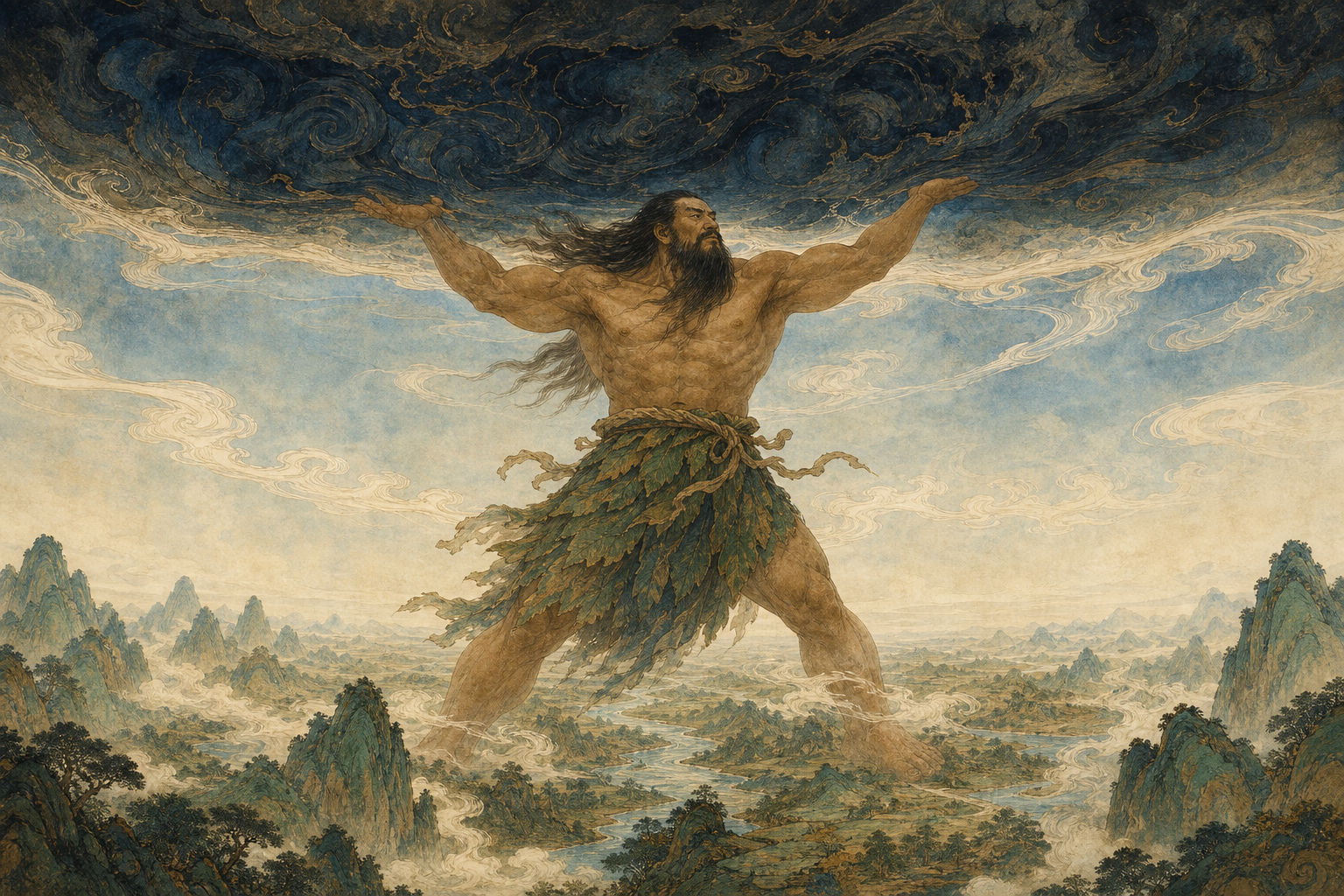
A second account, preserved from the Wuyun Linian Ji and also attributed to Xu Zheng, describes what happened as Pangu died. His body did not simply disappear; it became the living structure of the universe. His breath became wind and clouds, and his voice became thunder. His left eye became the sun and his right eye the moon. His limbs and body formed the directions and sacred peaks, while his blood became rivers and his flesh became fertile soil.
The transformation continues in increasingly fine detail. Pangu’s hair becomes stars and vegetation, his bones become stone and mineral, and his sweat becomes rain. Some versions also say that tiny creatures upon his body, stirred by the wind, became human beings. The imagery makes the landscape into a cosmic body: sky, weather, waterways, mountains, plants, and people all participate in the remains of the primordial being.
The Axe and Other Later Variations
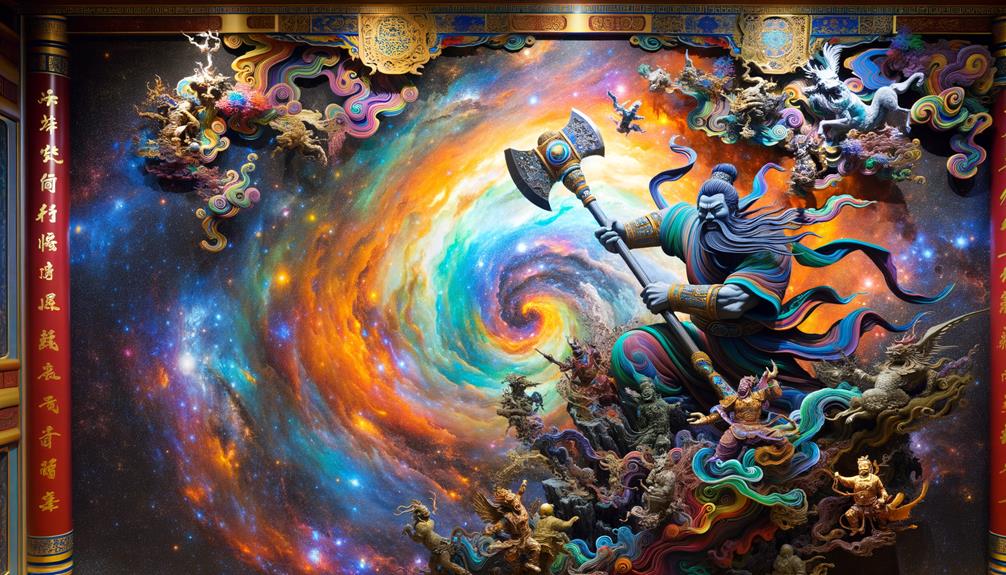
Modern illustrations often show Pangu as a muscular, horned giant swinging a great axe. That image belongs to later artistic and oral traditions rather than to the earliest surviving Pangu passage. Later variants have him shatter the egg-like enclosure or cut the bond between heaven and earth with tools. A Chinese talismanic woodblock print documented by the Smithsonian likewise depicts an axe resting on a stump beside Pangu.
Other regional versions give Pangu different appearances, companions, and additional deeds. Scholars have proposed different origins for the tradition, including connections with southern Chinese stories or creation myths beyond China, but no single origin theory has been conclusively established.
Why the Pangu Myth Matters
Pangu should not be treated as the universally accepted creator of every Chinese religious tradition. His story is one influential creation narrative within a much larger and more varied mythological landscape. Its lasting power lies in its image of creation as transformation: order emerges from chaos, complementary forces take shape, and the body of a primordial being becomes the interconnected natural world.