Accuracy note: The Duat is not mapped identically in every Egyptian funerary composition. The Pyramid Texts, Coffin Texts, Book of the Dead, Amduat, Book of Gates, Book of Caverns, and later works belong to different periods and purposes. Their images should not be combined into one rigid “twelve-level afterlife.”
The Duat is the Egyptian otherworld through which the sun travels at night and where the dead encounter gods, gates, transformations, dangers, and renewal. It can be imagined beneath the earth, within the body of the sky goddess, or through other sacred geographies depending on the text. Its central pattern is not eternal darkness but the possibility of regeneration: the sun enters the west, passes through night, and emerges again in the east.
The Duat is not one fixed map
Egyptian ideas of the afterlife developed over more than two millennia. Royal pyramid chambers of the Old Kingdom preserve utterances now called the Pyramid Texts. Middle Kingdom coffins carry a broader body of spells known as the Coffin Texts. New Kingdom royal tombs introduce extensive illustrated books of the sun’s nocturnal journey, while papyri commonly called Books of the Dead equip many non-royal people with selected spells.
Modern titles such as “Book of the Dead” and “Amduat” are scholarly labels, not evidence that Egyptians kept a single canonical scripture. A papyrus could contain a personalized selection, and royal tomb programs could combine several compositions.
Ra’s journey through the night
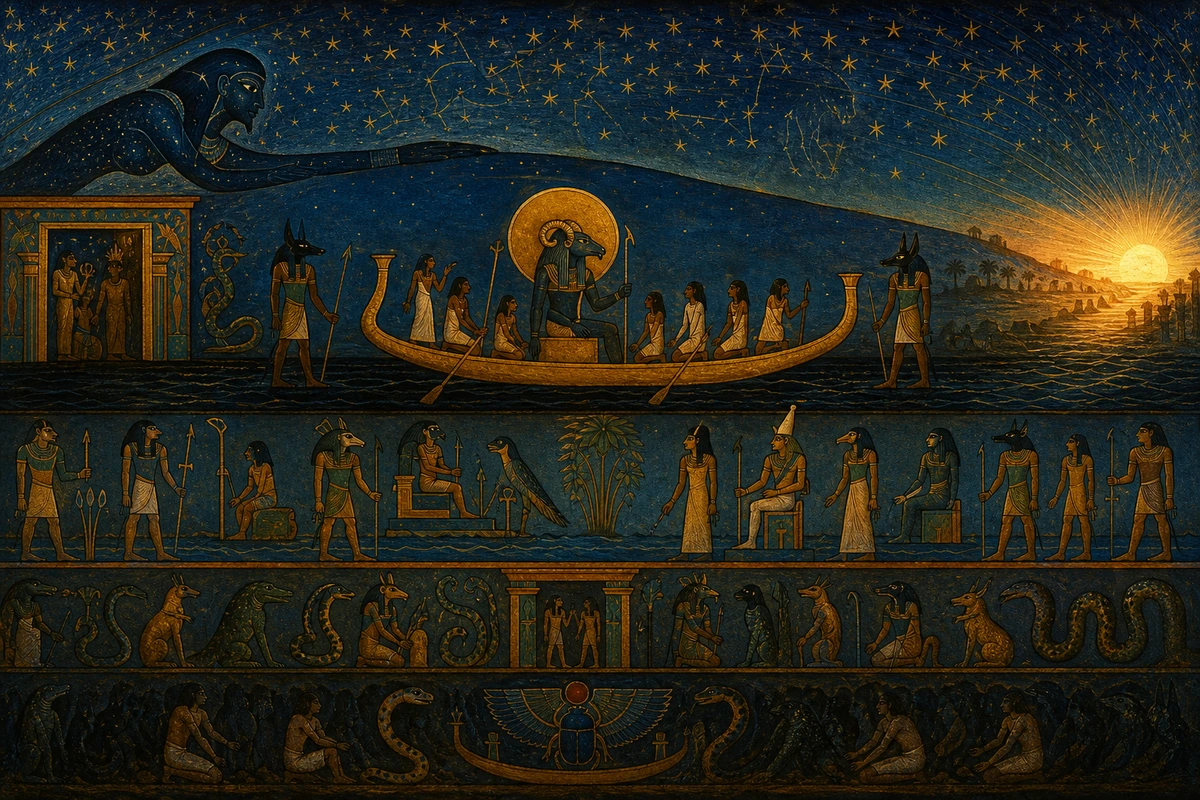
The Amduat, meaning “What Is in the Duat,” divides the night journey into twelve hours. Ra travels in a solar barque, often in a ram-headed nocturnal form, accompanied by divine beings. The landscape contains water, banks, caverns, gates, fields, deities, the blessed dead, and enemies who threaten the cycle.
At the deepest phase, the sun’s power is renewed through an encounter or union with Osiris. The serpent Apophis must be restrained or defeated so that the barque can continue. At dawn the regenerated sun emerges, commonly represented through scarab and horizon imagery. The route is therefore cosmic, funerary, and temporal at once.
The Book of Gates and other underworld books
The Book of Gates also organizes the night into twelve divisions, but guarded gates mark the transitions. Gatekeepers and their names matter because correct knowledge allows passage and helps maintain order. Its fifth division includes a judgment scene, while its final imagery presents the sun’s emergence from the night.
The Book of Caverns, Book of the Earth, Books of the Sky, and related compositions arrange the underworld differently. Some emphasize caverns and divine corpses; others give large cosmic images of the sky. Saying that every Egyptian expected exactly twelve identical gates confuses one influential textual design with the whole tradition.
Judgment before Osiris
The weighing of the heart is especially familiar from Book of the Dead Spell 125. In the Papyrus of Ani, Anubis attends the balance, the heart is weighed against the feather of Maat, and Thoth records the result. Ammit waits to consume the heart if judgment fails, while Osiris presides within the larger scene.
This judgment should not be described as Anubis checking the soul at the entrance to a universal twelve-gate maze. Nor did Egyptians teach that every dead person was automatically divided into only two parts at death. The ritual goal was to preserve, restore, and reunite multiple aspects of personhood so the deceased could become an effective akh.
Body, heart, ka, ba, name, and shadow
| Aspect | Careful summary |
|---|---|
| Body | Preserved and ritually transformed as a necessary anchor of continued existence |
| Heart (ib) | Center of thought, character, and memory; judged against Maat |
| Ka | Life force or vital aspect sustained through offerings and ritual |
| Ba | Mobile manifestation of individuality, often shown as a human-headed bird |
| Name (ren) | Preserving and speaking the name maintained identity |
| Shadow (shut) | Another enduring aspect represented in funerary thought |
| Akh | An effective, transfigured state achieved through successful rites and renewal |
These terms changed in use over time and cannot be matched neatly to the modern English word “soul.” The ba did not simply equal personality while the ka raced a decaying corpse through twelve gates.
The Field of Reeds
Book of the Dead Spell 110 gives a famous vision of the Field of Reeds or Field of Offerings. The blessed deceased farms, sails, receives abundance, and joins divine society in an ideal landscape patterned on fertile Egypt. In the Papyrus of Ani, the successful Ani plows, harvests, and paddles after judgment.
Agricultural labor was not erased from this paradise. Shabti figures and spells could provide substitute workers when service was demanded. Claims that rich and poor simply worked together as social equals, or that every lost pet was guaranteed to appear, go beyond the cited funerary scenes.
Which text says what?
| Corpus | Broad period and use | Important focus |
|---|---|---|
| Pyramid Texts | Old Kingdom royal pyramids | Royal ascent, transformation, and relation to gods |
| Coffin Texts | Especially Middle Kingdom coffins | Expanded funerary spells and otherworld routes |
| Book of the Dead | New Kingdom onward, especially papyri | Selected spells for movement, protection, judgment, and renewal |
| Amduat | New Kingdom royal tombs, later adapted | Ra’s twelve-hour nocturnal journey |
| Book of Gates | New Kingdom royal tombs and later contexts | Twelve divisions marked by guarded gates |
Reading the Duat responsibly
Greek underworld journeys and Norse journeys to Hel can provide useful comparisons, but resemblance does not make them versions of the same system. Egyptian texts use their own language of solar rebirth, Osirian renewal, divine names, offerings, embodied preservation, and Maat.
The Duat also is not a prototype of a Christian hell. It contains punishment and annihilation for enemies of order, but it is equally a place where gods and justified dead are renewed. Darkness is a phase in a repeating transformation, not the final meaning of the realm.