Before the familiar Egyptian gods establish an ordered cosmos, some creation traditions imagine an undifferentiated world of darkness, limitless water, hiddenness, and boundlessness. At Hermopolis, a group of eight primordial deities gave those conditions divine form. The Greeks called the group the Ogdoad, meaning “the Eight”; the ancient Egyptian name of the city, Khmun, likewise referred to eight.
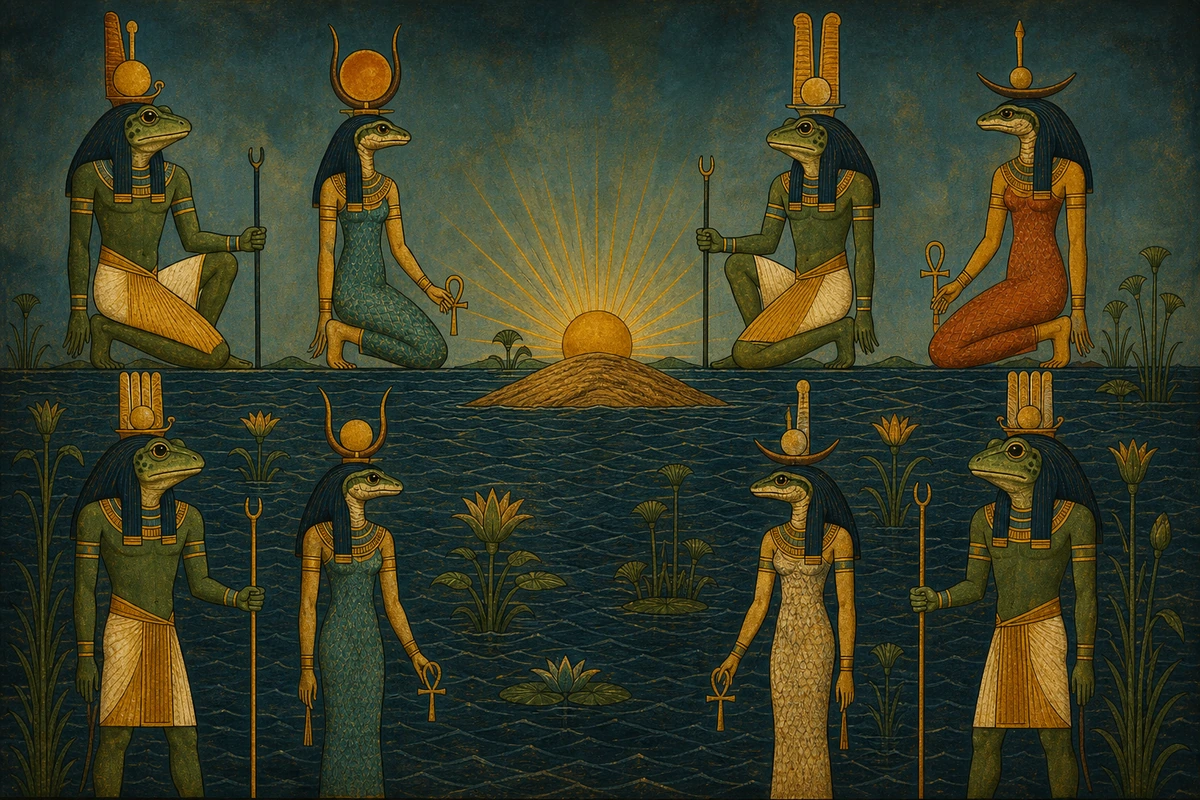
The Ogdoad is best understood not as a single, fixed creation story but as a theological framework developed around Hermopolis. Four male deities and four female counterparts form four pairs. In the roster most familiar from later sources, they are Nun and Naunet, Heh and Hauhet, Kek and Kauket, and Amun and Amaunet. Together they represent the state that precedes the created world rather than a dynasty ruling it afterward.
The four primordial pairs
Egyptian divine names often carry several possible shades of meaning, and translations differ. The following table gives the conventional later grouping while avoiding the misleading idea that each pair was an abstract philosophical definition in the modern sense.
| Pair | Common association | Place in creation imagery |
|---|---|---|
| Nun and Naunet | Primeval water or watery abyss | The limitless waters from which the first land and sun can emerge |
| Heh and Hauhet | Endlessness or boundlessness | The immeasurable extent of the pre-created state |
| Kek and Kauket | Darkness | The absence of created light before the first sunrise |
| Amun and Amaunet | Hiddenness | The concealed, unseen quality of what exists before manifestation |
These pairs are grammatically and theologically gendered, but it is too simple to explain them as a modern doctrine of “male and female energy.” Egyptian sources present paired male and female names and images; they do not supply a universal theory matching contemporary spiritual terminology. The pairs express completeness and complementarity within the Hermopolitan system, but their significance must be inferred from Egyptian evidence rather than imposed from outside.
Frogs, snakes, and the landscape before creation
In many later representations, the male members appear with frog heads and the female members with snake heads. Both animals suit the imagery of a watery, fertile environment. Frogs emerge in abundance when the Nile inundation brings renewal, while snakes can move through earth and water and were potent religious symbols throughout Egyptian history. The deities can also appear in other forms, including fully human figures or baboons, so the animal-headed convention was important but not exclusive.
The Ogdoad’s action is described through several creation images. One has the Eight stirring or inhabiting the primeval waters while the first mound rises. Another connects them with the birth of a solar child or with the opening of a lotus from which the sun appears. The first sunrise ends the darkness and begins the ordered world. Such images need not be forced into one narrative sequence; Egyptian temples often combined or reworked creation motifs according to local theology.
Hermopolis and the god Thoth
Hermopolis, called Khemenu or Khmun in Egyptian, was also the great cult center of Thoth, god of writing, knowledge, reckoning, and the moon. Later Hermopolitan theology could position Thoth as the organizer or coordinator of the primordial group. This does not mean that every surviving Ogdoad text gives Thoth exactly the same role. The city’s theologians developed relationships among local gods, cosmic origins, and the sun using material drawn from different periods.
The Louvre’s account of Hermopolitan creation emphasizes the four couples and Thoth’s role in coordinating their creative action. The Global Egyptian Museum notes that much of the surviving imagery is relatively late, especially from the Graeco-Roman period, even though the deities and concepts have older roots. Temple reliefs from places such as Dendera and Medinet Habu therefore help document the developed theology, not necessarily its earliest form.
The member list was not always fixed
A crucial complication appears in earlier funerary texts. University College London’s Digital Egypt resource points to Coffin Text Spell 76, where the four pairs do not line up perfectly with the roster most often repeated today. The fourth pair can vary before Amun and Amaunet become standard in later presentations. This matters because a neat list can make a long religious history look more uniform than it was.
Egyptian creation traditions were also plural. Heliopolis emphasized Atum and the Ennead; Memphis developed a theology centered on Ptah; other centers framed beginnings through their own gods. These were not necessarily rival “denominations” asking Egyptians to choose one scientifically literal account. A temple could assert the primacy of its god while accepting a larger divine world in which other creation images remained meaningful.
What the Ogdoad does—and does not—represent
The Eight give shape to absence without turning it into nothingness. Before ordered creation there is already water, darkness, limitlessness, and concealment. The cosmos begins when distinction becomes possible: land emerges, light appears, and the sun enters a cycle. The group therefore dramatizes transition from an unstable, undifferentiated state to maat, the ordered pattern on which life and kingship depend.
Modern descriptions sometimes call the Ogdoad “eight chaos gods.” That can be useful shorthand if chaos means the unbounded state before order, but it should not imply moral evil. Nun and the other conditions are dangerous because they are formless and limitless, not because they belong to a devil-like opposition. Egyptian religion could imagine the primeval waters remaining around and beneath the created world even after creation had begun.
Accuracy note
The canonical four-pair list is a later standard, not the only roster ever attested. Translations of divine names and reconstructions of creation episodes differ among Egyptologists. This article distinguishes ancient evidence from modern interpretation and avoids treating the Ogdoad as one fixed scripture or as a modern gender-duality system.