
The ancient Greek word daimōn did not mean a horned evil demon, nor did it always name a minor spirit standing between humans and Olympian gods. Across Homer, Hesiod, tragedy, philosophy, and later religion, it could refer to an unnamed divine power, an allotted fate, a guardian, a deceased person granted a special role, or an intermediary being. Its meaning depends on the author and passage.
A word about spelling
Daimōn is singular and daimones plural. “Daemon” is a Latinized spelling still used in scholarship, while “demon” developed through later Jewish, Christian, and late antique histories. Translating every ancient occurrence as “demon” imports moral and visual associations that may be absent from the Greek text.
Daimōn in Homer
In Homeric epic, daimōn can overlap with theos, “god,” especially when a character senses divine action without identifying the god responsible. The word often emphasizes an unexpected, intrusive, or inscrutable power behind events. It does not consistently identify a separate species of lesser supernatural being.
Hesiod’s guardians of the Golden Race
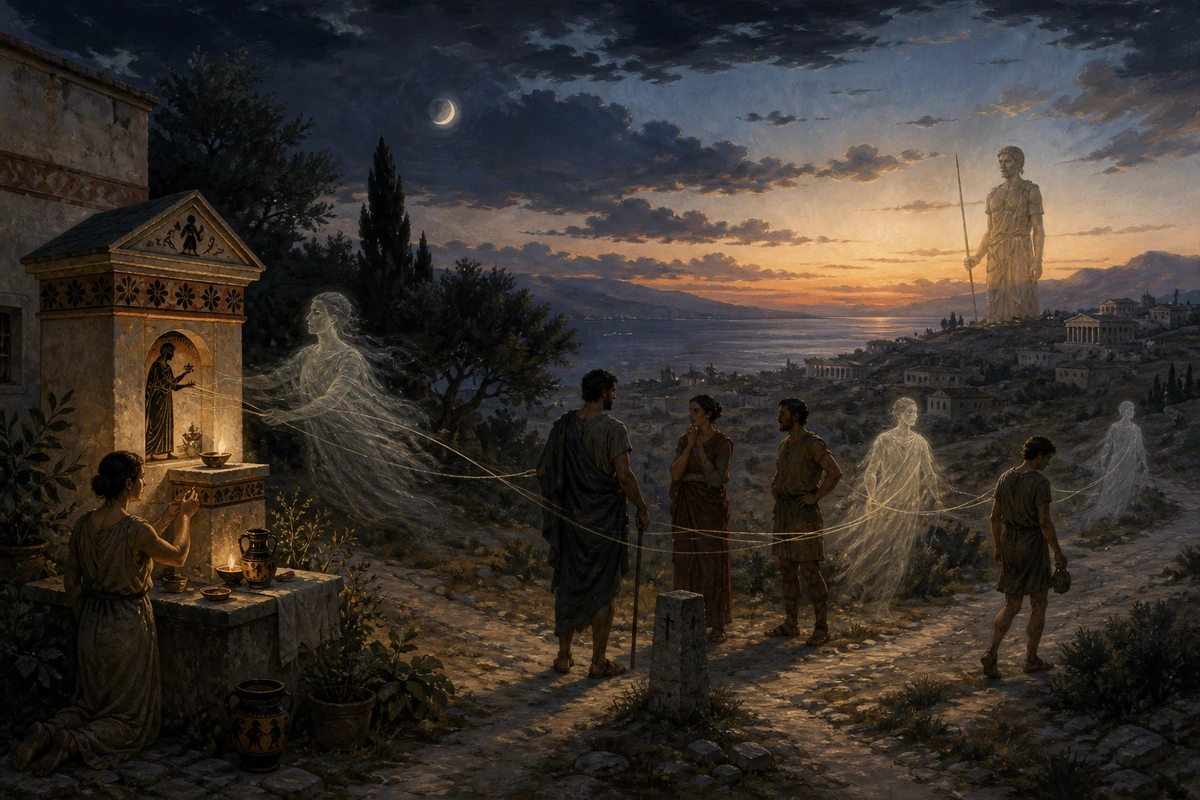
In Works and Days, the first human generation lives in the time of Cronus. After death, members of this Golden Race become earth-dwelling daimones by the will of Zeus. Hidden in mist, they watch human judgements, guard mortals, and bestow wealth. This influential passage gives daimones a protective posthumous role without making all daimones dead ancestors.
Allotment and fate
Ancient explanations connect daimōn with dividing or allotting. Greek writers can speak of a person’s daimōn when discussing the fortune or portion that shapes a life. The adjectives eudaimōn and kakodaimōn describe someone with a good or bad allotment—one root of later ideas about happiness and misfortune.
Plato’s intermediaries
Plato gives the term new philosophical precision in some dialogues. In the Symposium, Diotima calls Eros a “great daimōn” between mortal and immortal, conveying prayers and sacrifices upward and divine instructions downward. This famous model of daimones as intermediaries is Platonic; it should not be projected unchanged onto Homer.
Socrates’ daimonion
Socrates describes a divine sign—his daimonion—that restrains him from certain actions. It is not a little creature whispering general advice, and Plato does not simply equate it with the guardian spirits of every later tradition. The neuter adjective means something “divine” or “daimonic,” highlighting a sign or intervention rather than a named personal god.
Named personifications and “minor gods”
Modern mythology guides often classify personifications such as Sleep, Strife, Fear, or Retribution as daimones. Ancient poetry does personify forces, but the modern catalogue can imply a standardized rank that Greek sources never established. A figure may be called a god, a daimōn, a personified abstraction, or several of these depending on context.
Good, harmful, and morally ambiguous powers
Daimonic influence can protect, enrich, mislead, punish, or terrify. That range is not the same as a battle between good angels and evil demons. Greek religious language often describes power through its effects on a particular person or event rather than assigning every being a permanent moral alignment.
How the word became “demon”
Hellenistic philosophy, Jewish Greek texts, early Christianity, and late antique theology progressively reorganized the category. Some writers treated pagan divine powers as deceptive or evil spirits, helping produce the later English “demon.” That history matters, but it is a reception history—not a definition that can be read backward into every archaic poem.
Sources and further reading
- Oxford Classical Dictionary, “daimōn”
- Hesiod, Works and Days, Center for Hellenic Studies translation
- Plato, Symposium, Perseus Digital Library
- H. S. Versnel, “Daimon,” Oxford Research Encyclopedia of Classics