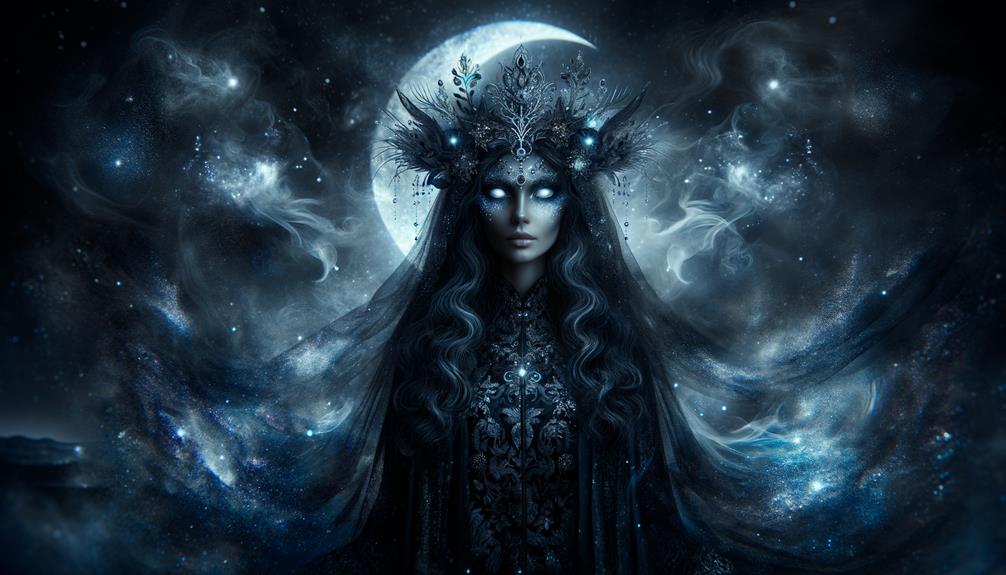
Nyx is Night personified, one of the earliest beings in Greek cosmogony. Hesiod makes her a daughter of Chaos and the mother of a formidable family that includes Sleep, Death, Strife, and the Fates. Homer adds one arresting detail: even Zeus avoids offending Night.
Nyx in Hesiod’s first generations
In the Theogony, Chaos comes first. From Chaos arise Erebus and black Nyx. Nyx joins with Erebus and bears Aether, the bright upper air, and Hemera, Day. Darkness and night therefore produce brightness and day in a compact pattern of opposites.
Gaia, Tartarus, and Eros are not Nyx’s siblings in a conventional parental genealogy; Hesiod simply says that they come into being after Chaos. Family trees that give Chaos the same explicit relationship to all four primordial powers overstate the text.
The children of Night
Hesiod next says that Nyx, without lying with a partner, bears Moros (Doom), the Keres, Thanatos (Death), Hypnos (Sleep), and the tribe of Dreams. Her line continues with Momus (Blame), Oizys (Misery), the Hesperides, the Moirai or Fates, Nemesis, Apate (Deceit), Philotes, Geras (Old Age), and Eris (Strife).
The list gathers experiences that limit or overtake mortal life. It does not mean that every child is “evil.” Sleep can be gentle; the Hesperides guard a divine garden; the Fates distribute both good and bad portions. Hesiod’s genealogy organizes relationships, not a simple moral team.
The house of Night and Day
Near Tartarus, Hesiod describes the terrible house of dark Night. Night and Day approach a bronze threshold, greet one another, and pass in opposite directions. One travels over the earth while the other waits inside, so the house never holds both at once.
Sleep and Death also dwell in this remote region. The Sun never looks upon them. Hesiod makes nightfall part of a cosmic geography: Nyx is not merely the colour of the sky but a power with a route, a dwelling, and a family at the world’s edge.
Did Zeus fear Nyx?
The famous claim comes from a speech by Hypnos in Iliad 14. Sleep recalls an earlier trick against Zeus, after which the furious god pursued him. Hypnos escaped by taking refuge with Nyx, “who subdues gods and men,” and Zeus stopped because he hesitated to do anything displeasing to her.
The passage does not stage a battle in which Nyx defeats Zeus. It is reported history inside Hypnos’s argument with Hera. Even so, it gives Night an exceptional authority: Zeus’s anger has a boundary.
Nyx in other Greek traditions
Orphic poems and later philosophical traditions can place Night in a different genealogy and give her a more exalted role as ruler, prophet, or counsellor. Those accounts are important but not interchangeable with Hesiod. “Nyx was the supreme ruler before Uranus” is an Orphic-style claim, not a summary of every Greek cosmogony.
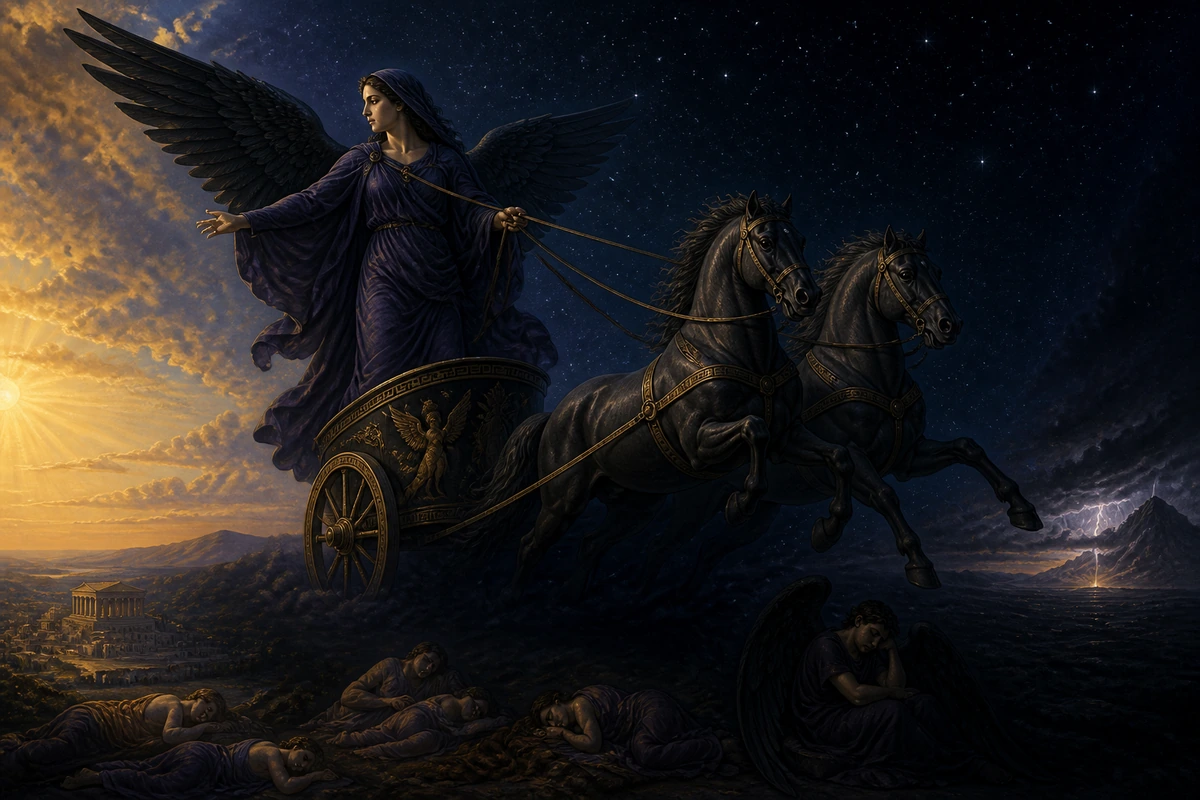
Drama and later art may show Night as winged, veiled, or driving a chariot. No single portrait is canonical. The dark chariot is an expressive personification of night’s movement rather than a detailed scene from Hesiod.
Cult and modern symbolism
Nyx appears frequently in poetry but has far less evidence for an independent civic cult than major Olympian gods. References to offerings or shared sacred spaces should not be inflated into a universal “cult of Nyx” with standard rituals.
Modern associations with the unconscious, feminism, astrology, or personal transformation are later receptions. They may be creative readings, but they should be identified as modern rather than presented as ancient Greek doctrine.