
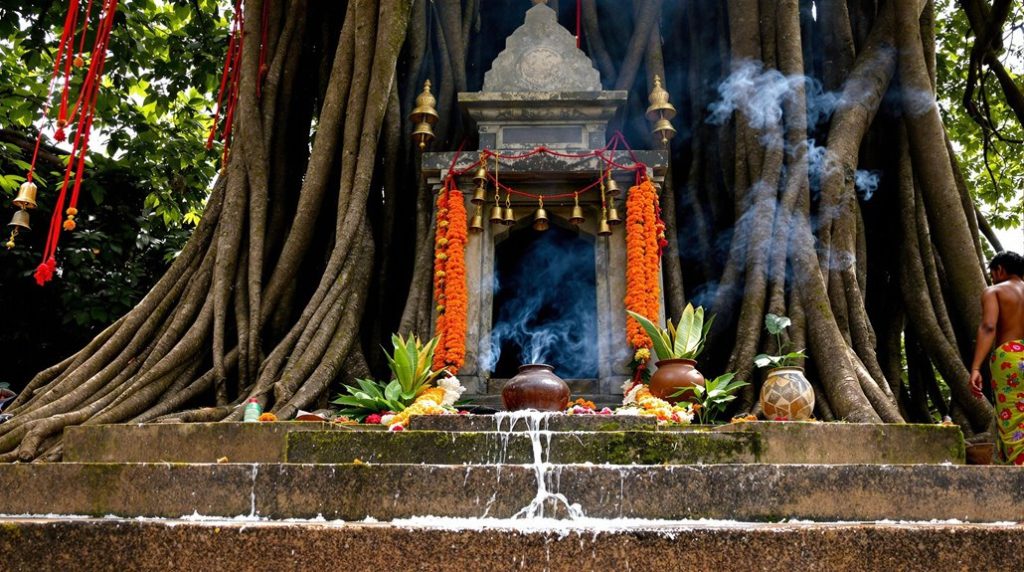
India’s religious calendar cannot be reduced to a single set of nationwide festivals. Alongside celebrations known across the country, communities maintain intensely local traditions centered on a particular goddess, guardian, hero, ancestor, or place. These observances may be organized by a neighborhood temple, a lineage, a village, or a network of performers whose ritual responsibilities have been inherited over generations.
Two especially vivid examples are Bonalu, associated with Mahakali worship in Telangana, and Theyyam, a family of ritual traditions practiced in northern Kerala. They are not versions of the same ceremony, and neither stands for every local-deity festival in India. Studied together, however, they show how food offerings, procession, costume, music, possession, sacred geography, and community memory can make a deity present in a specific place.
What “local deity” means in practice
A local deity is not necessarily minor. The term usually describes the scale and setting of a cult rather than the power devotees attribute to the god or goddess. A village goddess may be understood as a form of a widely worshipped deity such as Devi or Mahakali, while also possessing a local name, shrine, origin story, calendar, and set of obligations. The same community can participate in temple Hinduism, household worship, pilgrimage, and local festival traditions without treating them as mutually exclusive systems.
Local observances also change over time. Urbanization can transform a village procession into a neighborhood festival; government tourism programs may make a regional rite visible to outsiders; performers may adapt schedules while protecting ritual rules. It is therefore safer to describe what official cultural institutions and practitioners document than to assume that every district follows one unchanging pattern.
Bonalu: an offering to Mahakali in Telangana
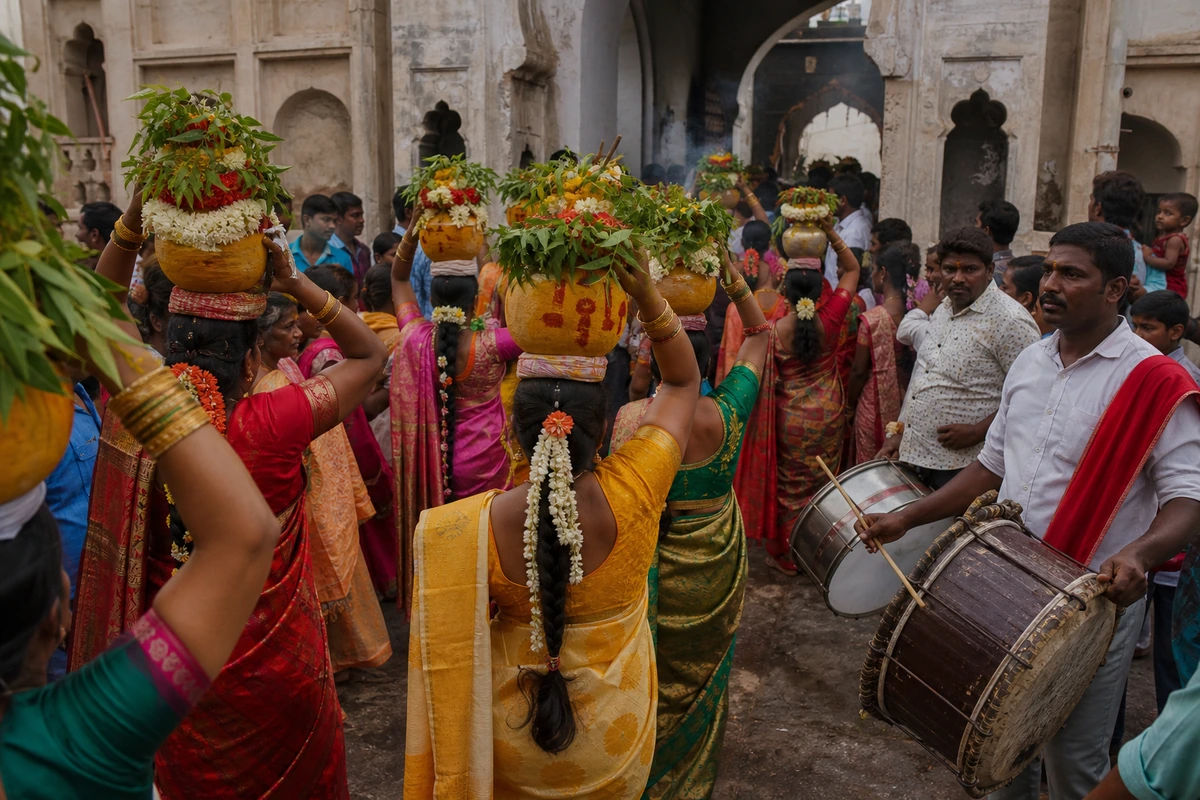
Bonalu is celebrated during the month of Ashada, usually falling in July or August. Telangana’s official festival description centers the observance on Mahakali and on the bonam, an offering whose name is connected with the idea of a meal. Women prepare cooked rice with milk and jaggery in an earthen or brass pot, decorate the vessel with neem leaves, turmeric, vermilion, and a lamp, and carry it to a local goddess temple.
The festival is not confined to one sanctuary. Hyderabad and Secunderabad have prominent celebrations associated with temples such as Golconda’s Jagadambika temple, Ujjaini Mahakali, and Lal Darwaza, while neighborhoods honor the goddess under local forms and names. Drumming and procession turn streets into ritual routes. The offering pot makes domestic preparation visible in public: food moves from household labor to temple presentation.
Several roles add to the festival’s distinctive character. Pothuraju, commonly described as the goddess’s brother, appears at the front of processions in a forceful protective role. A decorated ghatam may represent the goddess and be carried in procession. The Rangam is associated with a woman delivering an oracle or forecast while understood to be under divine influence. Details and sequences can vary by temple and locality, so these elements should not be treated as a rigid script followed everywhere.
Theyyam: deity, performer, and sacred place
Theyyam belongs to the ritual landscape of North Malabar in Kerala. Kerala Tourism describes hundreds of named Theyyam forms performed at shrines, sacred groves, temples, and family compounds. The beings manifested in these rites may be gods and goddesses, local heroes, ancestors, or powerful spirits. Each has its own story, costume, face painting, songs, and ritual setting.
The performer does not simply portray a mythological character for an audience. Through preparation, costume, music, invocation, and performance, the figure is treated as a temporary embodiment of the deity. Devotees may approach for blessings or counsel. This is why “folk dance” is an incomplete label: movement and visual spectacle matter, but the rite operates within a living devotional relationship.
Knowledge is sustained by specialist communities and by disciplined transmission. Elaborate headdresses, painted faces, palm-leaf or textile elements, drums, and recited narratives are not interchangeable decoration. They identify a particular form and its history. A responsible visitor follows the host shrine’s rules, avoids obstructing worship, and remembers that a publicly visible ceremony is not automatically staged for tourism.
Bonalu and Theyyam compared
| Feature | Bonalu | Theyyam |
|---|---|---|
| Primary region | Telangana, especially Hyderabad and Secunderabad | North Malabar in northern Kerala |
| Central ritual focus | Food offering and procession to forms of Mahakali | Manifestation of a named deity, hero, ancestor, or spirit through a trained performer |
| Characteristic visual forms | Decorated bonam pots, neem leaves, lamps, drumming, Pothuraju, and ghatam processions | Highly specific face painting, costume, headdress, drumming, song, and movement |
| Important caution | Sequence and roles vary among temples and neighborhoods | A sacred rite should not be treated as entertainment alone |
What these festivals reveal
Both traditions join devotion to place. A temple courtyard, street, grove, or family shrine becomes a map of relationships: between deity and devotee, household and neighborhood, performer and lineage, memory and present need. Material objects help carry those relationships. Rice, jaggery, neem, paint, cloth, flame, and sound are not secondary illustrations of belief; they are part of how worship is performed.
They also challenge the idea that mythology survives only in old manuscripts. Myths are sung, worn, cooked, carried, and interpreted. Yet living practice should not be flattened into a picturesque survival from an imagined past. Bonalu and Theyyam exist in modern states, cities, media environments, and institutions. Their vitality comes partly from the ability of communities to maintain ritual identity while negotiating change.
Accuracy note
This article uses Bonalu and Theyyam as two documented case studies, not as a universal model for Indian local-deity worship. Spellings, calendars, narratives, and ritual roles vary by region and institution. Claims about specific observances follow official tourism and cultural descriptions; theological interpretations are presented as community traditions rather than scientifically testable facts.