
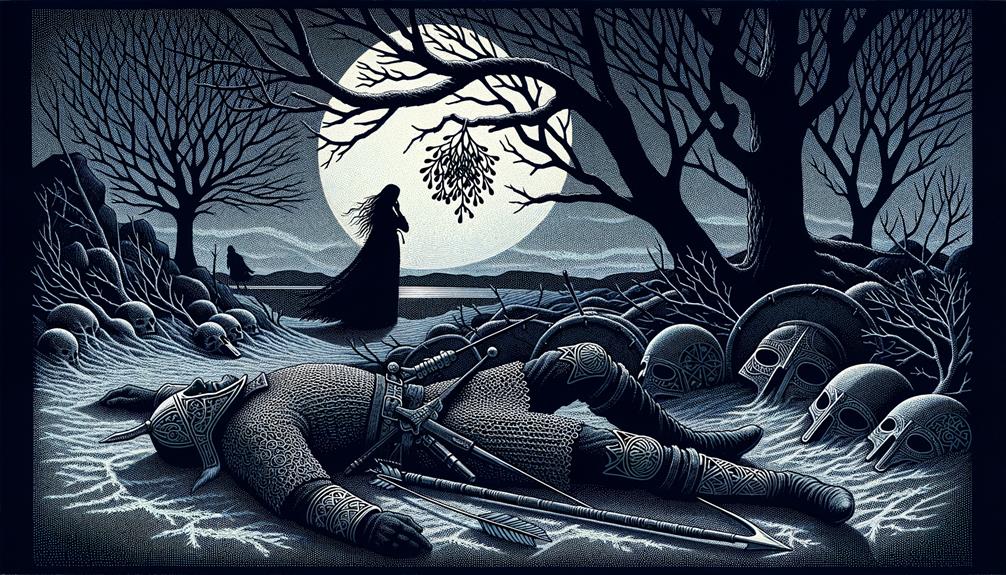
Baldr’s death is the catastrophe that makes Ragnarök feel inevitable. The fullest familiar story comes from Snorri Sturluson’s Gylfaginning: Frigg secures promises from nearly everything not to harm her son, but overlooks a young mistletoe shoot. Loki discovers the exception and guides the blind Höðr in using it against Baldr. Other sources confirm important pieces but do not all tell the event in the same way.
Source note: Völuspá names Höðr, Baldr, and mistletoe in compressed verse. Snorri supplies the oath-game and Loki’s deception. Saxo Grammaticus preserves a radically different, humanized rivalry.
Dreams and the oath of protection
Snorri begins with Baldr’s ominous dreams. The gods take counsel, and Frigg asks fire, water, metals, stones, earth, trees, sicknesses, animals, poisons, and other dangers to swear that they will spare him. Once his safety is known, the gods turn it into a game: they throw weapons and objects at Baldr, strike at him, and watch everything fail.
The game is both celebration and warning. Invulnerability becomes public spectacle, inviting the search for an exception. Snorri says Loki dislikes seeing Baldr unharmed. Disguised as a woman, he visits Frigg and learns that one plant was not asked to swear because it seemed too young: mistletoe.

Höðr, Loki, and the fatal shot
Höðr stands outside the game because he is blind and has no weapon. Loki gives him the mistletoe and guides his aim. The projectile passes through Baldr, who falls dead. Snorri calls it the greatest misfortune to befall gods and humans. The assembly is so shocked that the gods first lose the power to speak or act.
This is not a duel. Höðr does not knowingly challenge Baldr in Snorri’s version, and the victim does not fight back. Loki supplies knowledge, weapon, and direction. Völuspá also associates Höðr with the fatal mistletoe shoot, but its short stanzas do not narrate the disguise, conversation with Frigg, or throwing game in the same detail.
Funeral on Hringhorni
The gods prepare Baldr’s funeral on his great ship Hringhorni. They cannot launch it until the giantess Hyrrokkin arrives riding a wolf and pushes it into the water with such force that fire bursts from the rollers. Baldr’s wife Nanna dies from grief in Snorri’s account and is placed on the pyre with him. Odin lays the ring Draupnir on the fire, and Thor consecrates the pyre with Mjölnir.
The scene brings gods, giantess, animals, treasure, and ritual together. It is not merely decorative aftermath: Baldr’s body has crossed into the realm from which even divine power cannot easily retrieve him. The funeral also creates objects and messages that will move between worlds when Hermóðr rides to Hel.
The failed attempt to bring Baldr back
Hermóðr travels on Sleipnir to ask Hel for Baldr’s release. Hel agrees on a condition: every being and thing must weep for him. Messengers find that almost all do. A giantess called Þökk refuses, declaring that Hel should keep what she has. Snorri says people suppose Þökk was Loki in disguise.
That phrase is important. The identification is presented as an inference, not a witnessed transformation within the scene. Baldr remains in Hel until after Ragnarök, when Völuspá foresees Baldr and Höðr returning to dwell together in a renewed world.
| Source | Form of the story | Distinctive emphasis |
|---|---|---|
| Völuspá | Compressed mythic prophecy | Baldr’s fate, Höðr, mistletoe, vengeance, and later return |
| Baldrs draumar | Eddic dialogue with a seeress | Foreknowledge of death and the identity of the killer and avenger |
| Snorri’s Gylfaginning | Continuous prose narrative | Oaths, game, Loki’s deception, funeral, Hermóðr, universal weeping |
| Saxo’s Gesta Danorum | Latin legendary history | Balderus and Høtherus as rivals in a humanized conflict |
Saxo’s different Balderus
Saxo Grammaticus tells a substantially different story. Balderus and Høtherus compete over Nanna, warfare replaces the innocent throwing game, and a special sword rather than mistletoe governs the conflict. Saxo writes within Danish legendary history and often rationalizes gods as powerful ancient figures.
The difference is evidence, not noise to be erased. Medieval Scandinavians inherited more than one Baldr tradition, and the surviving authors shaped it for different projects. Modern retellings usually follow Snorri because his plot is coherent and memorable, but they should not present it as the only form the myth ever had.
Why the death matters
Baldr is praised as beautiful, wise, gentle, and nearly unstained by conflict. His death demonstrates that no oath-system can remove every vulnerability and that knowledge used maliciously can break collective protection. It also begins the chain leading to Loki’s punishment and the final crisis of the gods.
Yet the myth is not only about doom. Baldr’s return after Ragnarök places reconciliation beyond catastrophe: the killer and victim, Höðr and Baldr, inhabit the renewed world together. The mistletoe episode is therefore both an origin of grief and one part of a larger cycle of destruction and renewal.
Sources and further reading
- Viking Society, Snorri’s Gylfaginning
- Völuspá, Henry Adams Bellows translation
- Project Gutenberg, The Prose Edda

