
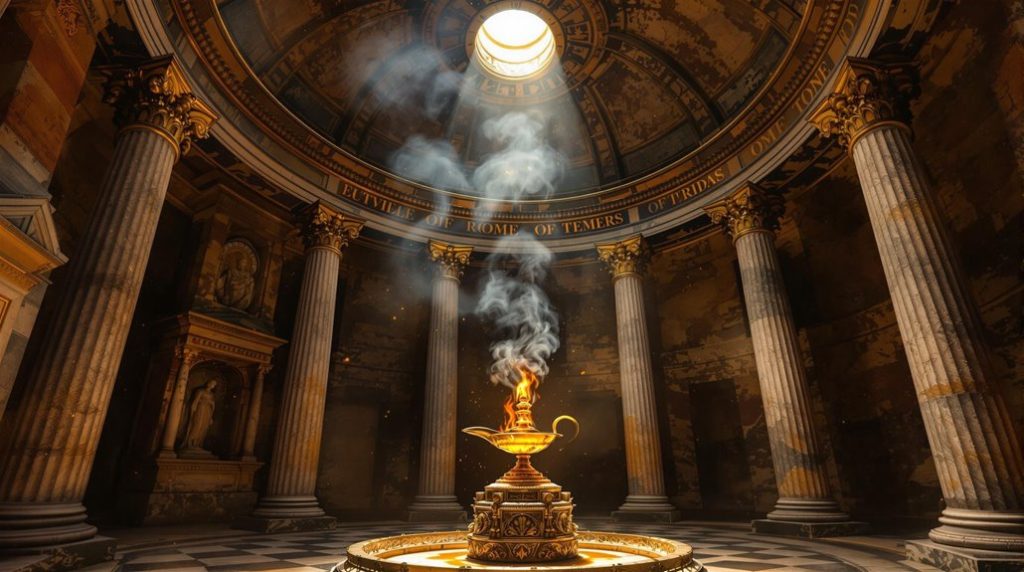
Vesta’s sacred flame was the public hearth of Rome. Tended by the Vestal Virgins in a round temple beside the Roman Forum, it joined domestic imagery to the security and continuity of the state. Roman authors attributed the organization of this cult to King Numa, but their accounts were written centuries after the traditional regal period and explain institutions already ancient in their own day.
Vesta and the Roman hearth
Vesta was the goddess of the hearth fire. Every Roman household depended on a hearth for heat, food, and sacrifice; the city’s flame extended that familiar center to the political community. Ancient writers frequently compared Vesta with Greek Hestia, but Rome’s public cult developed its own priesthood, legal privileges, sacred space, and state significance.
The flame was not the torch of Prometheus and did not commemorate a myth in which fire was stolen for humanity. That Greek story concerns a different religious and literary tradition. Vesta’s fire represented the maintained hearth: lawful, continuous, and ritually pure.
Why Numa appears in the tradition
Livy says that Numa Pompilius selected virgins for Vesta’s service, gave them a stipend from the public treasury, and surrounded their chastity and ritual obligations with sacred authority. Dionysius of Halicarnassus similarly credits Numa with establishing a common hearth between the Palatine and Capitoline and assigning its guardianship to virgins.
These accounts fit the larger literary portrait of Numa as Rome’s peaceful lawgiver and organizer of religion. They are evidence for how later Romans explained their institutions, not contemporary documentation from Numa’s supposed reign.
The Vestal Virgins
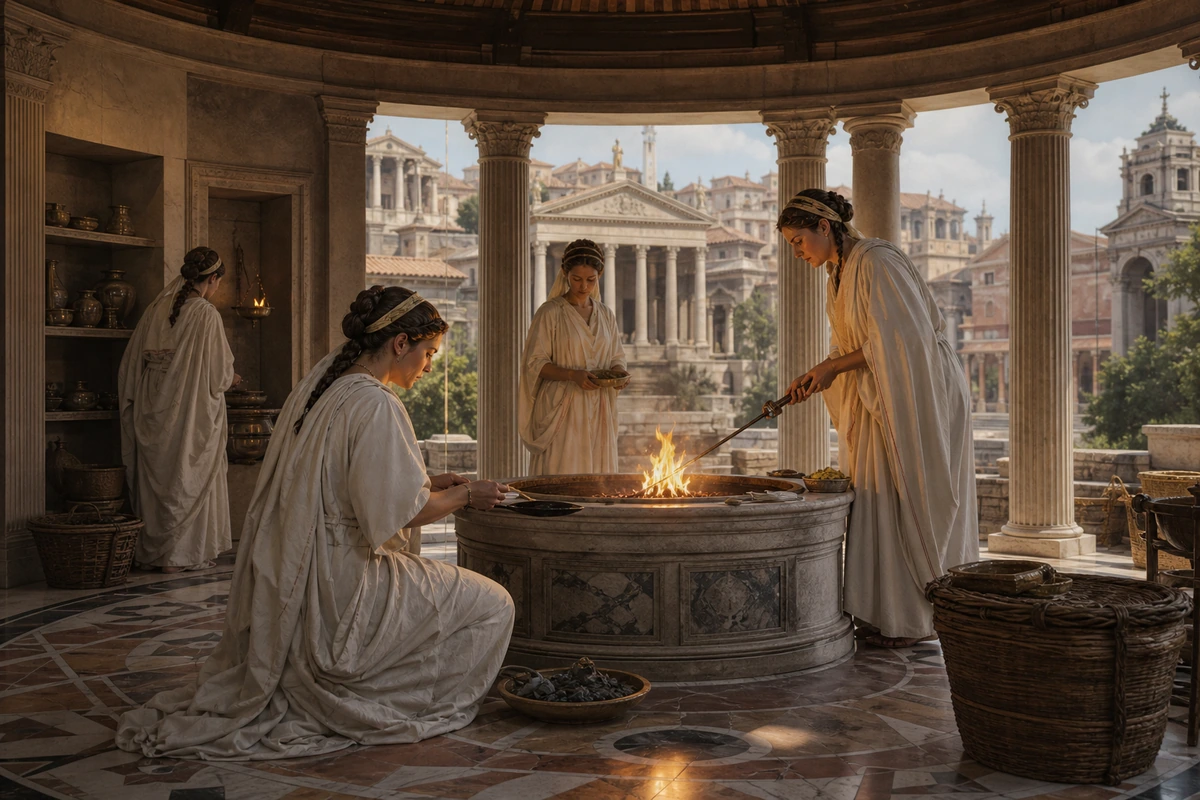
The Vestals were selected as children and served for a long fixed term. Ancient descriptions divide their service into stages of learning, performing the rites, and teaching newer members. The college eventually numbered six. Their duties included maintaining the flame, preparing ritual substances such as mola salsa, safeguarding sacred objects, and participating conspicuously in public ceremonies.
Their position was unusual. Vestals enjoyed honours and legal independence unavailable to most Roman women, yet they also lived under strict religious discipline. Allowing the flame to go out could bring punishment, while breaking the vow of chastity was treated as a danger to the whole community and punished with the notorious ritual of live burial. The contrast between privilege and extreme constraint was built into the office.
Was the fire literally eternal?
“Perpetual” described a cult that must continue, not a claim that the same physical flame could never be renewed. Roman ritual sources discuss procedures for rekindling it if it failed. Plutarch says new fire should be produced from a pure source rather than taken from an ordinary hearth.
Ovid’s Fasti connects the Kalends of March—the old Roman New Year—with the renewal of laurel at the Regia and Vesta’s hearth. Later antiquarian evidence describes the annual renewal of the sacred fire at this season. The cycle therefore combined continuity of office with ritual beginnings.
The round Temple of Vesta
The small temple stood near the Regia and the House of the Vestals at the eastern end of the Forum. Its circular form recalled an archaic hut or hearth building. Plutarch records a more philosophical explanation, comparing the round structure and central fire to the order of the cosmos. That explanation reflects ancient interpretation; it need not be the original reason for the architecture.
There was no conventional cult statue of Vesta in the central room. The visible flame embodied her presence, while an inner store—the penus Vestae—held sacred objects hidden from public view. Ancient writers disagreed about exactly what was kept there, which is a useful warning against confident modern inventories.
Fire, failure, and the Roman state
Because the hearth represented collective order, disasters involving the temple carried political meaning. During the Gallic attack remembered by Livy, the Vestals removed sacred objects from danger. In later periods, emperors restored the temple after fires and displayed their support for the cult. The institution’s continuity helped Rome imagine itself as a household surviving across generations.
That symbolism should not be reduced to the modern slogan that “if the fire died, Rome would fall.” Romans certainly treated its extinction as ominous and ritually serious, but the cult had procedures for correction. Its power lay in repeated maintenance: trained priestesses, public funding, prescribed rites, and a hearth that made the city’s continuity visible.