
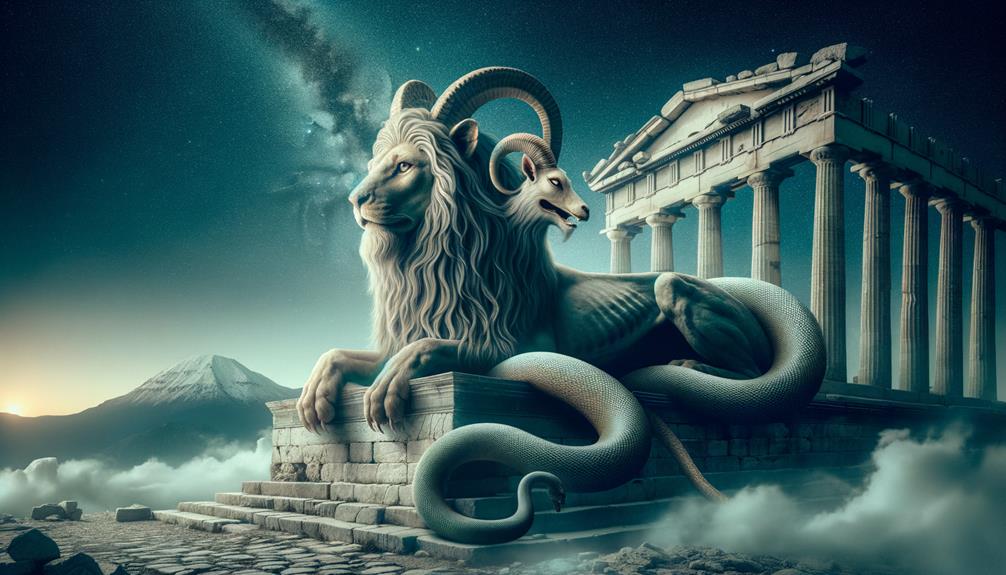
The Chimera is one of the earliest described hybrid monsters in Greek literature. Its surviving ancient portraits are concise but specific: the creature combines a lion, a goat, and a serpent or dragon, and it breathes fire. Later art normally shows a lion’s body with a goat’s head rising from its back and a snake forming the tail.
The Chimera in Early Greek Sources
In Book 6 of Homer’s Iliad, King Iobates orders Bellerophon to kill the Chimera in the expectation that the monster will destroy him. Homer describes it as divine rather than human, with a lion at the front, a goat in the middle, and a serpent at the rear. It breathes flames, but Bellerophon kills it with divine guidance.
Hesiod’s Theogony gives a related description with three heads: lion, goat, and snake. In that genealogy the Chimera is a child of Typhon and Echidna, not of Hydra or Ceto. Hesiod names Pegasus and Bellerophon together as its killers. These passages establish the core form of the monster and its place within a family of dangerous beings that includes Cerberus and the Lernaean Hydra.
Bellerophon and Pegasus
Bellerophon’s encounter with the Chimera belongs to a longer tale of exile, false accusation, and impossible assignments. Proetus sends the hero to Lycia carrying a sealed message that calls for his death. Iobates avoids killing a guest directly and instead assigns lethal tasks, beginning with the Chimera.
The Iliad does not explain the mechanics of the fight, and it does not name Pegasus in this episode. Hesiod supplies the connection between the winged horse and the victory. Later authors and artists expanded the scene, commonly placing Bellerophon above the monster on Pegasus. Details such as a lead-tipped spear melting in the Chimera’s fiery throat belong to later retellings and should not be treated as part of Homer’s account.
Appearance in Ancient Art
Greek vase painters and metalworkers often rendered the Chimera as a compact three-part animal. A goat’s head projects from a lion’s back, while the tail ends in a serpent’s head. This differs from a simple three-headed beast because each animal occupies a different part of one body. Wings are not a standard feature of the ancient Chimera, although modern fantasy art sometimes adds them.
The monster is closely associated with Lycia in the story of Bellerophon. Attempts to explain its fire as a memory of natural gas vents in the region are modern hypotheses. They may help explain why later readers connected the tale to a particular landscape, but no surviving ancient text proves that the myth began as an account of a geological fire.
Meaning of the Name Today
The word chimera later became a general term for an impossible or fanciful combination. Biology and medicine also use related terms for an organism or individual containing genetically distinct cell populations. Those technical meanings borrow the ancient monster’s mixed form, but they are separate from the Greek narrative.
The most reliable profile remains narrow: a fire-breathing female monster formed from lion, goat, and serpent, killed in Lycia by Bellerophon with Pegasus. Claims about fixed moral symbolism, prehistoric sightings, or a single historical animal go beyond the evidence.
Sources
- Homer, Iliad, Book 6, Perseus Digital Library
- Hesiod, Theogony, lines 304 to 336, Perseus Digital Library