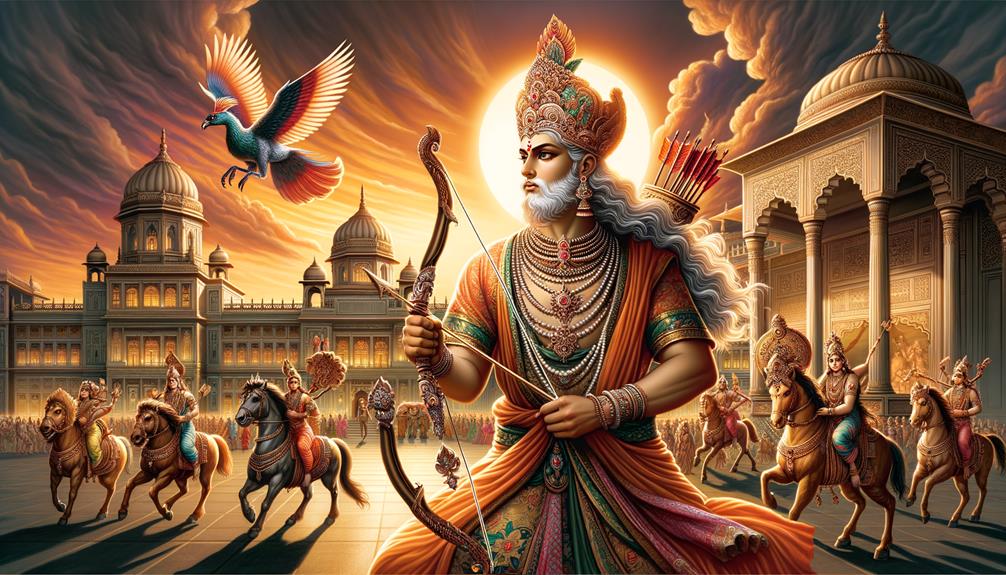
Rama is the prince at the center of the Ramayana, a major form of Vishnu in Hindu devotion, and an enduring ideal of righteous rule. Yet the epic does not make dharma easy. Rama’s exile, alliance with the vānaras, war against Ravana, treatment of Sita, and later kingship repeatedly bring one duty into conflict with another. The story’s moral power lies in those pressures as much as in its victories.
The Ramayana is a family of traditions
The Sanskrit Ramayana attributed to Valmiki is foundational, but it is a layered work that developed over centuries. Its seven-book form contains roughly twenty-four thousand verses, and scholars have long discussed the relative dates of its sections. Oral performance, commentary, translation, temple art, theater, and devotion have continued to reshape the narrative.
Major versions include Kamban’s Tamil Iramavataram, Tulsidas’s Awadhi Ramcharitmanas, Jain and Buddhist tellings, and works in Bengali, Assamese, Malayalam, Telugu, Kannada, and many other languages. The story also became central across Southeast Asia, where traditions such as the Thai Ramakien developed distinctive characters, scenes, and political meanings.
These are not merely imperfect copies of one Sanskrit original. Each retelling interprets Rama for a community, language, theology, and artistic form. A careful account identifies its source instead of forcing all episodes into one seamless master plot.
Exile from Ayodhya
Rama is the eldest son of King Dasharatha of Ayodhya and Queen Kausalya. When Dasharatha prepares to crown him, Queen Kaikeyi claims two boons the king had promised her: her son Bharata will inherit the throne, and Rama will spend fourteen years in the forest. Dasharatha is bound by his word even though the demand destroys him.
Rama accepts exile to preserve his father’s truth and the legitimacy of royal promises. Sita insists on accompanying her husband, and Rama’s brother Lakshmana joins them. Bharata rejects the spirit of Kaikeyi’s scheme, seeks Rama in the forest, and eventually governs as his representative rather than treating the disputed succession as an easy personal victory.
The episode makes obedience costly. Rama’s conduct protects one dimension of dharma, but a king’s private promise also damages a household and kingdom. The epic does not hide Dasharatha’s grief or Sita’s determination behind a simple slogan about duty.
Sita’s abduction
In the forest, the rakshasa king Ravana uses deception to abduct Sita. A golden deer draws Rama away; a cry imitating Rama draws Lakshmana from the shelter; Ravana then arrives disguised as an ascetic. The dying bird Jatayu attempts to stop him and later gives Rama crucial information.
Sita is a prisoner in Lanka, but she is not narratively absent. She refuses Ravana, debates him, protects her own moral agency, and endures threats without transferring allegiance. The Sundara Kanda centers Hanuman’s search for her and their careful exchange of signs, memories, and trust.
Sugriva, Vali, and Hanuman
Rama and Lakshmana ally with Sugriva, an exiled vānara ruler whose brother Vali holds the kingdom of Kishkindha. Rama kills Vali from concealment while Vali fights Sugriva. The scene has generated debate within the epic tradition itself: Vali challenges Rama’s authority and method, and Rama offers a defense based on kingship, punishment, and alliance.
The difficulty should not be removed from the story. Rama’s alliance restores Sugriva and gains the search network needed to find Sita, but the means raise questions about jurisdiction and just combat. The epic can present Rama as an exemplar while still staging arguments about his actions.
Hanuman becomes the mission’s indispensable agent. He crosses the ocean, enters Lanka, finds Sita in the ashoka grove, offers Rama’s ring, assesses Ravana’s defenses, and returns with news. In devotional interpretation, his strength is inseparable from disciplined service and unwavering attention to Rama.
The bridge to Lanka and the war
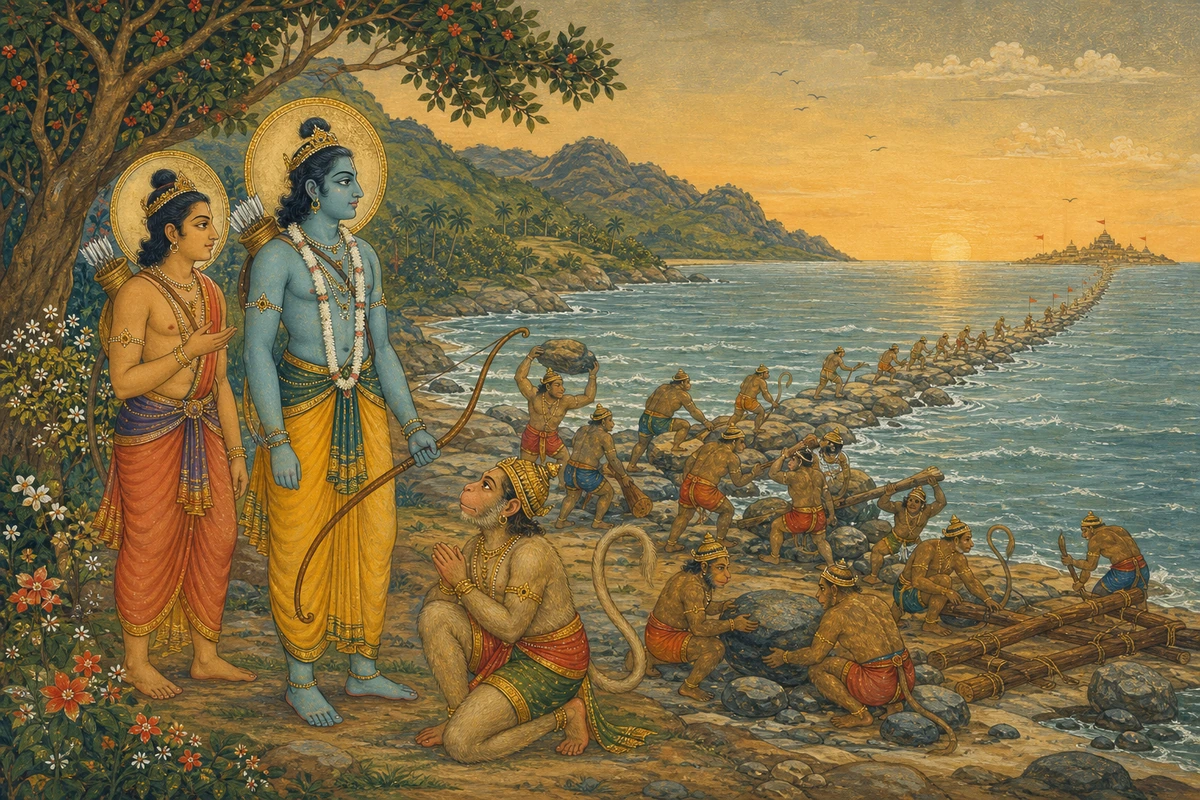
The vānara and bear forces gather at the sea. With the work of Nala and the army, they build a causeway to Lanka. Art and performance render the crossing in many ways: as stones floating through divine power, as organized engineering, or as a cosmic act of devotion. The bridge makes a collective answer to the separation imposed by abduction.
In Lanka, duels and mass battle lead toward Rama’s confrontation with Ravana. Ravana is learned, powerful, and devoted to ascetic achievement, but his refusal to release Sita brings destruction upon his household. His brother Vibhishana defects after urging him to choose a different course and is later installed as ruler.
Rama kills Ravana with a divinely empowered arrow. Victory restores order, but it does not end the epic’s moral strain. Rescue must be followed by public recognition, return, and rule.
Characters and the dharmic pressure they reveal
| Figure | Central commitment | Conflict opened by the story |
|---|---|---|
| Rama | Truth, royal duty, protection, and righteous order | Different duties can demand incompatible actions |
| Sita | Integrity, choice, endurance, and rightful relationship | Public suspicion places an unjust burden on the harmed person |
| Lakshmana | Service to Rama and protection of Sita | Obedience can pull him between competing commands |
| Hanuman | Devotion expressed through intelligent action | Great power becomes meaningful only when disciplined |
| Bharata | Loyalty to Rama and responsibility for Ayodhya | He must govern without accepting the wrongful basis of his rule |
| Ravana | Power, status, desire, and refusal to yield | Learning and ascetic achievement do not excuse violation |
Sita’s ordeal and later exile
After Ravana’s defeat, Sita undergoes a fire ordeal to demonstrate her purity, and Agni returns her unharmed. The scene is interpreted differently across texts and communities: as public vindication, a painful test, a divine revelation, or an injustice. Some retellings change its circumstances or use a “shadow Sita” to protect the divine Sita from abduction.
The final book of the Sanskrit epic tells that public gossip later leads Rama to send the pregnant Sita away, despite knowing her innocence. She finds refuge at Valmiki’s hermitage and raises the twins Lava and Kusha. When called again to prove herself, she appeals to the Earth, her mother, and is received into the ground.
This ending has inspired devotion, protest, reinterpretation, and debate for centuries. Its textual history is also complex, and many performances end with the triumphant return to Ayodhya. Responsible discussion should neither hide Sita’s suffering nor claim that one response represents all Hindu readers.
Rama as an avatar of Vishnu
Within Vaishnava theology, Rama is an avatar of Vishnu who descends to restore dharma and defeat Ravana. Divine framing is present in the Sanskrit epic, while later devotional traditions make Rama’s supreme identity and grace increasingly central. For many worshippers, “Rama” is also a sacred name used in prayer, song, pilgrimage, and meditation.
Devotional Rama is not confined to the role of a literary character. Temples, festivals such as Rama Navami, recitations, Ramlila performance, and the poetry of Tulsidas make the story lived religion. Analysis should therefore combine textual precision with respect for active traditions.
History and sacred geography
Ayodhya, Chitrakoot, Panchavati, Rameswaram, and many other places are embedded in Ramayana pilgrimage and local memory. Their sacred significance is a historical reality for communities. That does not mean every narrative episode can be verified as a modern chronological biography through archaeology or astronomical calculation.
Epic, sacred geography, political memory, and material history ask different questions. Claims about a single exact date for the war or a direct proof of every character usually go beyond what the evidence can establish. The story’s importance does not depend on disguising those limits.
Why Rama remains compelling
Rama’s ideal is demanding because kingship exposes every private choice to public consequence. He gives up the throne to preserve a promise, crosses the ocean to recover Sita, and returns to establish a celebrated reign. Yet the same commitment to royal reputation contributes to Sita’s later suffering.
The epic asks whether a ruler can satisfy family, law, truth, reputation, compassion, and cosmic purpose at once. Rama’s greatness and the pain around him remain in tension. That tension has generated thousands of years of art and argument—and ensures that the Ramayana is still interpreted rather than merely repeated.
Sources and further reading
- The Metropolitan Museum of Art: Sita and Rama—The Ramayana in Indian Painting
- The Metropolitan Museum of Art: Epic India—Scenes from the Ramayana
- English translation of the Valmiki Ramayana
- Vishnu: Avatars, Iconography, and the Restoration of Dharma
- Hanuman: Devotion, Strength, and the Ramayana Traditions