
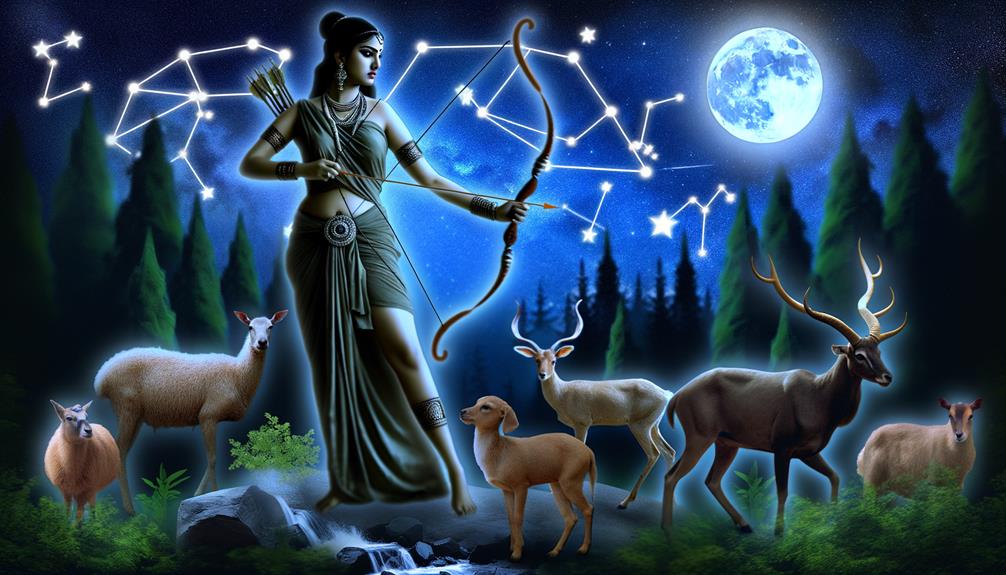
Artemis is the Greek goddess of hunting and wild places, the daughter of Zeus and Leto, and the sister of Apollo. But the familiar bow, quiver, and deer tell only part of her story. Ancient poetry also associates her with dance and childbirth, while local sanctuaries connect her worship with children, women, and the life of the city.
These roles are not mistakes to be reconciled into a single modern job description. Artemis can guard young life while also appearing as a dangerous power whose boundaries cannot safely be crossed.
The huntress in the Homeric Hymns
Homeric Hymn 27 presents Artemis moving through mountains with her bow, pursuing wild animals while the landscape resounds around her. Yet the poem does not leave her in the wilderness. When the hunt is over, she goes to Apollo’s house at Delphi, puts aside her equipment, and leads the Muses and Graces in dance.
The movement from hunting to music is essential to this portrait. A summary that gives her only weapons and solitude omits the hymn’s second half. Homeric Hymns 9 and 27 are short, accessible starting points for reading Artemis in ancient poetry rather than through a modern list of powers.
What Artemis asks of Zeus
Callimachus begins his Hymn to Artemis with the goddess as a child seated on her father’s knees. She asks to retain her maidenhood, to have many names, and to receive a bow and arrows. She also requests a short tunic suitable for hunting, nymph companions, and mountains in which to roam.
In the same speech, she explains that she will visit cities when women in childbirth call for help. Her independence from marriage therefore coexists with concern for birth. The poem itself brings those associations together; they are not competing traditions that must cancel one another. Read Callimachus, Hymn 3, opening lines.
Actaeon and the danger of seeing a goddess
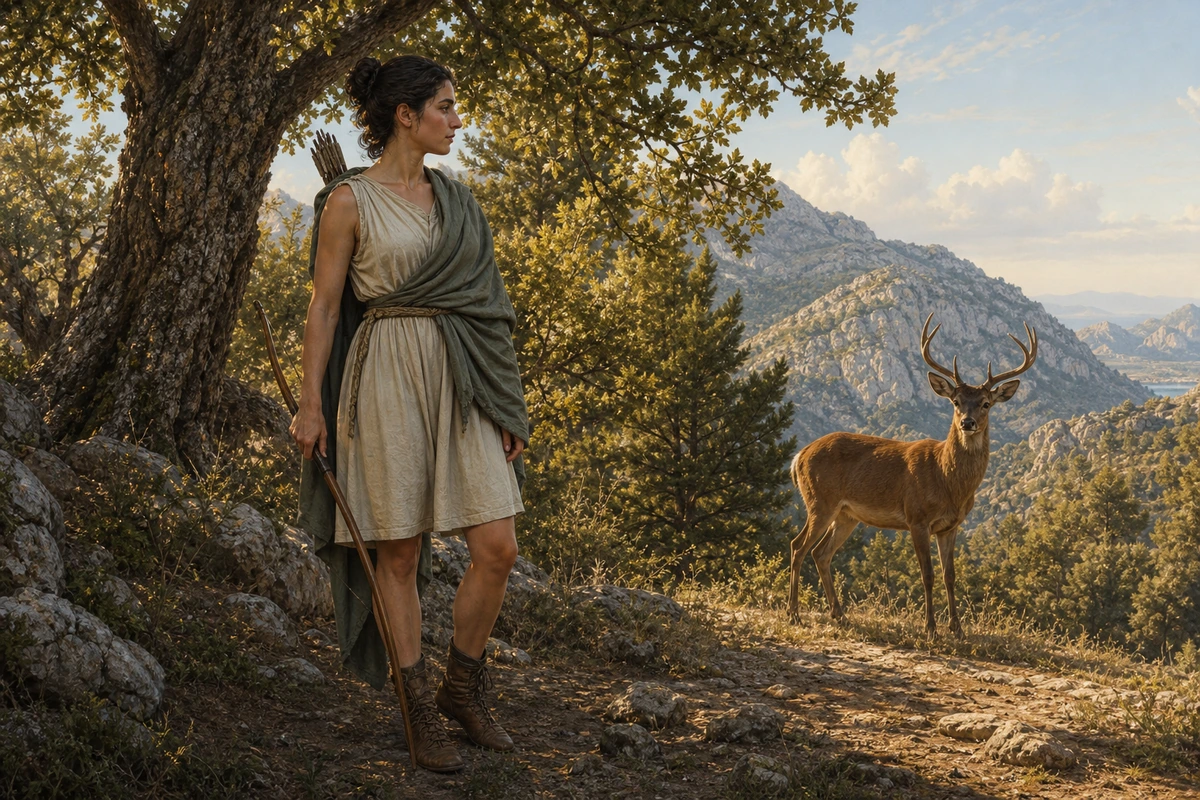
One of the best-known stories associated with Artemis concerns the hunter Actaeon. In Ovid’s Metamorphoses, where the goddess is called Diana, he accidentally wanders into the place where she is bathing. She transforms him into a stag, and his own hounds kill him. He retains the awareness of who he is but cannot make the animals recognize their master.
Ovid explicitly treats the encounter as a misfortune rather than a deliberate crime. That detail makes the episode more troubling than a simple lesson that a knowingly wicked man receives a deserved punishment. The narrator also reports disagreement over the goddess’s action. See Ovid, Metamorphoses 3, lines 138–252.
Even the cause of Actaeon’s death varies. The mythographical Library 3.4.4 gives the bathing story but also preserves an account attributed to Acusilaus in which Zeus is angry because Actaeon courts Semele. A responsible retelling names the version it follows instead of merging those explanations.
Artemis Brauronia and the protection of young life
The cult of Artemis Brauronia offers a different perspective from a mountain hunt. The Acropolis Museum describes the Athenian sanctuary as a city branch of the goddess’s main sanctuary at Brauron on the east coast of Attica. Artemis here protected pregnant women, women who had recently given birth, and children.
The museum also connects a fourth-century BCE marble bear cub with the arkteia, a ritual service associated with girls’ transition from childhood toward adolescence. Its connection with the sanctuary is described as probable. The object is useful evidence for the cult’s imagery, but it does not supply a complete script for every ceremony or prove that every girl participated in exactly the same way.
Recognizing Artemis without flattening her identity
A bow and deer can make a hunting image readily recognizable, while a sanctuary object may emphasize another relationship altogether. The Acropolis Museum’s large marble head associated with Artemis Brauronia, dated around 330 BCE, is interpreted as part of her cult statue. Its carefully arranged braids are linked by the museum to her association with children.
Poetry, myth, and material evidence thus contribute different views. Artemis is a huntress in the mountains, a participant in divine song and dance, a helper invoked at childbirth, and a goddess whose encounter can overturn a mortal life. Keeping those settings in view gives a fuller portrait than treating any single story as the definition of the goddess.