
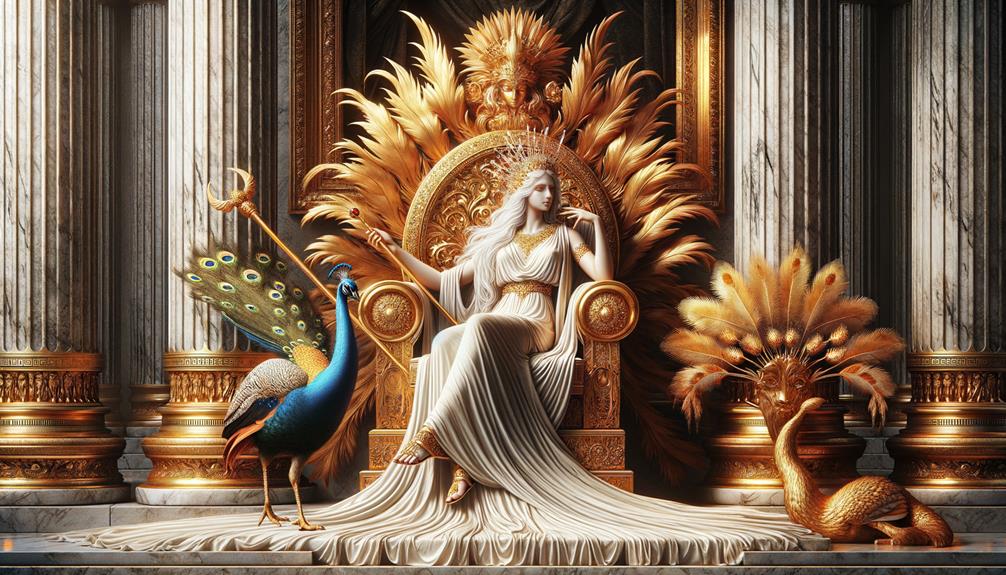
Hera is the queen of the Greek gods, the wife of Zeus, and a goddess deeply associated with marriage and the life of communities. Her quarrels in poetry are memorable, but they are only part of the evidence. Temples, festivals, offerings, and descriptions of her images reveal a figure whose importance cannot be reduced to jealousy.
Reading Hera well means holding together two kinds of material: stories about a difficult divine marriage and the religious honors given to a powerful goddess. Neither makes the other disappear.
Hera’s family and position among the gods
In Hesiod’s Theogony, lines 453–458, Hera belongs to the children of Cronus and Rhea, alongside Hestia, Demeter, Hades, Poseidon, and Zeus. Her marriage to Zeus is therefore also a marriage between siblings within the poem’s divine genealogy.
Later, at lines 921–929, Hesiod names Hebe, Ares, and Eileithyia as their children. He then says Hera bore Hephaestus without sexual union with Zeus, in the context of a quarrel. Rather than silently combining incompatible family trees, it is better to identify the particular author when discussing a disputed parentage.
A formidable voice in the Iliad
Hera supports the Greek side in the Trojan War. In Iliad 4.50–67, she names Argos, Sparta, and Mycenae as especially dear to her, while negotiating with Zeus over Troy’s fate. The exchange is unsettling: beloved human cities become part of a bargain between immortals.
Her argument rests partly on status. She insists that she too is divine, comes from the same family as Zeus, and is his wife. The scene presents a participant in divine government, even while acknowledging Zeus’s greater power. It is more than a domestic complaint detached from the war.
In Iliad 14.153–360, Hera obtains Aphrodite’s help and recruits Sleep before seducing Zeus. Once he sleeps, Poseidon can assist the Greeks. The episode joins desire, deception, alliance-building, and military consequences; Hera changes events through planning rather than battlefield force alone.
What worshippers saw at the Argive Heraion
Pausanias provides a detailed account of Hera’s sanctuary near Mycenae. In Description of Greece 2.17, he describes the great gold-and-ivory seated image made by Polycleitus. Hera wears a decorated crown and holds a pomegranate and a sceptre, with a cuckoo perched on the sceptre.
The details invite interpretation, but the source also sets limits. Pausanias declines to explain the pomegranate’s sacred meaning. He reports a story in which Zeus approached Hera in a cuckoo’s form, while explicitly distancing himself from belief in such tales. His account separates what an image displayed, what people said about it, and what the writer accepted.
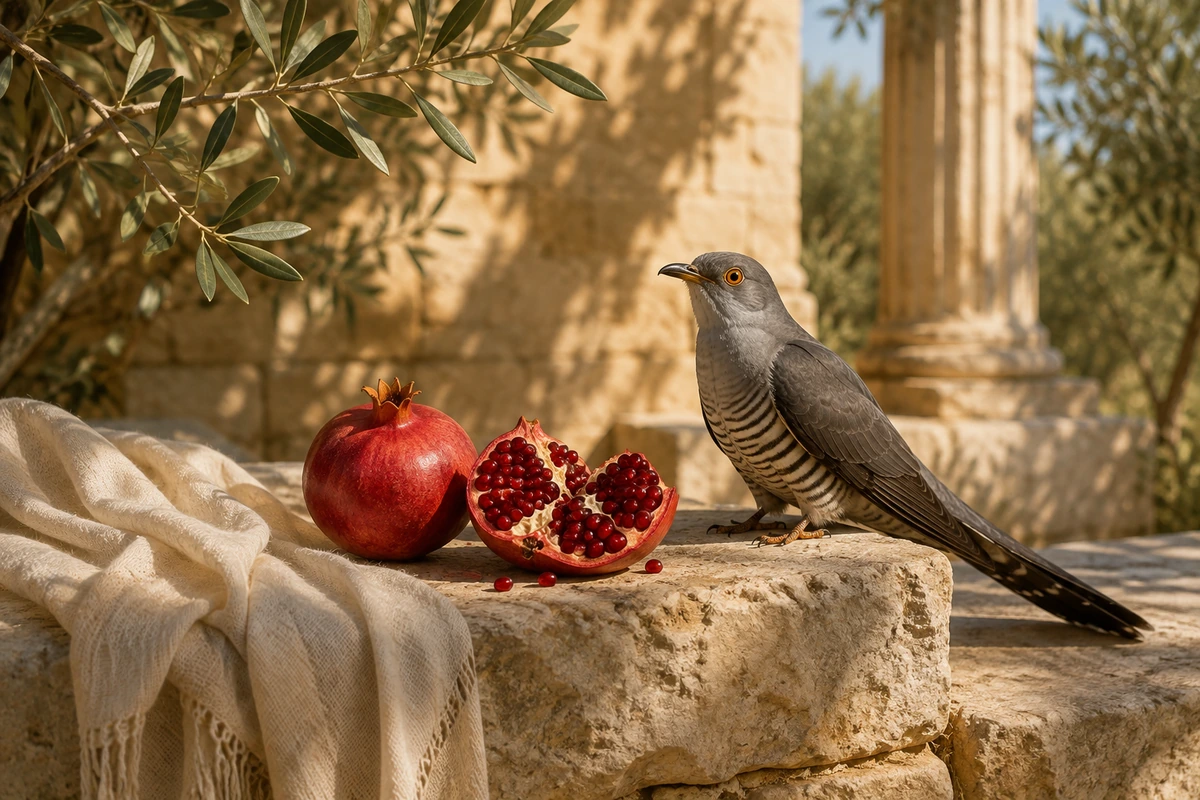
Pausanias also records a jeweled golden peacock dedicated by the emperor Hadrian because the bird was considered sacred to Hera. This gives the familiar peacock association a specific attested setting. It does not mean that every image of Hera, in every period, needed a peacock to be recognizable.
Women, weaving, and races at Olympia
Hera’s public importance is especially clear in Pausanias’s description of the Heraea at Olympia, 5.16. A group called the Sixteen Women organized a robe for the goddess and races for unmarried girls. The runners competed in age groups, and the course was shorter than the full stadium length.
Victors received olive crowns and a share of the animal sacrificed to Hera; they could also dedicate inscribed images. These details place worship within a community of organizers, participants, and spectators. The festival was not merely an illustration of a myth about Zeus’s affairs.
Pausanias supplies more than one account of the institution’s beginnings, including one connecting it with Hippodameia’s marriage to Pelops. That variety is worth retaining: an ancient festival could have several explanatory stories rather than a single uncontested foundation narrative.
Hera and Heracles: hostility is not the whole ending
Hesiod connects Hera with threats faced by Heracles, including the Hydra. Yet the same Theogony, at lines 950–955, places the hero on Olympus as the husband of Hebe, Hera’s daughter, after his labors. The relationship therefore reaches beyond a simple, unchanging opposition.
Hera can be angry, dangerous, regal, protective, and honored in public ritual. Those are not errors that need to be smoothed into one personality. They are different aspects of the surviving tradition, and a fuller account lets readers see why the queen of the gods mattered beyond her most frequently retold quarrels.