
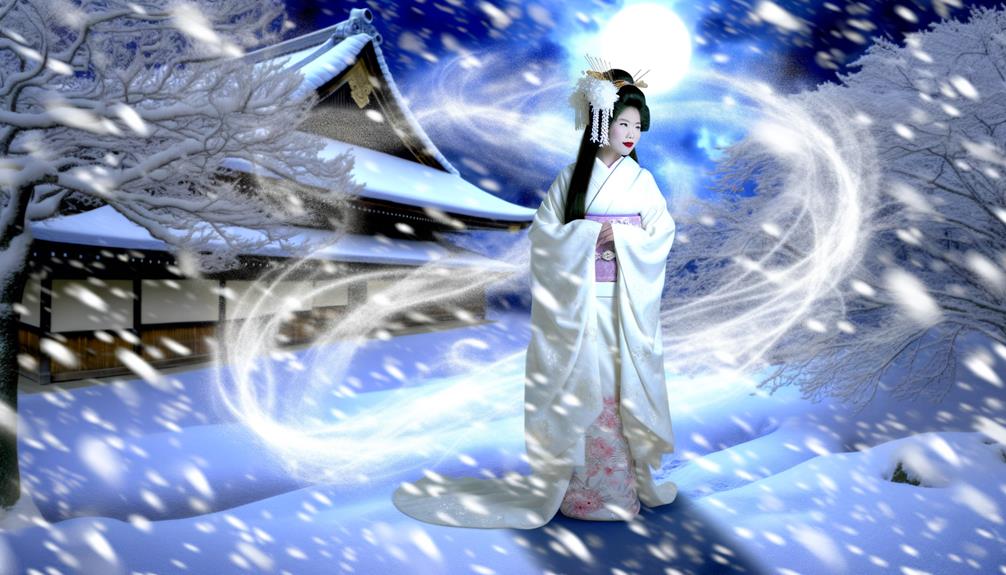
Yuki-onna, the “snow woman,” belongs to a varied body of Japanese supernatural storytelling. She may appear as a deadly visitor in a blizzard, a mysterious mother, or a woman whose marriage to a human depends on keeping a secret. These are related traditions, not chapters in one fixed biography.
One particularly influential version appears in Lafcadio Hearn’s Kwaidan, published in 1904. Its power comes from a disturbing transformation: the beautiful stranger who threatens a young woodcutter becomes the beloved wife with whom he builds a family.
Where Hearn said the story came from
In his introduction, Hearn says that a farmer from Chōfu in Nishitama, in the old province of Musashi, told him the tale as a legend of the farmer’s native village. Hearn did not know whether that particular account had already been written in Japanese. This is valuable information about his source, but it does not make his English literary retelling a verbatim transcript or a complete account of Japanese belief.
The full text of Kwaidan allows readers to distinguish Hearn’s own framing from details supplied by later adaptations.
The night in the ferryman’s hut
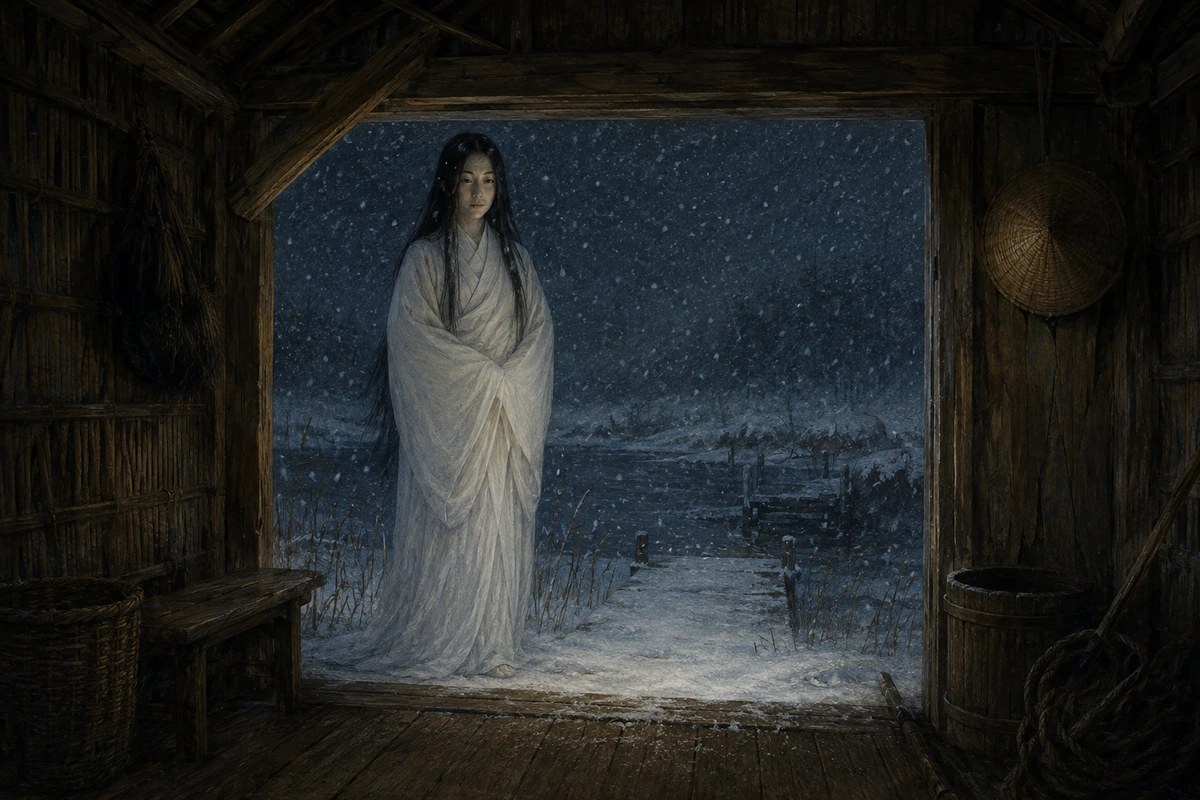
Hearn’s story begins with two woodcutters, the elderly Mosaku and the young Minokichi, caught in a fierce snowstorm. They cannot cross a river because the ferryman has left his boat on the opposite bank. The men take shelter in his tiny hut, where there is no fire to warm them.
Minokichi wakes to find the door open and a woman dressed in white bending over Mosaku. Her breath resembles white smoke. When she turns to Minokichi, she decides to spare him because of his youth, but warns that she will kill him if he ever tells anyone what he has seen.
Mosaku is dead by the time Minokichi can move again. Rescued the following morning, the younger man recovers from his exposure and returns to work, keeping the encounter secret.
O-Yuki and the broken promise
The next winter, Minokichi meets a young woman named O-Yuki. She says she has lost her parents and is traveling to Yedo, now Tokyo, to seek help from relatives. He invites her home, where his mother welcomes her. O-Yuki stays, marries him, and eventually bears ten children.
Years pass, but she seems not to age. One evening, watching her sew by lamplight, Minokichi is reminded of the woman in the hut. He tells his wife the secret he has guarded for so long.
O-Yuki reveals that she was the snow woman. She spares him again, this time for the sake of their children, and warns him to care for them properly. Then she dissolves into white mist and disappears. Hearn closes by saying she is never seen again.
Why the ending is more than a punishment
The broken promise explains the separation, but the children change its outcome. The figure who once killed Mosaku refuses to kill their father. A reading attentive to both scenes finds danger and affection in the same character, rather than a monster who simply pretends to be human until the final revelation.
The contrast between the exposed hut and the family home is also important. In the first, Minokichi is helpless before the cold; in the second, ordinary domestic intimacy leads him to speak. This interpretation follows the story’s arrangement, not an explicit statement that Hearn gives a single moral for it.
A different snow-woman story from Miyagi
Regional records show why Hearn’s marriage story should not stand for every Yuki-onna tradition. The International Research Center for Japanese Studies records a tale published in 1976 from Miyagi Prefecture: a young samurai is asked by a snow woman to hold a baby. She disappears, and the icy child will not come away from his arms; he loses consciousness.
The Nichibunken folklore record identifies the publication, collector, informant, and locality. Its date is the publication date of that account—not a claim that the tradition first arose in 1976. This version centers on an uncanny encounter with a child rather than a long marriage and a promise of secrecy.
Reading Yuki-onna today
Yuki-onna is most interesting when those differences remain visible. For Hearn’s version, the essential elements are the storm, two acts of mercy, a forbidden disclosure, and a family left behind. Other records supply other encounters. An illustration or modern adaptation may choose freely among them, but identifying its source keeps a compelling retelling from becoming a misleading claim about all Japanese folklore.