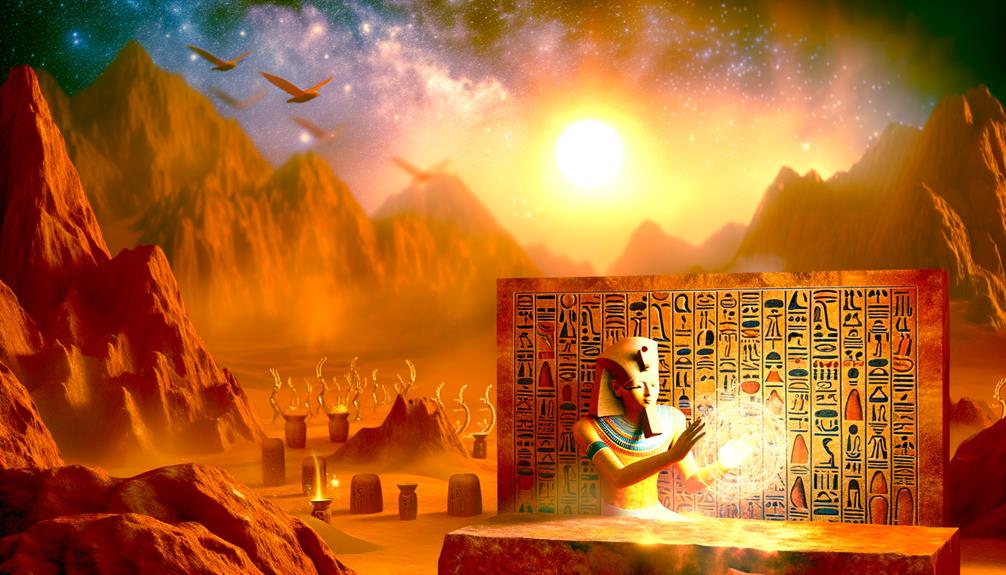
Ptah was the great god of Memphis, a creator associated with skilled making, and a patron of craftspeople and artists throughout ancient Egyptian history. The famous Memphite creation account says that divine realities came forth through Ptah’s heart and tongue—thought and authoritative speech—but this was one Egyptian theology among several, not a declaration that every other creator god had been discarded.
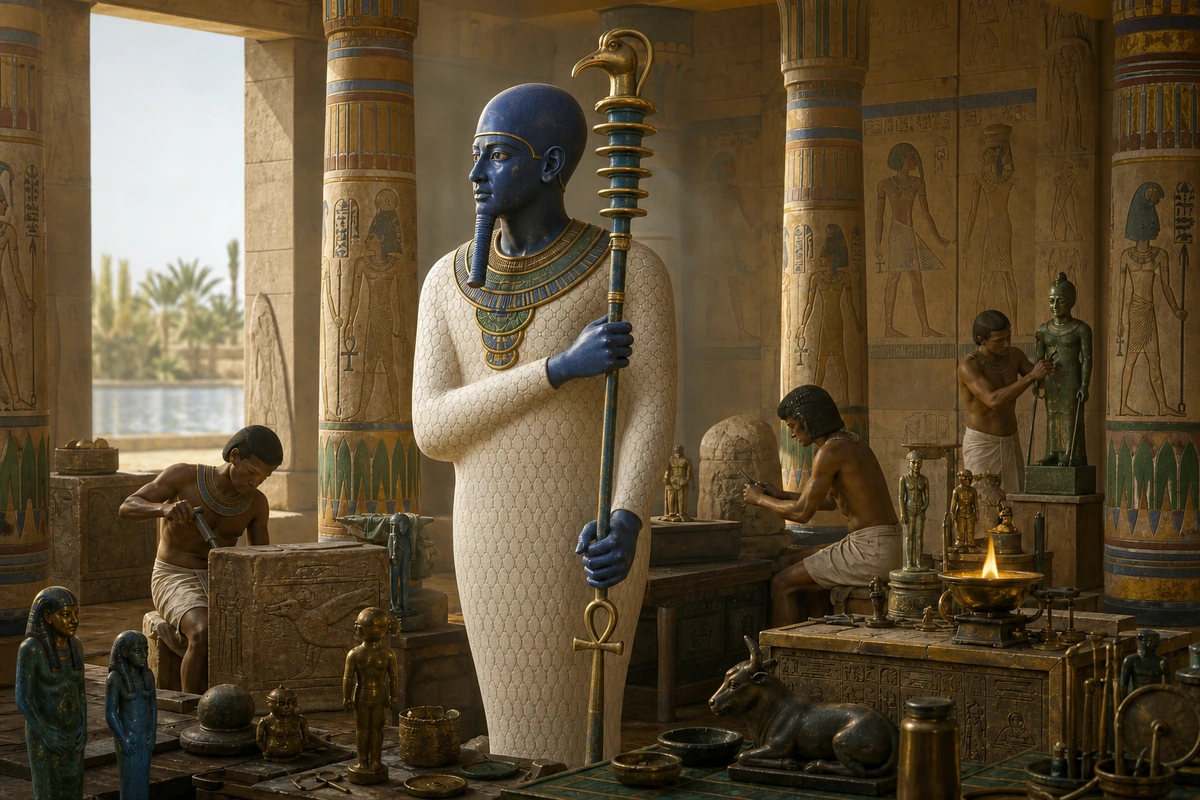
Ptah, lord of Memphis
Memphis stood near the apex of the Nile Delta and served as a major political, religious, and craft center for millennia. Ptah was its principal deity. Egyptian inscriptions call him “Lord of Memphis” and give him titles connected with truth, creation, listening, and workmanship.
His great temple was known as the Hut-ka-Ptah, the “Estate of the Ka of Ptah.” A much-discussed linguistic history connects that temple name, through Greek Aigyptos, with the later word “Egypt.” The development is more complex than saying the country was simply named after Ptah, but the connection reflects Memphis’s importance to foreign visitors.
Greek authors often equated Ptah with Hephaestus because both were associated with craft and making. Such identifications helped ancient cultures translate one religious world into another; they do not make the two gods identical.
Creation through heart and tongue
The composition conventionally called the Memphite Theology presents Ptah as the power through whom gods and the ordered world come into being. The heart conceives, the tongue commands, and the body carries out action. In Egyptian thought, the heart was a center of understanding and intention rather than merely an organ of emotion.
The text links sight, hearing, breath, thought, speech, naming, and skilled activity. Ptah’s creation is not simply “saying words” in isolation. It is a model in which perception becomes understanding, understanding becomes effective utterance, and intention becomes material form. That pattern helps explain why the creator is also patron of craftspeople.
Modern summaries sometimes call this “creation from nothing.” The phrase can mislead. Egyptian cosmogonies usually work with primordial waters, emerging land, divine differentiation, generation, naming, and the establishment of order. Ptah’s speech organizes and manifests reality within that religious universe.
The Shabaka Stone and its dating problem
The Memphite composition survives most famously on the Shabaka Stone, now in the British Museum. It was inscribed during the Twenty-fifth Dynasty, around 710 BCE, under the Kushite king Shabaka. The stone says that an older, worm-damaged document was copied so the work of the ancestors would be preserved.
That claim once encouraged very early dates for the composition. Many scholars now regard the “rescued ancient document” as a literary or royal strategy, while debate continues over whether the theology incorporates genuinely older traditions. The stone itself is late eighth century BCE evidence; the date of every idea embedded in its text cannot be assumed from its archaizing style.
The object has an unusual afterlife. It was reused as a millstone, cutting a deep circular depression and damaging major portions of the inscription. Any translation must reconstruct a text with real gaps. Confident paraphrases should therefore distinguish readable claims from scholarly restoration.
Ptah and the Egyptian craft tradition
Ptah’s association with craft was institutional as well as symbolic. The high priest of Ptah held a title conventionally translated “Greatest of the Directors of Craftsmen.” Royal sculpture, metalwork, jewelry, temple furniture, architecture, and ritual equipment depended on organized workshops and specialized knowledge.
For Egyptian makers, design and execution were not opposites. Measuring, planning, naming, carving, casting, polishing, and animating an image through ritual all brought intention into form. Ptah could therefore be creator of gods and patron of human makers without those roles feeling unrelated.
Later tradition also connects the deified architect and healer Imhotep with Ptah, sometimes as his son. That relationship is not the starting point of Ptah’s worship; it is one development in a long-lived Memphite religious network.
How Ptah was shown
Ptah is usually represented as a standing man enclosed in a close-fitting shroud. He wears a smooth cap and a straight divine beard, with his hands emerging to hold a composite sceptre. The staff combines signs associated with power (was), stability (djed), and life (ankh).
The shrouded body does not make Ptah a mummy or a god of horror. It gives him a compact, enduring form distinct from deities shown striding in kilts. Images may color his flesh green, blue, or conventionally, and materials such as faience, bronze, stone, gold, and lapis lazuli add their own symbolic value.
Ptah can stand on a pedestal shaped like the hieroglyph for truth or order, maat. Every visual detail need not appear on every object; identification depends on the combination of cap, beard, shroud, posture, staff, inscription, and archaeological context.
Ptah, Sekhmet, Nefertum, and the Memphite family
In a common Memphite grouping, Ptah is paired with the lioness goddess Sekhmet, and Nefertum is their son. Modern books often call them the “Memphite Triad.” The family arrangement was important but not a closed system, and relationships could change across periods and locations.
Sekhmet expresses solar heat, dangerous force, protection, and healing. Nefertum is associated with the lotus, fragrance, renewal, and the rising sun. Their placement beside Ptah connects creative stability with volatile power and daily regeneration.
The Apis bull was also centered at Memphis and described as a living manifestation or herald of Ptah. After death, Apis bulls were linked with Osiris as Osiris-Apis, a relationship that contributed to the later Serapis tradition. The animal’s cult should not be collapsed into a claim that Ptah himself was always bull-shaped.
Ptah-Sokar-Osiris and funerary renewal
Ptah joined with Sokar, an ancient Memphite funerary god, and Osiris in the composite form Ptah-Sokar-Osiris. Objects bearing this form became common in funerary equipment, especially small wooden figures placed in tombs. The combination united Ptah’s power of formation, Sokar’s necropolis associations, and Osiris’s death and renewal.
Syncretism in Egyptian religion did not mean three gods ceased to exist separately. A combined name made a particular relationship active for a ritual context. Ptah could simultaneously remain Memphis’s lord, receive prayers, protect craftsmen, and participate in funerary regeneration.
Ptah could also merge with Tatenen, a god associated with the rising land and deep earth. Ptah-Tatenen emphasizes primordial ground, fertility, and the physical basis from which created forms emerge.
Ptah “who hears prayers”
New Kingdom and later devotion increasingly emphasizes Ptah as a god who listens. Stelae and temple spaces use ear imagery to express divine attention to ordinary petitioners. This aspect complements rather than contradicts the creator theology: the tongue that makes commands effective is paired with a deity attentive to human speech.
Ptah’s cult spread well beyond Memphis. Craftspeople at Deir el-Medina, the community that built and decorated royal tombs, honored him alongside other protective gods. His appeal rested not only on abstract cosmogony but on work, skill, livelihood, illness, justice, and answered prayer.
Ptah’s roles across the evidence
| Role or form | Evidence and meaning | Common misconception |
|---|---|---|
| Memphite creator | Heart and tongue turn conception into effective divine speech and form | Egypt had only one exclusive creation story |
| Patron of craftspeople | Workshop skill, royal production, and priestly titles connect making with divine order | He was merely a modern-style god of artistic inspiration |
| Canonical cult image | Shroud, cap, beard, and was–djed–ankh staff identify him | The shrouded form makes him a mummy |
| Ptah-Sokar-Osiris | Composite funerary form joins formation, necropolis, death, and renewal | Syncretism erased the separate gods |
| God who hears prayer | Ear imagery and personal devotion emphasize accessibility | Creator theology made Ptah remote from daily life |
Egyptian creation traditions can coexist
Heliopolis emphasized Atum and the Ennead; Hermopolis developed traditions around the Ogdoad; Theban theology magnified Amun; temple texts elsewhere centered other deities. Egyptian religion could identify a local god with primordial creation without requiring a single universally enforced creed.
The Shabaka Stone incorporates other gods into Ptah’s creative process and gives Memphis a prestigious cosmic role. That is theology embedded in place and kingship. Reading it beside other cosmogonies reveals competition, synthesis, and reinterpretation rather than a simple sequence in which one story replaces another.
Frequently asked questions
Did Ptah create the world by speaking?
The Memphite Theology links his heart’s conception with his tongue’s effective command. “Thought and speech” is a useful summary, provided it does not erase perception, naming, bodily action, and the wider Egyptian cosmos.
Was Ptah the god of architects?
He was patron of craftsmen and skilled makers broadly, including builders, sculptors, metalworkers, and artists. Later tradition’s link between Ptah and Imhotep strengthens the architectural association.
Why does Ptah look mummified?
His close-fitting shroud is a conventional divine costume. Ptah is not simply a mummy; the form communicates stability, containment, and an ancient, recognizable iconography.
Are Ptah and Hephaestus the same god?
Greek writers equated them through their craft associations, but they come from different languages, myths, cults, and theological systems.