
Hanuman is the courageous vānara hero whose intelligence, strength, and devotion make Rāma’s rescue of Sītā possible in the Rāmāyaṇa. Later Hindu traditions honor him as the ideal servant of God, a master of disciplined power, a protector, and a focus of living worship. Calling him only a “monkey god” misses both the epic’s complex vānara society and the theology of devotion built around him.
Who is Hanuman?
Hanuman belongs to the vānaras, forest-dwelling beings whose name and nature have been interpreted in different ways. Sanskrit literature and visual art regularly give them simian bodies or features, but the epic also presents organized kingdoms, ministers, warriors, speech, law, and diplomacy. Translating vānara as “monkey” is traditional and useful, provided it does not turn the characters into ordinary animals.
Hanuman’s mother is Añjanā, and Keśarī is named as his father in influential traditions. He is also the son of Vāyu, the wind, through divine agency, so titles such as Vāyuputra (“son of Vāyu”) and Māruti connect his speed, breath, movement, and strength with the wind god. Birth stories differ among Sanskrit and regional texts; no single later account should be presented as the only ancient version.
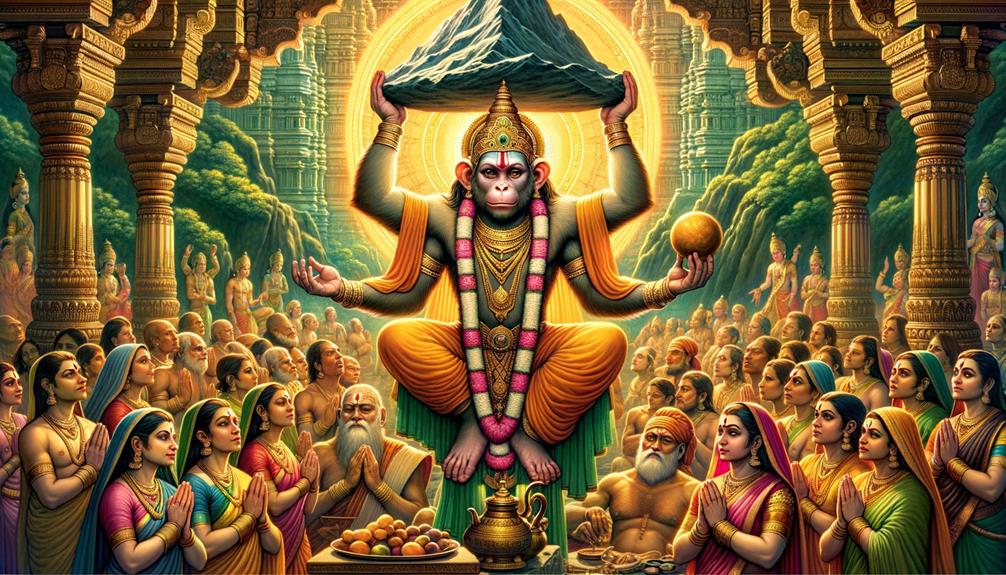
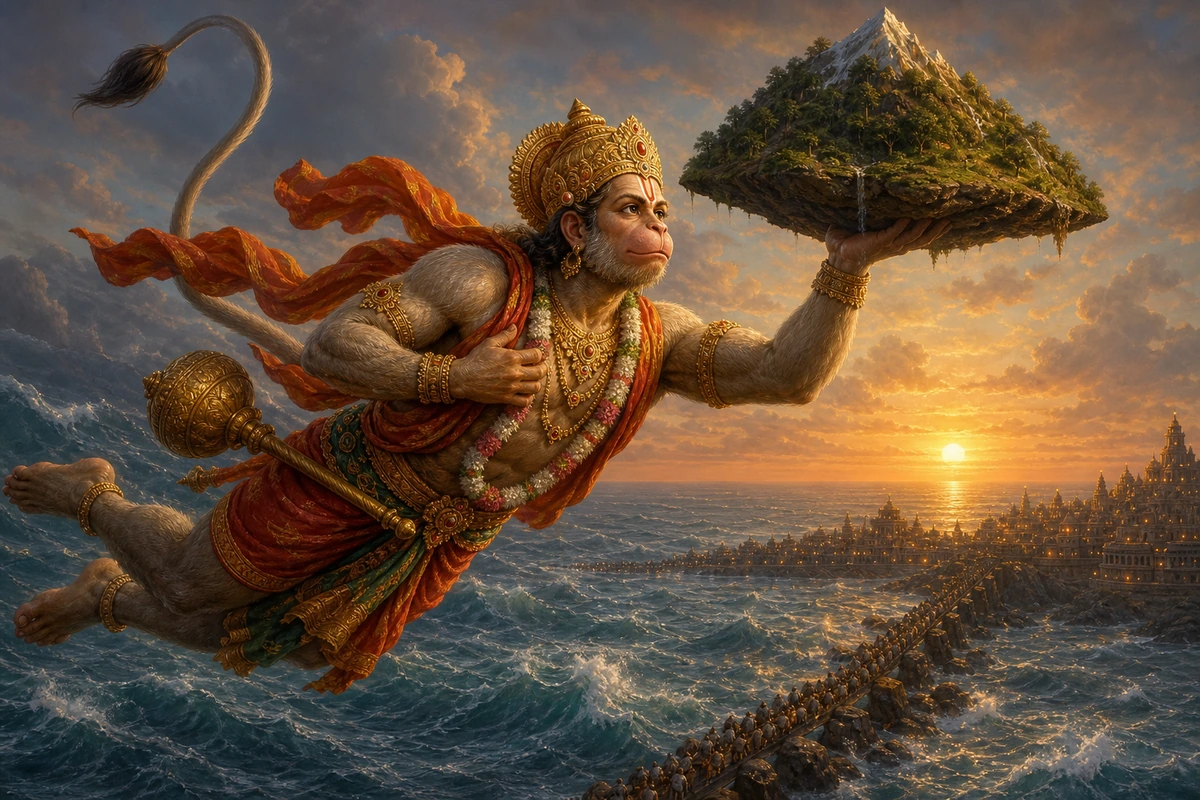
His best-known weapons and emblems—the mace and the medicine-bearing mountain—come from different moments in a long visual history. In worship he may appear standing humbly before Rāma, tearing open his chest to reveal Rāma and Sītā in later devotional imagery, leaping across the ocean, or carrying a mountain peak.
Meeting Rāma and serving Sugrīva
Hanuman first becomes essential to Rāma’s search while serving Sugrīva, the exiled vānara claimant to Kiṣkindhā. He approaches Rāma and Lakṣmaṇa in disguise and speaks with such learning, clarity, and control that Rāma praises his command of language. The meeting establishes that Hanuman’s greatest asset is not brute force. He is a perceptive envoy who can identify strangers, build trust, and connect two displaced rulers.
Hanuman brings the brothers to Sugrīva. Rāma helps Sugrīva regain his kingship from Vāli, and Sugrīva’s forces undertake the search for Sītā. The alliance involves grief, contested kingship, promises, delay, and renewed obligation. Hanuman remains the figure who turns that alliance into effective action.
The great leap to Laṅkā
At the southern coast, the search party learns that Sītā is in Laṅkā. Jāmbavān reminds Hanuman of his capacity, and Hanuman expands to a tremendous size before leaping from Mount Mahendra across the ocean. The Sundara Kāṇḍa devotes sustained attention to the journey.
Obstacles test different qualities. Mount Maināka rises from the sea and offers rest, but Hanuman politely honors it and continues. The nāga-mother Surasā demands that he enter her mouth; he first grows larger with her, then suddenly becomes tiny, enters and exits, satisfying the demand without abandoning the mission. The shadow-grasping Siṃhikā requires force. The episodes display courtesy, strategic flexibility, control of size, and combat judgment.
Calling the leap “flight” is convenient, though the poem repeatedly imagines an immense jump sustained through the air. Later art often shows Hanuman flying. Both expressions capture supernatural movement, but the epic’s athletic imagery matters.
Finding Sītā in the Aśoka grove
Hanuman searches Laṅkā at night and finds Sītā guarded in an Aśoka grove. Identification is delicate: he must approach without making a frightened captive think he is another deception by Rāvaṇa. He speaks of Rāma, presents Rāma’s ring, and receives a token and message to carry back.
Hanuman offers to take Sītā away himself in some tellings. She refuses, explaining reasons connected with the dangers of the escape, the honor of Rāma’s rescue, and her inability to endure the proposed journey. Her refusal is not helplessness. It helps define the terms under which she believes the conflict must be resolved.
As messenger, Hanuman confirms that Sītā is alive, establishes contact, assesses Laṅkā’s defenses, and gives hope to both sides of the sea. The whole war effort depends on the accuracy of his observation and report.
The burning of Laṅkā
After allowing himself to be captured in the course of his destructive reconnaissance, Hanuman is brought before Rāvaṇa. The court orders his tail wrapped in cloth and set alight. Hanuman escapes his bonds, moves across the city, and uses the burning tail to ignite buildings. The scene transforms an attempted humiliation into a weapon.
Retellings differ over the extent of the destruction, the protection of Sītā and Vibhīṣaṇa, and the theological reason the fire does not harm Hanuman. It is safer to say that he burns much of Laṅkā than to treat a later visual totality as a precise map of the epic city.
The episode is not simply exuberant chaos. Hanuman worries that anger may have endangered Sītā and seeks reassurance. That moment of self-scrutiny distinguishes purposeful strength from uncontrolled violence.
The medicine mountain
During the war in Laṅkā, Rāma, Lakṣmaṇa, and many vānara warriors are incapacitated. Jāmbavān sends Hanuman north for life-restoring herbs from a Himalayan peak. The plants are described as radiant and powerful, but Hanuman cannot reliably identify them—or they conceal themselves, depending on the telling.
Rather than return empty-handed, he lifts the mountain peak and carries it to the battlefield. The fragrance or application of the herbs restores the fallen. Texts and later regional traditions vary in the plant names, mountain name, route, and exactly who is healed. The popular name sañjīvanī is strongly associated with the episode, but the earliest epic passage lists multiple medicines.
The image captures Hanuman’s distinctive problem-solving. His strength serves an urgent life-saving purpose, while the decision to carry the whole source compensates for incomplete botanical knowledge.
Strength governed by devotion
Later bhakti traditions make Hanuman an exemplary devotee of Rāma. He acts without seeking Rāma’s throne, Sītā’s place, or independent glory. Service gives direction to extraordinary capacity. For worshippers, this combination of humility and strength makes Hanuman a model for discipline, courage, loyalty, and control of the senses.
That devotional ideal does not erase his epic personality. Hanuman jokes, threatens, debates, judges risk, experiences doubt, and makes tactical decisions. Reverence is expressed through competent action rather than passive obedience.
Traditions often regard him as a ciranjīvin, one who remains alive across ages, and say he is present wherever Rāma’s story is recited. The idea connects epic time with current worship: Hanuman is not only remembered but invited as a witness to devotion.
The Hanuman Cālīsā and living worship
The Hanuman Cālīsā, traditionally attributed to the poet Tulsīdās, is a forty-verse hymn in Awadhi that praises Hanuman’s knowledge, virtues, strength, and service to Rāma. It is later than Vālmīki’s Sanskrit epic and belongs to a different literary and devotional world. Its enormous popularity should not cause its details to be silently inserted into every account of the earliest Rāmāyaṇa.
Hanuman is worshipped across India and in Hindu communities worldwide. Tuesday and Saturday observances are common in many regions. Devotees seek courage, health, protection from fear and harmful forces, success in disciplined effort, and deepened devotion. Wrestlers and martial communities have also honored him as a patron of strength and celibate self-control.
Practices vary by lineage and place. Hanuman is often described as a celibate devotee, while some regional traditions give him a spouse or different domestic relationships. Diversity is part of the tradition, not an error that must be forced into one biography.
Hanuman across textual layers
| Textual or devotional context | Prominent Hanuman | Reading caution |
|---|---|---|
| Vālmīki Rāmāyaṇa | Envoy, searcher, warrior, healer, and strategist | The epic has its own layers and variant recensions |
| Regional Rāmāyaṇas | Episodes are expanded, localized, theologized, or retold | A beloved regional detail may not occur in every Sanskrit witness |
| Rāma-bhakti literature | Ideal devotee whose strength is wholly directed toward Rāma | Devotional interpretation is not merely a plot summary |
| Temple and popular iconography | Mace, mountain, open heart, kneeling service, protective presence | No one pose contains every part of his mythology |
| Contemporary global worship | Protector, source of courage, discipline, and relief from fear | Practice varies across regions, languages, and communities |
Frequently asked questions
Is Hanuman literally a monkey?
He is a vānara and is consistently represented with simian form or features. “Monkey” is the standard shorthand, but the epic vānaras are speaking, political, supernatural persons rather than ordinary animals.
Why did Hanuman carry a whole mountain?
He was sent to obtain healing herbs but could not identify or seize the correct plants. Carrying the entire peak ensured that the medicines reached the battlefield in time.
Did Hanuman burn all of Laṅkā?
The epic depicts extensive burning after his tail is set alight, but versions and images differ about the exact destruction. Sītā survives, and traditions often emphasize divine protection.
Is Hanuman an avatar of Śiva?
Some later traditions understand him as an aspect or incarnation of Śiva or Rudra. The Rāmāyaṇa and different theological schools do not all frame his identity in the same way.