
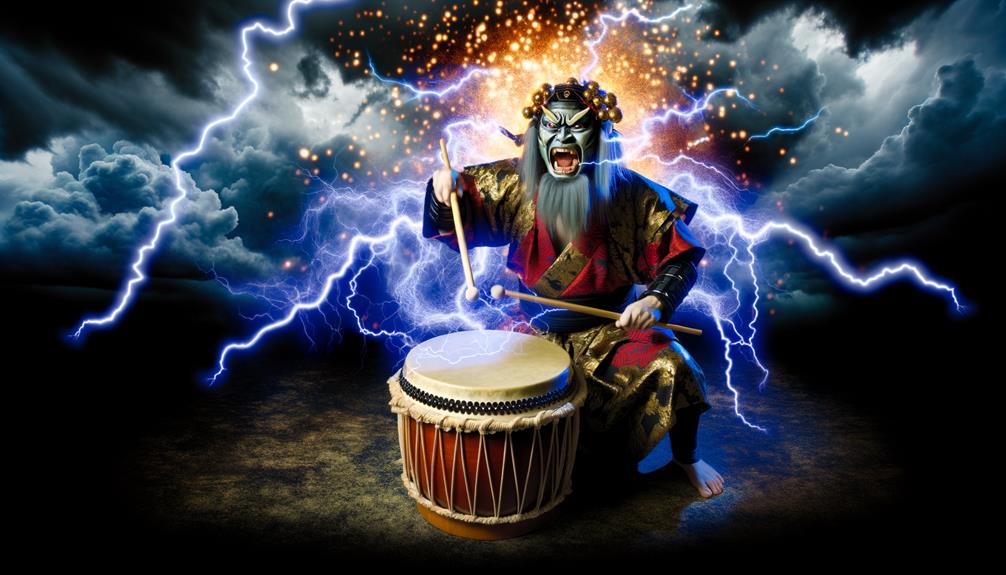
Raijin is the Japanese thunder deity, commonly shown amid drums that he strikes to create thunder. His imagery developed through Buddhist, Chinese, Japanese court, shrine, and popular traditions.
Raijin in the surviving tradition
The Kojiki and Nihon Shoki describe thunder kami associated with Izanami’s body in Yomi, but the familiar drumming Raijin image is a later visual synthesis. Paintings and sculptures show a fierce airborne figure with wild hair and a ring of drums. The appearance resembles an oni without making Raijin merely an evil demon.
Texts, objects, and evidence
Raijin is often paired with Fūjin, the wind deity carrying a great bag. The pair became famous through folding screens, temple guardians, festival art, and modern design. At Kyoto’s Sanjūsangen-dō, medieval statues of thunder and wind gods stand among a wider Buddhist sacred ensemble.
Key points
- Name: Rai means thunder and jin or shin means deity.
- Drums: The tomoe designs on drums reinforce motion and storm power.
- Agriculture: Thunder and rain can support crops while also threatening fire, flood, and injury.
- Protection tales: Stories about hiding the navel from Raijin are playful children’s warnings and vary by region.
How to read the material
Raijin is not a simple copy of Thor or Indra. Comparison can show common storm imagery, but Japanese religious history gives the figure a distinct setting.