
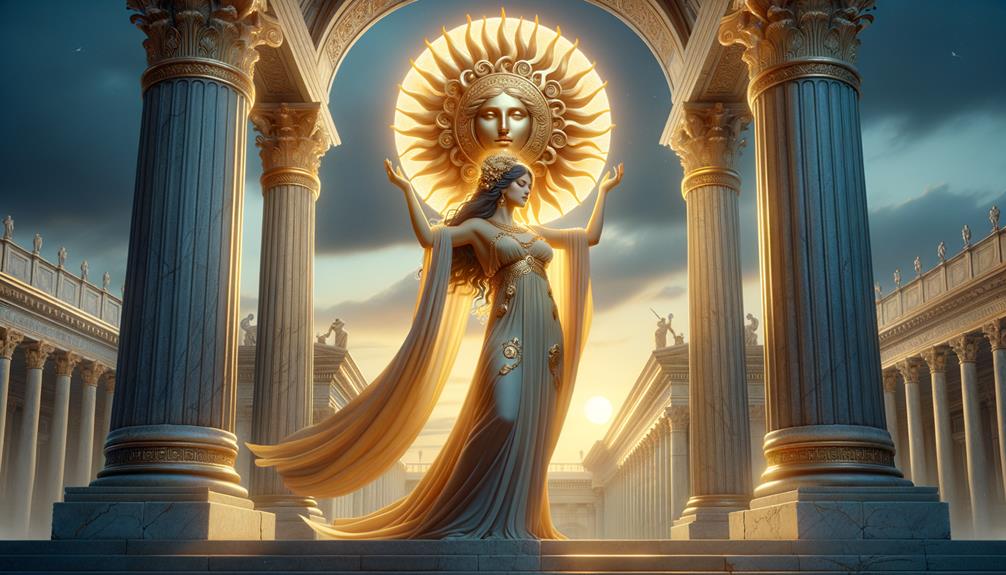
Hemera is the personification of Day in Greek cosmogony. She is easy to summarize in one sentence and easy to overstate in the next. Hesiod gives her a clear genealogy and a memorable place at the threshold shared by Night and Day, but surviving Greek literature does not provide a large cycle of adventures, a standard iconography, or evidence for a major independent cult.
Her importance is structural rather than dramatic. Hemera helps the cosmos keep time. She belongs to the generation in which darkness, light, night, and day become ordered realities, before the familiar Olympian family dominates the story.
Hemera’s genealogy in Hesiod
Near the beginning of Hesiod’s Theogony, Chaos is followed by primordial powers including Gaia, Tartarus, Eros, Erebus, and Night. Night unites with Erebus and bears Aether and Hemera. Aether is the bright upper air; Hemera is Day. The pairing gives darkness and night luminous counterparts without turning the process into a modern scientific explanation.
These are personified conditions of existence. Greek poetry can speak of Day as a divine female being while also using the ordinary word for the span of daylight. The boundary between deity, personification, and natural phenomenon is deliberately permeable.
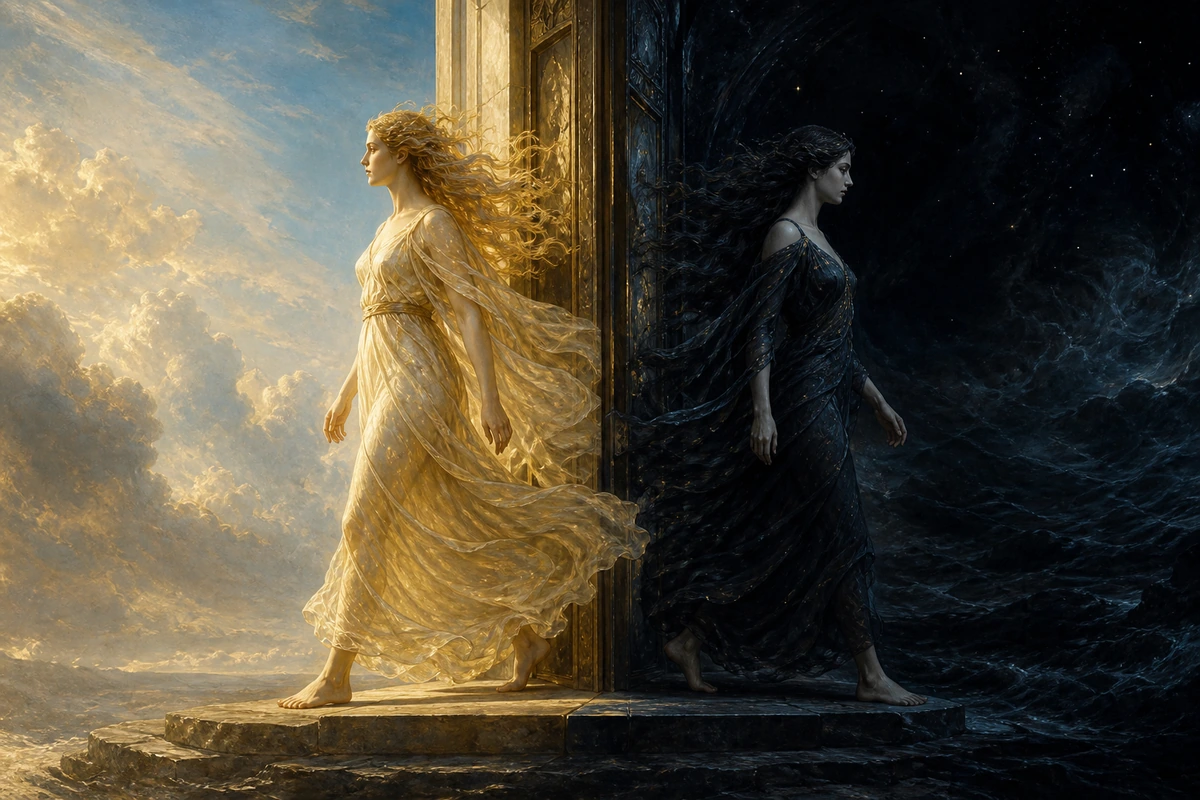
The bronze threshold of Night and Day
Hesiod later describes a remote and frightening cosmic region near the house of Night. There, Night and Day approach one another and exchange a greeting as they cross a bronze threshold. The house never contains them both: one travels over the earth while the other waits inside for her turn. Day carries light for those on earth; Night carries Sleep, the brother of Death.
The passage does not tell a conventional myth with conflict and resolution. It turns daily alternation into architecture and movement. Sunrise and sunset become a perfectly regulated exchange at the edge of the known cosmos. Hemera’s “action” is the dependable act of emerging, travelling, returning, and yielding place to Night.
Hemera, Eos, and Aether are not interchangeable
Hemera is often confused with Eos, goddess of Dawn. The distinction is useful: Eos marks the arrival of morning, while Hemera personifies Day more broadly. Eos has a richer narrative and visual tradition, appearing in stories involving Tithonus, Memnon, Cephalus, and the opening of heaven for the sun. Hemera’s surviving profile is more abstract.
Hemera is also distinct from Aether. Hesiod makes them siblings, both born from Night and Erebus, but Aether names the bright upper air associated with the gods while Hemera names the daylight period experienced through the ordered cycle. Later authors and mythographers could offer different genealogies or identifications. Greek mythology has variant traditions rather than a single binding canon.
Was Hemera a “primordial goddess”?
The label is useful if it means that Hemera belongs to an early cosmogonic generation and embodies a basic condition of the world. It can mislead if it suggests a formally defined ancient category whose members all shared the same worship or personality. “Primordial deity” is largely a modern organizing term.
Hesiod’s sequence moves from broad realities toward increasingly particular divine families. Day is already active before Zeus establishes Olympian kingship. That chronological position makes Hemera primordial in the ordinary scholarly sense, even though Hesiod does not stop to give her an elaborate biography.
What the sources do—and do not—support
| Claim | Evidence | Assessment |
|---|---|---|
| Hemera is the personification of Day | Her Greek name is the ordinary word for day, and Hesiod places her in a cosmic genealogy | Strongly supported |
| She is the daughter of Night and Erebus | Theogony 123–125 | Hesiod’s explicit genealogy; other cosmogonies may differ |
| She alternates with Night at a bronze threshold | Theogony 744–763 | Her principal surviving poetic scene |
| She is identical with Eos | Later summaries sometimes blur day and dawn | Not a safe universal statement; Hesiod treats the names as different figures |
| She had a major temple cult | No strong evidence for a widespread independent cult | Should not be claimed without a specific inscription or sanctuary |
| Her sacred symbols were a fixed list of flowers, metals, or animals | Mostly modern correspondences | Useful in modern practice, not established ancient iconography |
Cult and representation
No major sanctuary, festival calendar, or body of votive objects is securely associated with Hemera as an independent cult figure. This absence does not make her unreal within Greek religion. Many personifications function most clearly in poetry, genealogy, ritual language, or art without receiving the institutional profile of Athena, Apollo, or Demeter.
Likewise, modern images that show a radiant woman in white or gold are visual interpretations of “Day,” not copies of a canonical ancient statue. Ancient artists could personify time and cosmic divisions, but identifying an unlabeled female figure specifically as Hemera requires contextual evidence.
Why such a brief figure matters
Hemera shows how Greek cosmogony makes order imaginable. Day is not merely switched on by the sun; it has a place, a route, a relation to Night, and a rule that neither power violates. The two opposites do not defeat one another. Each occupies the world in turn.
That image also complicates a simplistic opposition between good light and evil darkness. Hesiod calls Night grim and places frightening beings near her, but the cosmic mechanism requires both Night and Day. Their greeting at the threshold presents alternation, not annihilation. Time depends on reciprocal limits.
Hemera in modern retellings
Contemporary myth dictionaries, fantasy works, and spiritual practices often give Hemera a fuller character, solar imagery, or a set of personal powers. Creative development is not inherently mistaken when it is labelled as interpretation. Problems arise only when new material is presented as a direct ancient tradition.
A historically grounded portrait can remain evocative. Hemera is the day that comes forth from the house of Night, crosses the world with light, and returns when Night begins her own journey. The surviving material is spare, but its central image is one of the clearest descriptions of cosmic rhythm in archaic Greek poetry.
Accuracy note and primary reading
The surviving evidence for Hemera is limited. This article centres Hesiod’s genealogy and threshold passage, distinguishes Hemera from Eos, and avoids assigning an undocumented cult or fixed iconography.