
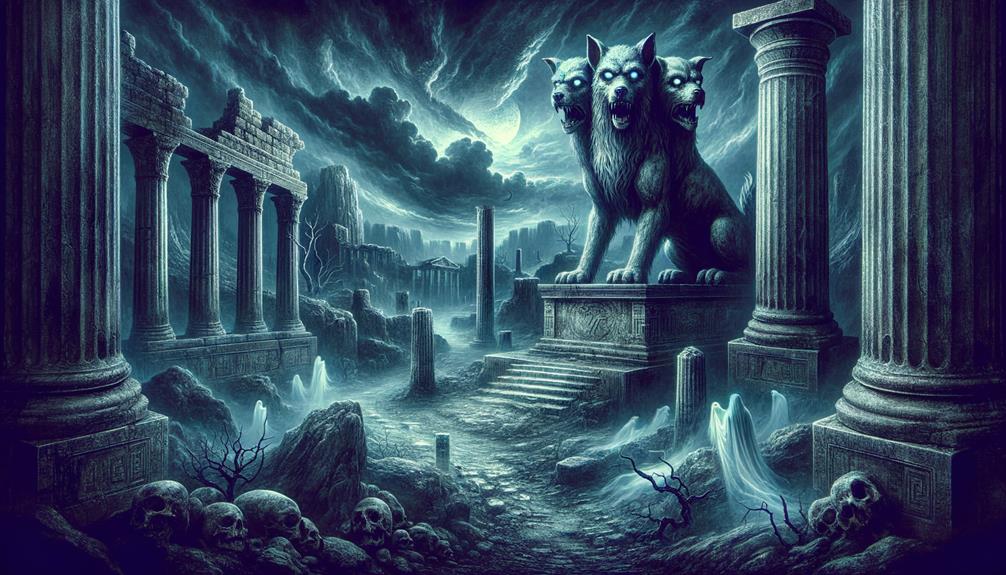
Cerberus—Greek Kerberos—guards the boundary of Hades. His basic function is often reversed in modern retellings: he is not chiefly a roaming predator sent to collect the living. He controls passage, confronting extraordinary visitors and preventing the dead from leaving the underworld.
Ancient poets and artists did not agree on one anatomy. A three-headed hound became the most familiar form, but some early texts give many more heads and artworks sometimes show two. Snakes may appear as a tail, mane, or growths along the body. Variation is part of the tradition, not an error to be corrected.
Family and changing appearance
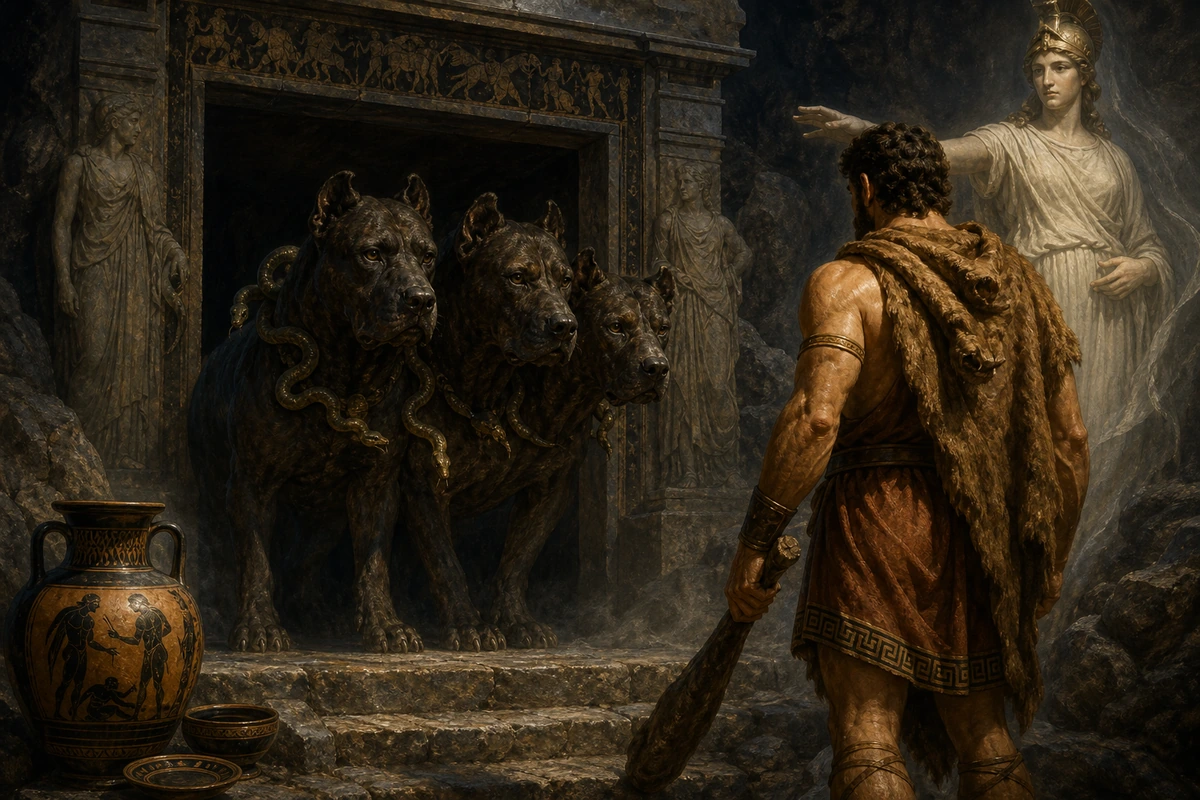
Hesiod’s Theogony makes Cerberus a child of Typhon and Echidna, alongside monsters connected with other heroic labors. Hesiod calls him fifty-headed. Later mythographic accounts commonly describe three dog heads, a serpent tail, and snake heads along his back. Vase painters chose forms that worked within a scene, sometimes showing fewer heads than a poem describes.
| Source or medium | Cerberus | Main emphasis |
|---|---|---|
| Hesiod, Theogony | Fifty-headed hound of Hades | Monstrous genealogy and excess |
| Archaic and Classical art | Often two or three visible heads, sometimes serpentine features | Readable encounter with Heracles |
| Apollodorus | Three dog heads, serpent tail, snakes on the back | Detailed final labor |
| Virgil’s Aeneid | Huge, triple-throated guardian subdued with a prepared cake | Aeneas’s authorized descent |
The popular claim that the name means “spotted” is an entertaining modern etymology, not a secure translation accepted by all linguists. The Greek name’s origin remains uncertain.
Heracles’ final labor
Bringing Cerberus to the upper world becomes the culminating labor of Heracles. In a common prose account, the hero receives permission from Hades to take the hound if he can master it without ordinary weapons. Heracles grapples with Cerberus, withstands the serpent’s attack, displays the captive to Eurystheus, and returns him.
Other tellings shorten or change the encounter. The point is not that Heracles permanently kills the guardian; Cerberus survives and resumes his place. The labor demonstrates a living hero’s exceptional power to cross the ultimate boundary and come back.
Orpheus, Psyche, and Aeneas
Later literature imagines other ways past the hound. Music associated with Orpheus can calm underworld powers. In Apuleius’s Roman novel, Psyche carries cakes during her descent and uses one for the dog. In Virgil’s Aeneid, the Sibyl throws Cerberus a cake prepared with soporific ingredients, allowing Aeneas to pass.
These are different narratives, not evidence for one standardized “Cerberus ritual.” Cakes did have funerary associations, but a literary device in an epic or novel should not be turned automatically into a universal Greek burial practice.
A guardian of categories
Cerberus gives the underworld a visible threshold. Gods may authorize a crossing, heroes may force or outwit it, and the dead remain subject to its rule. His dog form also draws on the familiar role of a watchdog while multiplying it into something no household could control.
Roman poets inherited Greek material and reshaped it for new journeys. Medieval and modern writers then placed Cerberus in other moral landscapes, most famously Dante’s gluttony circle. Those afterlives are influential, but Dante’s creature is not a direct transcript of Archaic Greek belief.
Accuracy note
This article treats head counts and serpentine traits as variant evidence. It does not claim that one image is the original design, that Cerberus permanently left Hades, or that every descent story used the same method to pass him.