
Brigid—Old Irish Brigit—is one of the best-known names in Irish tradition, but modern summaries often blend several different bodies of evidence into a single portrait. The medieval sources give us an Irish goddess connected above all with learned poetry, healing, and smithcraft; a separate and enormously influential Christian saint named Brigit; and later customs surrounding St Brigid’s Day and Imbolc. These strands interact, yet they should not be treated as if one ancient source described the entire modern “fire goddess” profile.
The most useful approach is therefore chronological. Start with what the Irish texts actually say, then distinguish medieval Christian tradition, later folklore, and modern religious interpretation. That method preserves Brigid’s importance without making the evidence more uniform than it is.
What Cormac’s Glossary says about Brigit
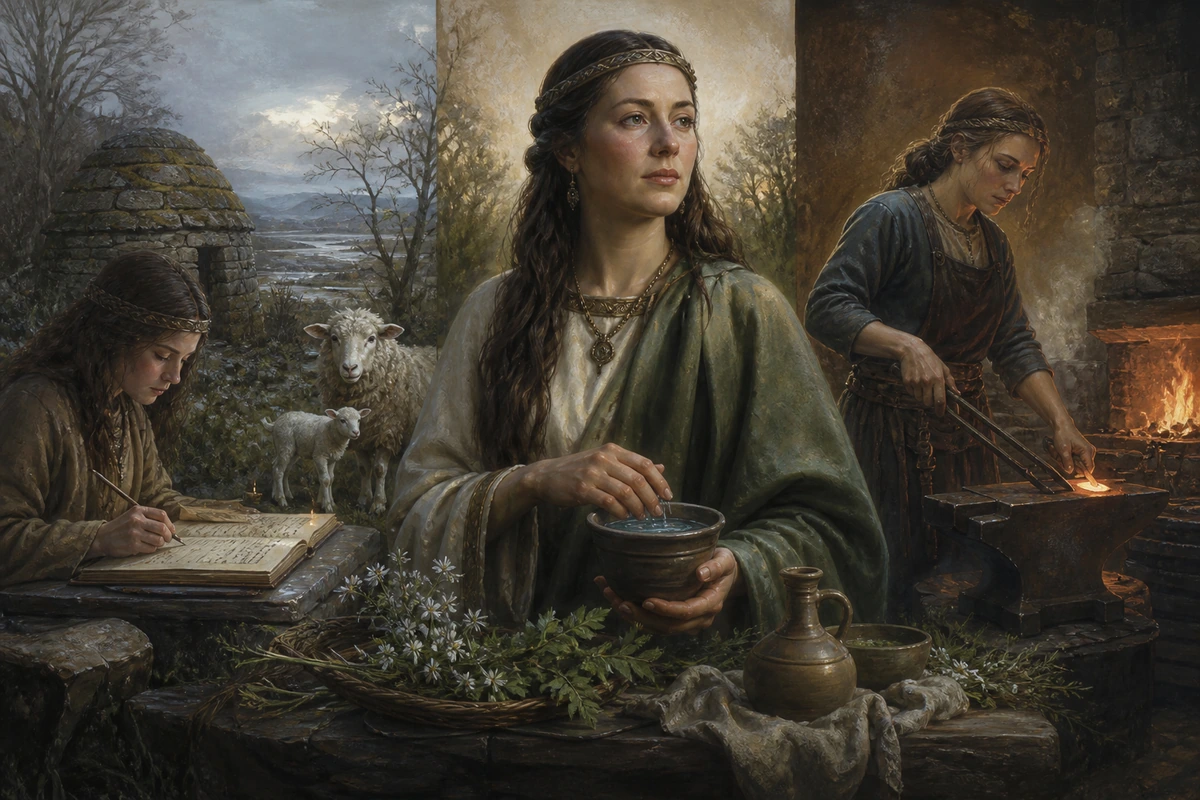
A celebrated entry in Sanas Cormaic, or Cormac’s Glossary, identifies Brigit as a poetess and daughter of the Dagda. It describes her as the goddess revered by poets and then names two other Brigits: a woman of healing and a woman of smithwork. The wording can be read as three sisters with the same name, three expressions of one divine name, or evidence that “Brigit” had become a title associated with exceptional female power. The text itself does not neatly settle that interpretive question.
What it does establish is unusually clear. Poetry, medicine, and smithcraft are not arbitrary modern additions: all three appear in a medieval Irish learned source. They are also skilled disciplines—verbal inspiration, bodily restoration, and transformative craft—rather than a loose list of natural forces.
Brigit in the Second Battle of Mag Tuired
The mythological tale Cath Maige Tuired places Brigit within the divine family of the Tuatha Dé. Ruadán is called the son of Bres and Brigit, daughter of the Dagda. Sent to spy on the Tuatha Dé’s craftsmen and healers, Ruadán attacks the smith Goibniu and is killed when the smith hurls the spear back. Brigit comes to mourn her son, and the tale presents her cry as an origin for lamentation or keening in Ireland.
This episode adds an important dimension to the goddess. Brigit is not only a catalogue of patronages. She appears as a mother caught across the conflict between the Fomorians and Tuatha Dé, and her grief becomes culturally creative: sorrow is turned into a patterned human practice. The scene also places her story directly beside smithcraft, although Goibniu—not Brigit—is the active smith in this episode.
Fire, Imbolc, and the limits of the evidence
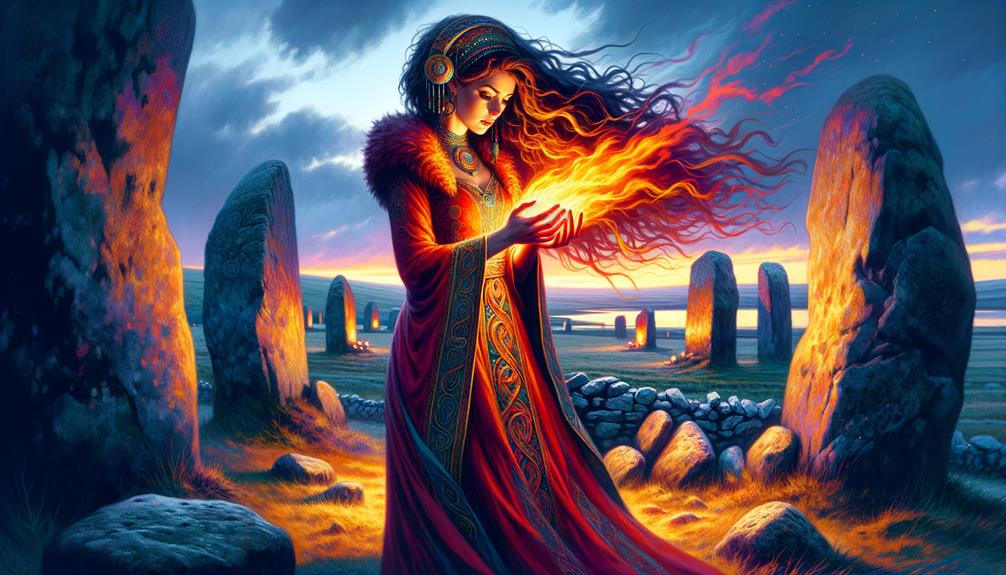
Brigid is now routinely called a goddess of fire. That description is understandable, but its ingredients come from different periods. Smithcraft requires controlled heat; later accounts connect St Brigit’s community at Kildare with a maintained flame; and candles, hearths, and returning light suit the seasonal symbolism attached to the beginning of February. Together these associations make fire a powerful Brigid symbol. They do not prove that an early Irish pagan text assigned her a single, all-encompassing office as “goddess of fire.”
Imbolc is one of the traditional Irish quarter days and falls at the opening of February, close to the Christian feast of St Brigit on 1 February. Later Irish and Scottish customs link the season with Brigid or Bride, domestic preparation, livestock, weather signs, and the first indications of spring. The exact relationship between the pre-Christian festival, the goddess, the saint, and regional folk practices is debated. It is safest to say that Brigid became the defining figure of this seasonal complex, not that every recorded custom is an unchanged survival from pagan antiquity.
Goddess Brigit and Saint Brigit
Saint Brigit of Kildare belongs to Christian hagiography. Her Lives describe a holy woman associated with Kildare, generosity, food production, livestock, healing miracles, and religious authority. Some motifs resemble ideas attached to the earlier divine name, and the shared name is undeniable. Scholars nevertheless differ over how to explain the overlap. Possibilities include deliberate Christian adaptation, the attraction of older motifs to a famous saint, the development of both traditions within the same cultural environment, or a combination of these processes.
Calling the saint “simply the goddess converted into a Christian figure” goes beyond what the surviving evidence can demonstrate. Treating the two as wholly unrelated is equally unsatisfying. The responsible conclusion is that their traditions became deeply entangled while remaining distinct bodies of evidence.
Brigid’s attributes by evidence layer
| Theme | Strongest evidence | How cautiously to state it |
|---|---|---|
| Poetry and learned inspiration | Cormac’s Glossary explicitly calls Brigit a poetess and goddess of poets | This is one of her clearest textual associations |
| Healing | The glossary names Brigit the woman of healing or medicine | The text may describe a sister, an aspect, or a shared divine name |
| Smithcraft | The glossary names Brigit the woman of smithwork | Clearly attested, but not a license to attach every smith myth to her |
| Kinship | The glossary and Cath Maige Tuired call her daughter of the Dagda | A stable part of her medieval Irish genealogy |
| Fire and perpetual flame | Smith symbolism and later Kildare traditions | Important in reception; the evidence is layered rather than a single pagan doctrine |
| Imbolc and early February | Calendar proximity and later custom centred on Brigid/Bride | A strong traditional association whose precise antiquity is difficult to reconstruct |
How Brigid is understood today
Modern devotion, literature, and art often unite poetry, healing, the forge, the hearth, wells, livestock, and spring renewal around Brigid. This synthesis has genuine roots in Irish tradition even when every element is not equally old or equally explicit. For readers, the distinction between source and reception is not a reason to discard the later image. It shows how a divine name could remain productive across manuscript culture, Christian devotion, folklore, national revival, and contemporary spirituality.
Brigid’s enduring force lies in the relationship among her core arts. A poem gives form to insight, healing restores a damaged body, and smithing reshapes raw material through knowledge and heat. Each is a disciplined act of transformation. That pattern explains her coherence better than a simple list of “domains,” and it remains visible even when the evidence is read with appropriate caution.
Accuracy note and further reading
This article distinguishes the medieval mythological Brigit, Saint Brigit, later seasonal custom, and modern interpretation. Spellings vary by language and period; “Brigid” is used here as the familiar English form, while “Brigit” appears when discussing Old Irish texts.