
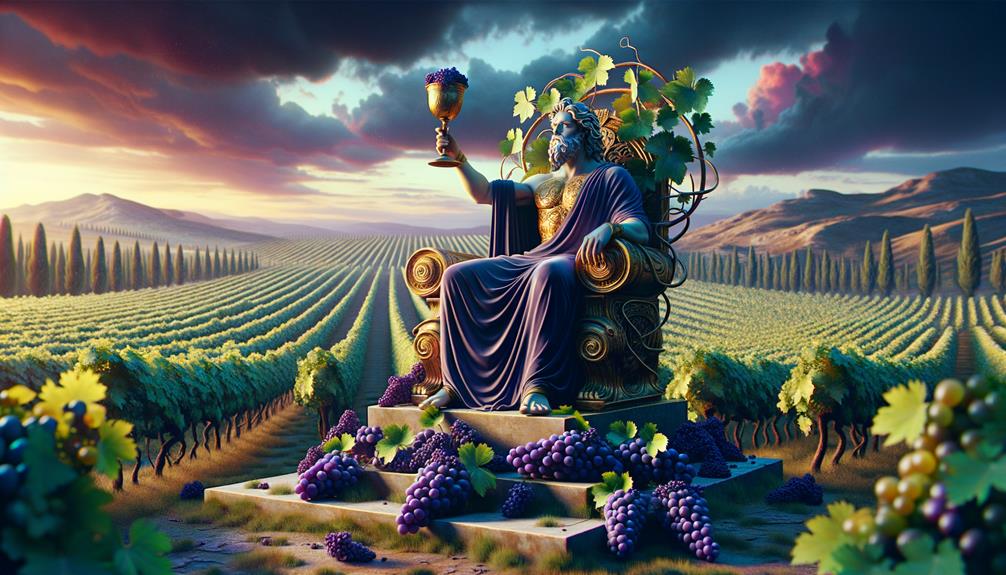
Dionysus is the Greek god of wine, the vine, procession, theater, ecstatic experience, and transformations that loosen ordinary identity. Ancient worship could be celebratory, civic, competitive, initiatory, or terrifying. Calling him merely a party god misses the disciplined cultivation of wine, the institutions of drama, and the danger attached to divine possession.
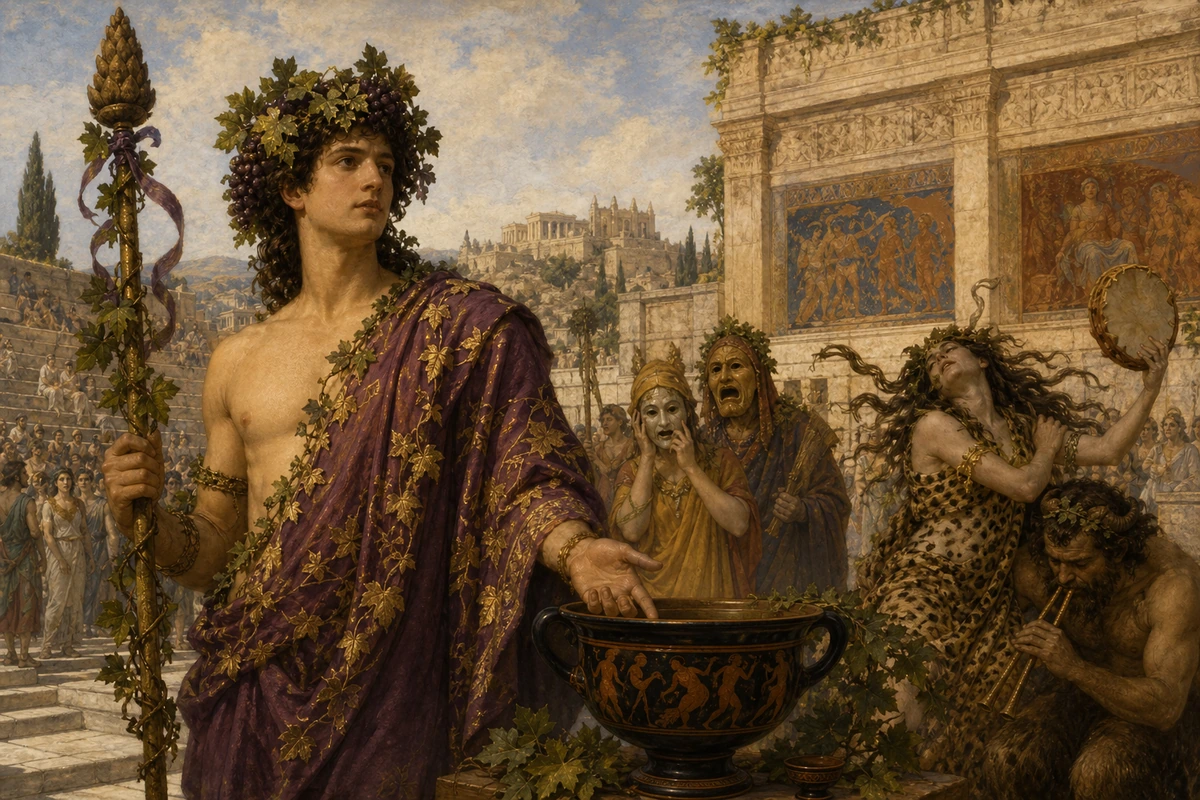
His images range from a mature bearded god to a youthful, long-haired figure. Ivy, grapevine, the thyrsus, drinking vessels, panthers, satyrs, and maenads identify him, but no single appearance belongs to every century.
Birth traditions
In the best-known story, Dionysus is the son of Zeus and the mortal Semele. Hera’s intervention leads Semele to demand that Zeus reveal himself fully; the divine display destroys her. Zeus rescues the unborn child and carries him in his thigh until a second birth, making Dionysus both mortal-connected and divinely reborn.
Ancient traditions also speak of Dionysus in other genealogies and forms. Material commonly called Orphic connects a divine child, sometimes named Zagreus, with dismemberment and renewed life. The evidence comes from texts of different dates and settings. It should not be fused into one original secret biography.
| Sphere | Dionysian role | What simplification misses |
|---|---|---|
| Wine | Growth, fermentation, mixing, fellowship, and altered consciousness | Ancient wine culture valued preparation and social rules as well as intoxication |
| Theater | Festival patronage of chorus, tragedy, comedy, and public competition | Drama was a civic and religious institution, not modern entertainment alone |
| Ecstasy | Leaving ordinary social or mental boundaries | Ecstasy could be ordered by ritual and could also become dangerous |
| Mystery and afterlife | Initiatory hopes attested in some texts and burials | Not every Dionysian worshipper belonged to one universal mystery church |
Gift and danger of wine
Wine makes Dionysus a giver of cultivated pleasure, but Greek practice normally mixed wine with water in a krater. The god’s gift therefore carried a lesson about proportion, hospitality, and social order. Myths repeatedly show what happens when communities reject the god or fail to recognize his power.
Euripides’ Bacchae makes that tension central. Pentheus tries to suppress the new cult at Thebes and becomes fascinated by what he condemns. Dionysus overturns categories of stranger and citizen, male and female, human and animal, observer and participant. The king’s destruction is not a generic warning against fun; it is a tragedy about denial, control, and divine power.
Theater and civic festival
At Athens, festivals including the City Dionysia and Lenaia hosted choruses and dramatic competitions. Tragedies and comedies were performed before the community within a sacred festival framework. Dionysus’s association with masks suits a god who changes identity, but theater was supported by civic organization, financing, judging, and ritual procession.
Rural Dionysia and local cults varied across Attica and the Greek world. There was no single annual festival duplicated everywhere.
Maenads, satyrs, and worshippers
Maenads in myth and art leave domestic space, carry thyrsoi, dance, and sometimes display violent power. Satyrs embody comic, sexual, musical, and unruly aspects of the god’s company. Images do not provide a documentary photograph of what every female worshipper or performer did. Mythic companions, ritual participants, and theatrical roles overlap but should not be equated automatically.
Dionysus, Bacchus, and Liber
Romans identified Dionysus with Bacchus and connected him with the Italian god Liber. The names and cults overlap extensively, yet Roman regulation, festival practice, and literature created new contexts. The Senate’s action against Bacchic associations in 186 BCE belongs to Roman political and religious history, not to a timeless Greek ban on Dionysus.
Accuracy note
This article keeps Semele’s son distinct from attempts to reconstruct one complete Orphic narrative, separates mythic maenads from documentary ritual practice, and treats Greek Dionysus, Bacchus, and Liber as historically overlapping rather than perfectly interchangeable.