
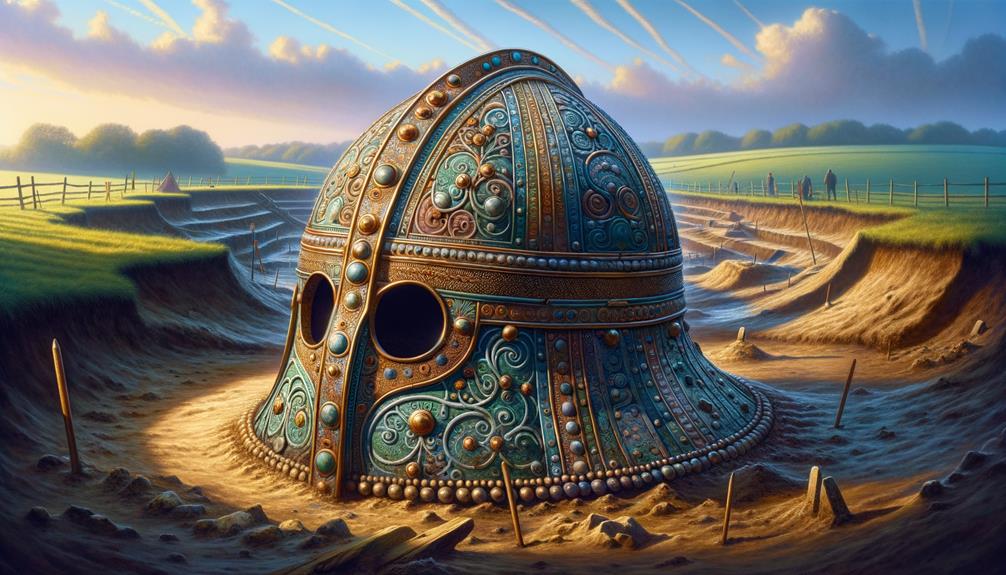
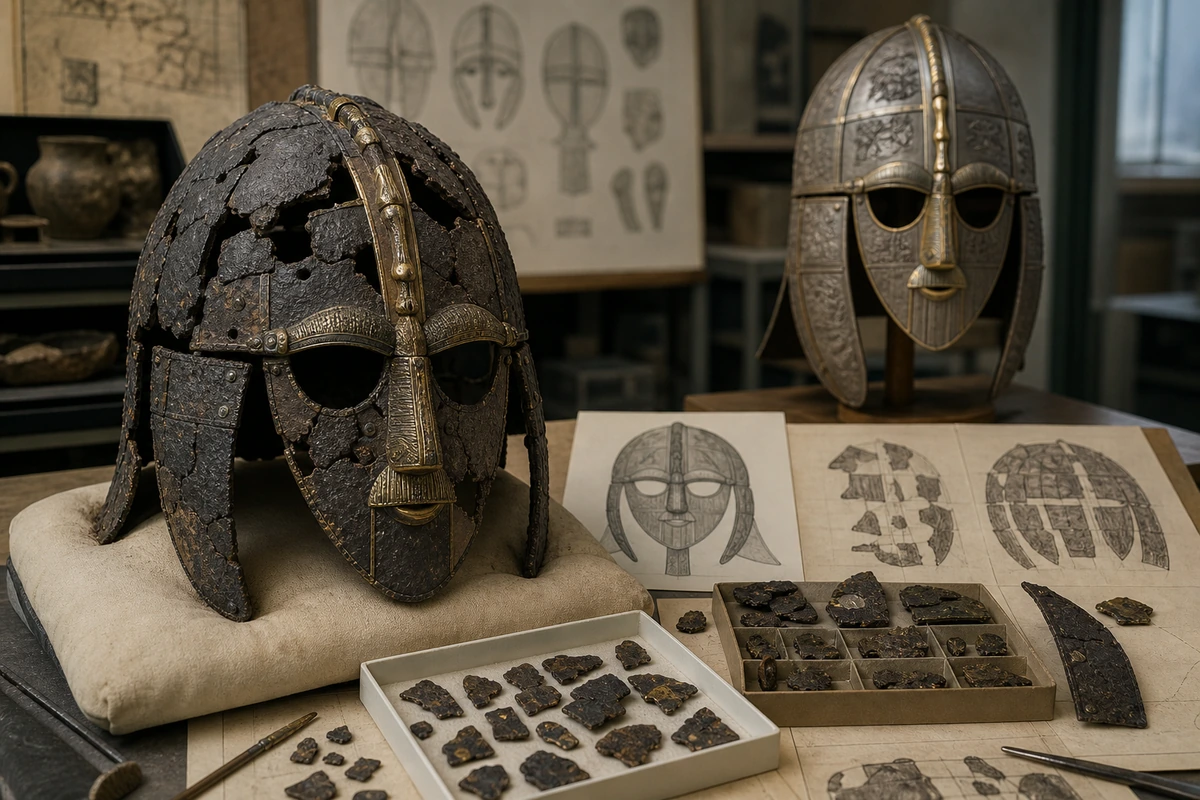
The Sutton Hoo helmet is an icon of early medieval England, but the object seen in the British Museum is also a triumph of modern reconstruction. The helmet was recovered not as an intact piece of armor but as hundreds of corroded iron and decorated metal fragments from the great ship burial in Mound 1 at Sutton Hoo, Suffolk. Conservators had to determine how those fragments once formed a face, a dome, cheek-pieces, and a neck-guard.
Made in the early seventh century, the helmet belonged to a burial of extraordinary wealth and political importance. Its owner is often linked with an East Anglian king, especially Rædwald, but the grave contains no inscription naming the dead person. “Royal burial” is a strong historical interpretation; a definite personal identification is not.
The helmet in the ship burial
Excavated in 1939, Mound 1 contained the impression and surviving fastenings of a long ship hauled onto land and covered by a mound. At its center was a burial chamber filled with weapons, feasting equipment, silverware, gold dress fittings, coins, and objects made across a wide geographic network. Acidic soil had destroyed most of the body, timber, and textiles, but the surviving arrangement established the burial’s exceptional status.
The helmet combined iron protection with a brilliant decorated surface. The British Museum records iron, copper alloy, gold, tin, garnet, and silver among its materials. Tinned copper-alloy panels would have flashed pale against gilded and garnet details. The structure included a domed cap, cheek-pieces, a face mask, and a neck-guard. A crest crossed the crown and ended in animal heads.
A face made from animals
Viewed from the front, the helmet creates a human face. The nose and eyebrows are also parts of a flying creature: the eyebrows can be read as wings, the nose as a body, and an animal head above the moustache area as the creature’s head. Garnets form striking eye details. This double image merges the wearer’s face with protective and predatory animal forms.
The surface panels use what archaeologists call Style II animal ornament, in which elongated creatures interlace and dissolve into ribbons. Two repeated figural designs have received descriptive modern names. The Dancing Warriors panel shows paired armed figures in dynamic movement. The Fallen Warrior panel depicts a mounted warrior above a fallen figure who drives a weapon toward the horse. These labels help identify the patterns; they are not surviving Anglo-Saxon titles.
Parallels with helmets and decorated metalwork from Sweden show that elite communities across the North Sea shared visual languages. That does not make the helmet “Viking.” Sutton Hoo predates the conventional beginning of the Viking Age by more than a century and belongs to an Anglo-Saxon kingdom with extensive Scandinavian connections.
From more than 500 fragments to a recognizable helmet
The first reconstruction was completed in 1947. It created a dramatic, recognizable helmet, but later study showed that several features and proportions were wrong. The reconstruction was dismantled in 1968. Conservator Nigel Williams and colleagues then spent about a year re-examining the fragments and their joins before completing the second reconstruction in 1971.
| Stage | Evidence and decision | Why it matters |
|---|---|---|
| Excavation, 1939 | Corroded fragments recorded from the Mound 1 burial chamber | Find position and associations anchored the object in the ship burial |
| First reconstruction, 1947 | Fragments assembled into an initial helmet form | Made the object intelligible but included errors in shape and placement |
| Reassessment, 1968–1971 | Old support removed; joins, curvature, and fragment relationships re-studied | Produced the reconstruction now associated with the helmet |
| Replica and continuing research | Modern copies test appearance and manufacturing possibilities | Replicas clarify the design but must not be mistaken for the ancient surface |
The present museum object combines ancient fragments with a modern support shaped to hold them. That support is not an attempt to deceive. It makes the surviving material stable and shows the structure that best fits the evidence. At the same time, every reconstruction contains judgments. Missing portions are not evidence, and a polished replica can look more certain than the archaeology permits.
Armor, identity, and ceremony
The helmet could provide physical protection, but its value went far beyond utility. Precious materials, labor, animal imagery, and martial scenes created a public identity for a ruler or elite warrior. The face mask transformed the wearer into something more than an ordinary combatant. In a hall or ceremony, reflections from tin, gold, and garnet would have made the object visually commanding.
Its inclusion in a burial removed a rare piece of military equipment from circulation and connected the dead person with warfare, leadership, ancestry, and long-distance alliances. Whether the helmet had been used in battle cannot be established simply from its burial. Objects can carry ceremonial and practical roles at different moments in their lives.
What the helmet can tell us
Sutton Hoo overturned older stereotypes of post-Roman Britain as isolated or artistically impoverished. The burial’s materials connect East Anglia with Scandinavia, the eastern Mediterranean, and the Frankish world. The helmet’s design shows highly trained metalworkers combining structural ironwork with stamped foils, interlace, animal ornament, and stone setting.
Yet the object does not give us a full biography of its owner or maker. Archaeology works from surviving relationships: material, style, wear, placement, and comparison. The most responsible account preserves that uncertainty instead of turning a probable royal context into a named king’s proven possession.
Accuracy note
The British Museum’s catalog record controls the description of materials, construction, and imagery. Dates for the reconstructions follow the museum and conservation histories. Rædwald is presented as a possible identification, not a fact, and the helmet is described as Anglo-Saxon rather than Viking.