The Cyrus Cylinder is a Babylonian royal inscription created after Cyrus II of Persia captured Babylon in 539 BCE. Its cuneiform text celebrates Cyrus, condemns the previous king Nabonidus, credits the Babylonian god Marduk with choosing the conqueror, and presents restoration of temples, cult images, and displaced communities as marks of legitimate rule.
It is historically important, but it is not a modern bill of rights. The phrase “first human-rights charter” arose from the object’s much later political reception. Reading the cylinder in its ancient genre makes Cyrus’s policies clearer without requiring either worshipful legend or cynical dismissal.
What the object is
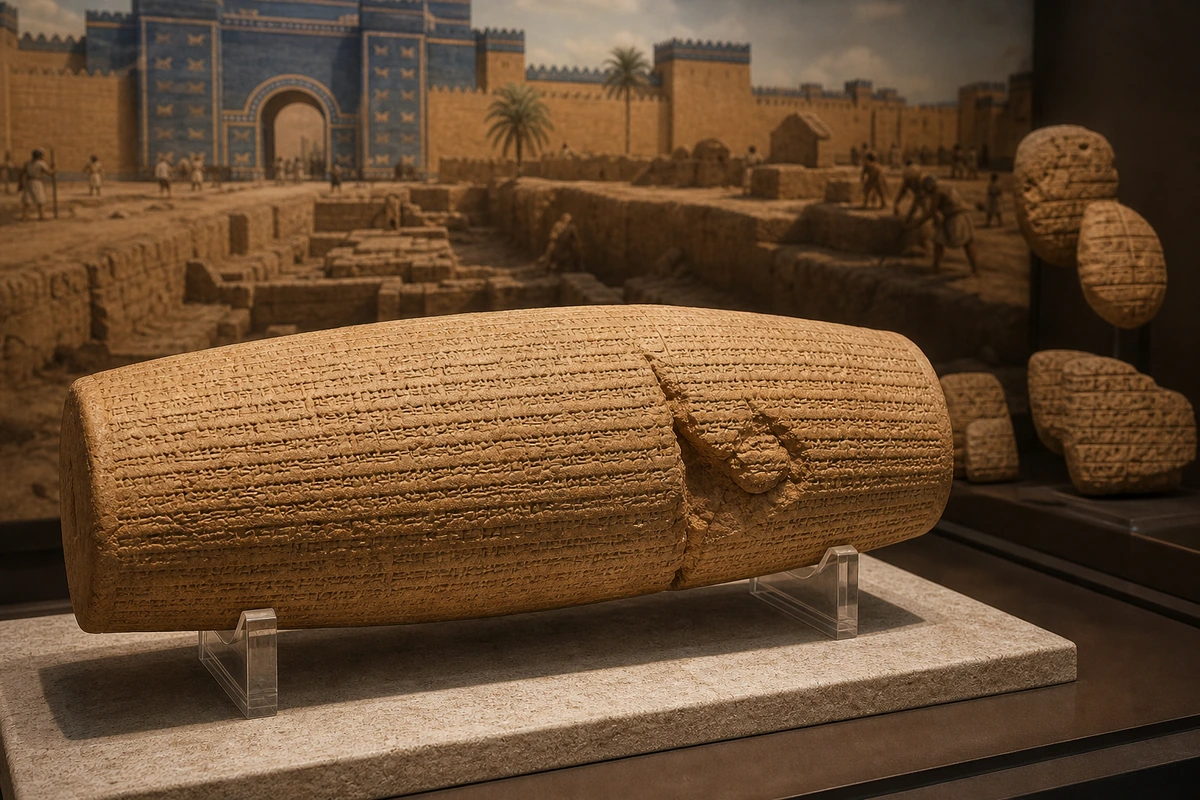
The incomplete baked-clay cylinder is written in Babylonian Akkadian using cuneiform script. Hormuzd Rassam excavated it at Babylon in 1879 during work for the British Museum. Its form and text identify it as a foundation deposit: an inscription intended to be buried in the fabric of a major building project, in this case associated with the city wall, rather than displayed in a public square for citizens to sign or consult.
Foundation inscriptions addressed gods, future kings, and posterity. They recorded building works and shaped royal memory. The cylinder belongs to that Mesopotamian tradition even though its ruler came from outside Babylonia.
| What the text says | Ancient function | Common overstatement |
|---|---|---|
| Marduk rejected Nabonidus and chose Cyrus | Divine legitimation for a new king of Babylon | An objective chronicle of the conquest |
| Cyrus entered Babylon peacefully and relieved burdens | Ideal royal self-presentation | A neutral record of every person’s experience |
| Cult images and displaced peoples were returned | Restoration of local sanctuaries and stable imperial rule | Universal freedom of religion as a legal right |
| The city wall was repaired | Conventional proof that the king fulfilled Babylonian duties | A constitutional program for all later governments |
Marduk and the fall of Nabonidus
The inscription begins in a voice that portrays Nabonidus as impious and oppressive. Marduk, patron god of Babylon, searches for a righteous ruler and selects Cyrus. Babylon accepts the new king joyfully, after which Cyrus speaks in the first person and lists royal titles, genealogy, piety, peace, restoration, and building work.
This presentation helped a foreign conqueror become a proper Babylonian king. It should be compared with other Mesopotamian royal texts that blame a defeated predecessor and show the victor restoring divine and civic order. “Propaganda” is appropriate if it means purposeful political self-presentation, not that every described action was invented.
Return and restoration
Cyrus states that he returned divine images to sanctuaries from which Nabonidus had gathered them and resettled associated peoples. Such measures could win support from temples, repair disruptions, and make provincial administration more stable. They were significant reversals in particular communities even though they were framed as royal favor rather than an equal right possessed by every human being.
The biblical book of Ezra also presents Cyrus authorizing the Jerusalem temple’s restoration and the return of exiles. This is an important comparison for Achaemenid policy. The cylinder itself, however, does not name Judah, Jerusalem, or Jewish deportees. It cannot serve as a direct duplicate of the decree quoted in Ezra.
Why “first human-rights charter” is misleading
Modern human rights are framed as universal claims held by individuals and protected through law regardless of a ruler’s favor. The cylinder announces a king’s virtues, divine selection, local restorations, tribute, and building activity. It neither defines universal rights nor creates institutions through which subjects could enforce them.
The British Museum explicitly notes that the concept would have been alien to the cylinder’s contemporaries and that the text says nothing about human rights. That does not make the return policies unimportant. It places them in a world of temple-centered kingship and imperial strategy, where beneficence strengthened authority.
The modern life of the cylinder
In the twentieth century the artifact became a powerful emblem of Iranian national history. Mohammad Reza Shah’s 1971 celebration of 2,500 years of Persian monarchy promoted it as an early charter of liberty. A replica was presented to the United Nations, and translations and exhibitions broadened the human-rights association.
That modern reception is part of the object’s history, but a later symbolic use is different from the ancient text’s genre. The UN display demonstrates the cylinder’s global reputation; it does not retroactively turn a foundation inscription into a United Nations-style declaration.
What the cylinder genuinely demonstrates
The inscription shows an Achaemenid conqueror adopting Babylonian language, theology, titles, and royal conventions. It documents how restoration could be used to secure a diverse empire. It also provides a contemporary ideological counterpart to later Greek and biblical memories of Cyrus as an unusually favorable ruler.
Its fame has opened valuable conversations about tolerance, displacement, religious institutions, and political memory. Those conversations become stronger when the ancient evidence and modern ideals are not collapsed into each other.
Accuracy note
This article describes the cylinder as a royal foundation inscription, not a neutral administrative report or universal rights code. It recognizes meaningful restoration policies while distinguishing them from enforceable modern human rights. It also separates the cylinder’s own wording from the biblical account of Jerusalem.