cauldron of mythical rebirth

Cauldron of Rebirth: Branwen, Silent Warriors, and the Cost of War

The Cauldron of Rebirth, or Pair Dadeni, is one of the most unsettling treasures in Welsh storytelling. In Branwen, daughter of Llŷr, the Second Branch of the Mabinogi, it restores fallen warriors to life—but not to speech. What first appears to be a generous gift becomes an instrument that prolongs a catastrophic war.

Its story is more specific than the familiar idea of a magical pot that grants immortality. The cauldron belongs to a narrative about a broken marriage alliance, escalating revenge, and an attempt to repair damage that comes too late. The account below follows Charlotte Guest’s translation of Branwen; spellings of the characters’ Welsh names vary between translations.

How the cauldron reaches Ireland

Matholwch, king of Ireland, marries Branwen, sister of Bendigeidfran, the king of Britain. Their half-brother Efnisien resents not being consulted and mutilates the Irish king’s horses. Bendigeidfran offers compensation to preserve the alliance. Alongside replacement horses and precious metal, he gives Matholwch the remarkable cauldron.

Bendigeidfran explains its power precisely: a man killed one day can be placed inside it and restored the following day, except that he will no longer be able to speak. The tale does not say that the revived warriors lose their souls, become immortal, or recover from every imaginable injury. Those additions go beyond what this episode actually states.

The vessel already has an Irish history. Bendigeidfran received it from Llassar Llaes Gyfnewid and his wife, who had fled Ireland. Matholwch recalls first encountering the huge man emerging from a lake with the cauldron on his back. Later, after conflict with the couple and their household, the Irish attempted to burn them in an iron house. The pair escaped and found refuge in Britain.

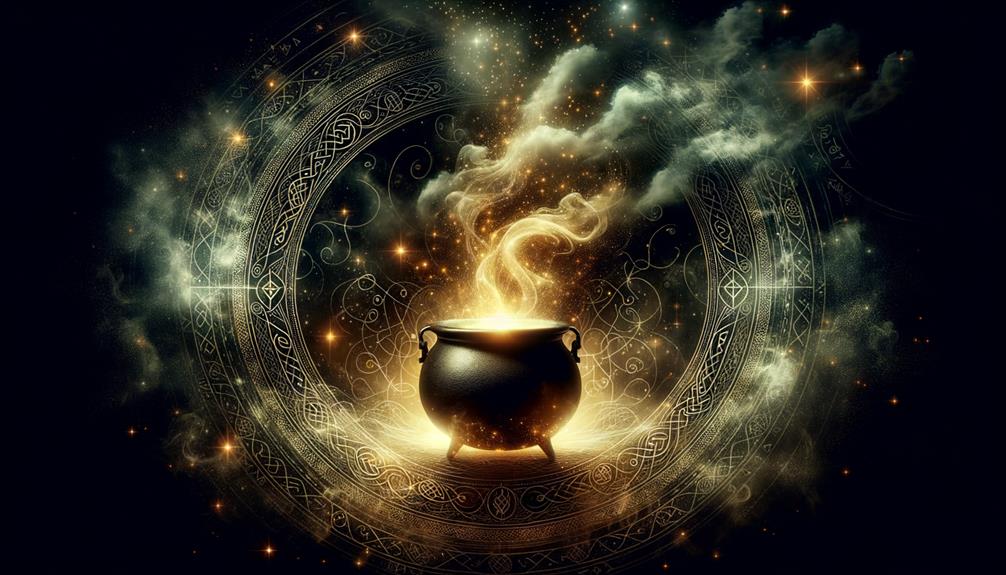
Original AI-generated illustration inspired by the cauldron in the Second Branch of the Mabinogi; an imaginative scene, not a reconstruction of an excavated object.

A gift becomes a weapon

The marriage does not secure lasting peace. Branwen is mistreated in Ireland and sends a trained starling to alert her brother. Bendigeidfran crosses the sea with an army. A proposed reconciliation then collapses at a feast when Efnisien throws Branwen’s young son, Gwern, into the fire.

In the fighting that follows, the Irish use the cauldron to restore their dead. The warriors return ready for battle but unable to speak. The gift intended to settle one violent insult now gives one side a devastating advantage in a much larger conflict. Cadw’s account of Branwen places the cauldron within this wider tragedy rather than treating it as an isolated magical artifact.

How Efnisien breaks the Cauldron of Rebirth

Efnisien sees that his own people are not being restored and recognizes the calamity his actions have helped cause. He conceals himself among the Irish dead and is placed inside the vessel. Stretching himself with enormous force, he breaks the cauldron into four pieces; the effort also bursts his heart.

This act ends the cauldron’s use, but it does not undo the war. Only seven men of Bendigeidfran’s company survive to return, accompanied by Branwen. Their mortally wounded king orders them to carry his severed head home. Branwen herself dies of grief. Efnisien’s final action is therefore not a neat victory that restores the world to its earlier condition. Readers can encounter the cauldron-breaking passage in Welsh and English through Cambridge’s Spoken Word resource.

What does the cauldron mean?

One compelling reading is that the vessel exposes the difference between replenishing an army and repairing human relationships. It can return bodies to the battlefield, but it cannot reverse Branwen’s suffering, save Gwern, or restore peace. Its silence makes the promise of rebirth troubling rather than uncomplicated.

That is an interpretation of the story, not a surviving explanation supplied by its narrator. The most secure starting point is the narrative itself: the revived warriors cannot speak, the fighting continues, and the cauldron is finally destroyed through self-sacrifice.

Is it the same as the Gundestrup Cauldron?

No. The Gundestrup Cauldron is an actual silver vessel discovered in Denmark in 1891, whereas the Cauldron of Rebirth is a treasure in a Welsh tale. The National Museum of Denmark discusses the archaeological vessel’s discovery and debated origins. Similarities between imagery and stories may invite comparison, but they do not establish that the excavated object is Branwen’s cauldron—or that either explains the other.

Scroll to Top