
Tezcatlipoca, whose name is commonly translated as “Smoking Mirror,” was a major deity of the Mexica and other Nahua-speaking peoples of central Mexico. He is associated with rulership, conflict, creation, and powers that humans cannot easily see or control. Calling him only a trickster obscures the breadth of his religious importance.
His identity is best approached through particular images, prayers, and ritual accounts. These sources do not present a single, tidy character biography. They show a deity addressed in different ways for different purposes, including exceptionally elevated language about his power.
The Smoking Mirror and recognizable attributes
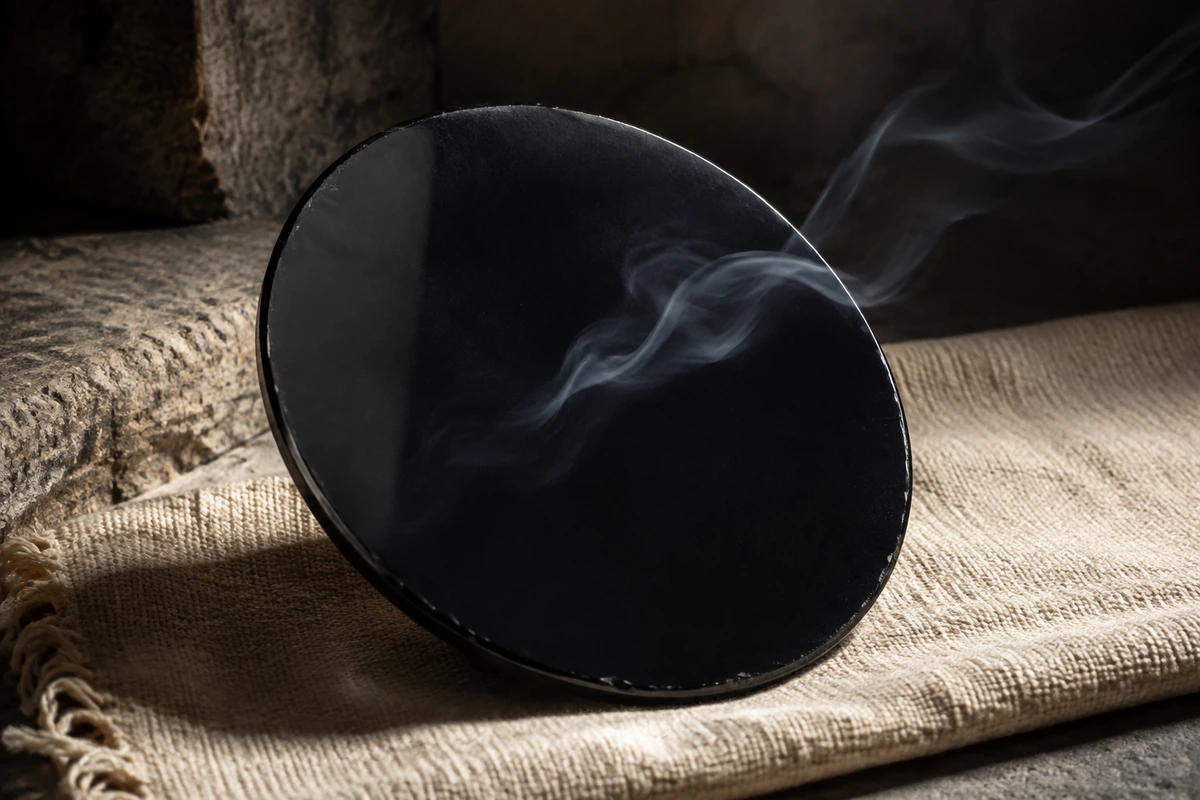
The mirror is a defining attribute rather than a decorative accessory added by modern fantasy artists. The British Museum’s discussion of Tezcatlipoca on Smarthistory describes representations with an obsidian mirror at the head or replacing a foot. The imagery connects his name with a dark, reflective material used in Mesoamerica.
The British Museum’s deity record also identifies dark body coloring, black-and-yellow facial bands, and warrior equipment such as a shield, arrows, and a spear-thrower among his attributes. Not every depiction contains every feature. Nor does each color have one universal meaning that can safely be assigned without considering the particular object or manuscript.
What a surviving mosaic can—and cannot—tell us
A striking object in the British Museum is a human skull decorated with turquoise and dark lignite mosaic. Its eyes incorporate iron pyrite, and shell contributes further contrasting details. The museum dates the object to approximately 1400–1521 and identifies its cultural setting as Aztec or Mixtec.
The collection record says that the object is believed to represent Tezcatlipoca. That qualification matters: the identification is an interpretation, not a surviving label naming the deity. Although often called a mask, it was probably worn as a back ornament. Describing it simply as a face mask used in a known ceremony would make the evidence more certain than the museum does.
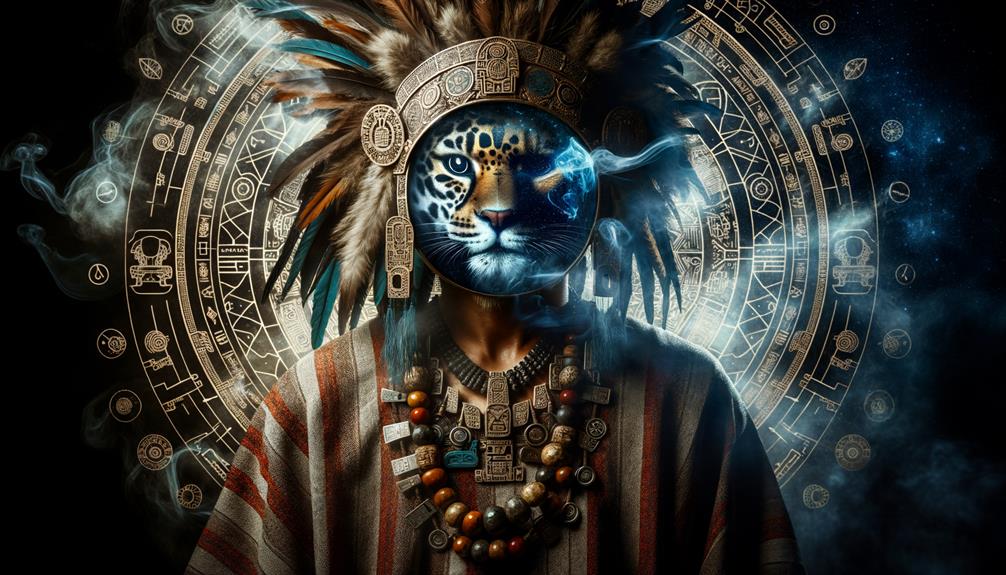
Modern illustrations, including the featured artwork on this page, serve a different purpose. They can introduce a subject visually, but they are not evidence for ancient clothing, ceremonies, or the exact appearance of a god.
Was Tezcatlipoca considered all-powerful?
The answer needs context. The opening of Book 6 in the Florentine Codex introduces a prayer associated with illness and pestilence. Its English translation describes Tezcatlipoca as “all-powerful,” alongside language emphasizing invisibility and elusiveness. It would therefore be inaccurate to claim that such language is entirely absent from Nahua accounts.
At the same time, an exalted prayer is not a simple statement that no other gods exist. The codex passage and its editorial context invite attention to formal religious speech and the challenges of translation. The careful conclusion is that Tezcatlipoca could be addressed as overwhelmingly powerful, not that every story or ritual expressed one uniform doctrine of his unlimited power.
Ritual importance beyond the trickster label
Book 2 of the Florentine Codex associates the festival of Toxcatl with Tezcatlipoca, also named Titlacahuan. Its account describes a young man who represented the deity for a year, receiving fine clothing, musical training, and public reverence before being sacrificed at the festival. The description of him breaking his flutes while ascending to his death is especially memorable. These details belong to a particular colonial-era account of Mexica ritual, not to a universal practice of every Indigenous community. See the codex’s account of Toxcatl.
Likewise, describing his relationship with Quetzalcoatl as a universal struggle between evil and good oversimplifies a religious world in which several deities participate in creation and exercise overlapping powers. “Trickster” can be a useful interpretive label for particular episodes, but it is not a complete translation of Tezcatlipoca’s place in Nahua religion.
Reading the sources with care
The Florentine Codex was completed in 1577 through the work of Nahua authors and artists in collaboration with the Franciscan Bernardino de Sahagún. Its Nahuatl and Spanish accounts are invaluable, but they were produced under colonial conditions rather than outside history. The Digital Florentine Codex makes those languages, images, and their differences available for closer study.
Reading an object record beside a specific prayer produces a richer picture than a list of supposed supernatural powers. Tezcatlipoca emerges as a deity whose importance encompassed authority, uncertainty, and ritual obligation—not merely a fantasy antagonist or a mischievous character.