
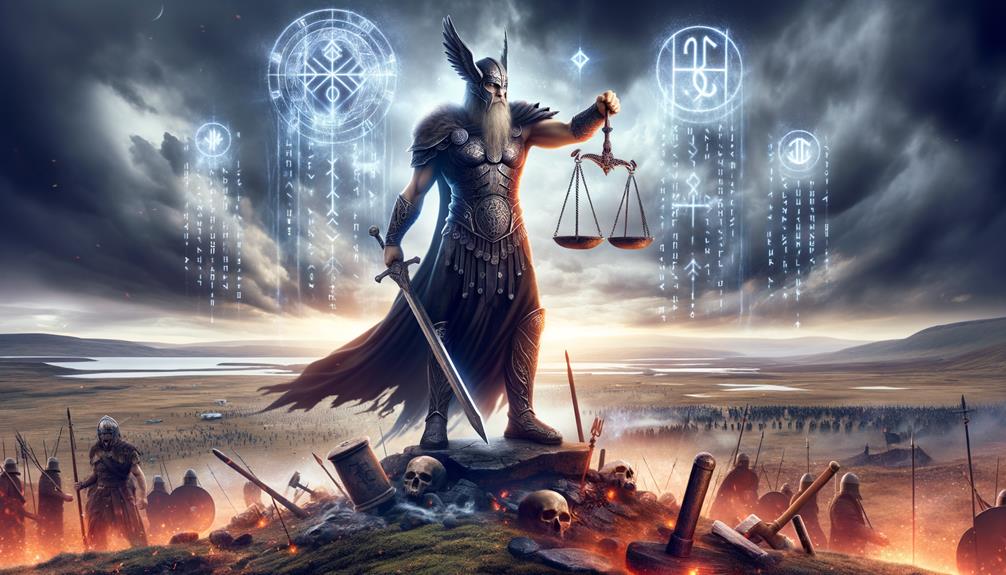
Týr is one of the oldest-named Germanic gods, but the surviving Norse sources say much less about him than modern labels suggest. He is associated with battle, courage, binding, and solemn obligation. Calling him simply “the Norse god of war and justice” is convenient; it is not a job description preserved in a single medieval text.
His best-known story is the binding of Fenrir. Its central action is not a victory in battle. It is a pledge: Týr knowingly places his right hand in the wolf’s mouth so the gods can persuade Fenrir to test a suspiciously delicate restraint. The episode makes Týr memorable because courage, trust, deception, and collective safety become impossible to separate.
What the sources call him
In Old Norse his name is Týr; related Germanic forms include Old English Tīw or Tīg. The word is related to an older Indo-European term for a god or shining sky, but etymology does not prove that every culture preserved the same deity with the same myths. By the Icelandic Middle Ages, Týr was one member of the Æsir and no longer the dominant figure his ancient name might lead us to expect.
Snorri Sturluson’s Prose Edda praises Týr as bold and says it is good for courageous people to invoke him. Poetic diction could also use his name in compounds for warriors. These clues support a martial association, but Norse religion did not assign war to one exclusive department: Odin, Thor, Freyja, valkyries, and other figures all participate in battle and its consequences.
The binding of Fenrir
According to Gylfaginning, the gods raise Loki’s wolf-child Fenrir among them. As he grows, only Týr dares to feed him. The gods test two strong fetters, Lædingr and Drómi, and Fenrir breaks both. They then obtain Gleipnir, a ribbon made by dwarfs from six impossible things, including a cat’s footfall, a woman’s beard, the roots of a mountain, a bear’s sinews, a fish’s breath, and a bird’s spittle.
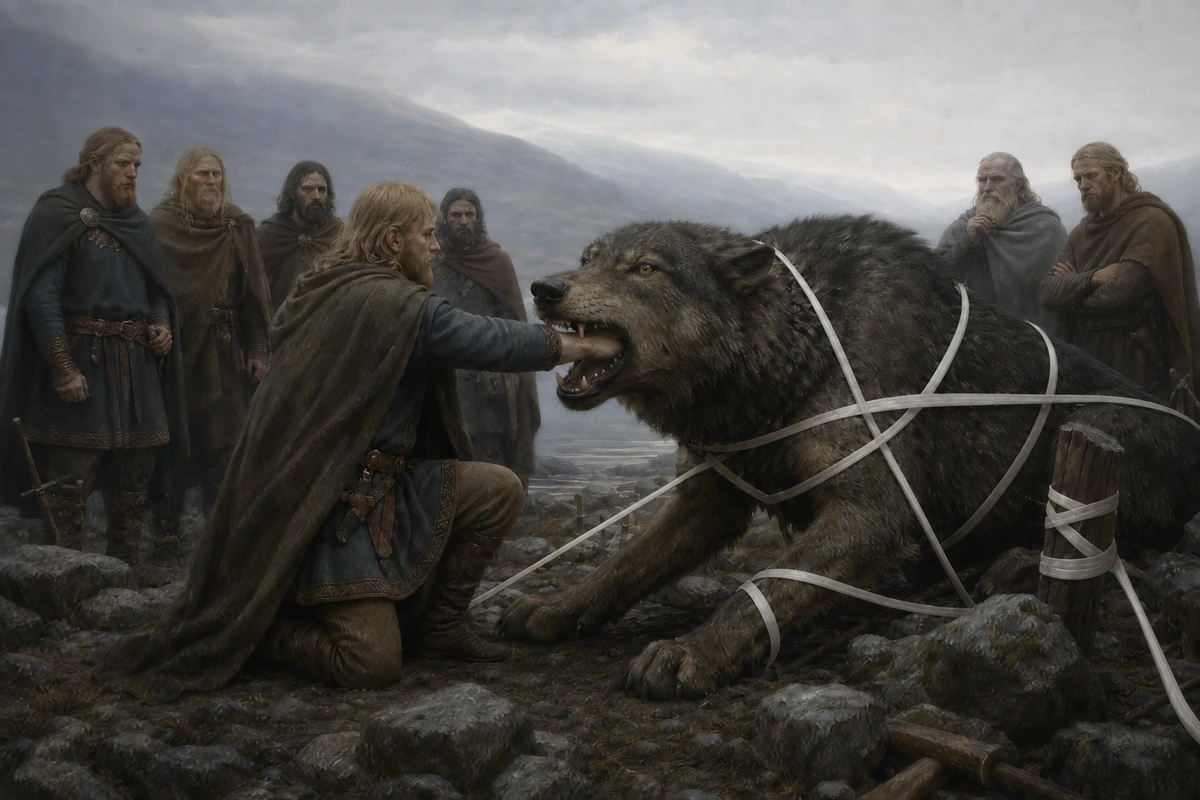
Fenrir suspects a trick. He agrees to be bound only if one god will put a hand in his mouth as a guarantee that the test is honest. The others look at one another; Týr alone extends his right hand. When Fenrir cannot break Gleipnir, the gods refuse to release him, and the wolf bites off Týr’s hand. Snorri adds a chilling detail: everyone laughs except Týr.
The story does not make the gods straightforward champions of good faith. They give a pledge they do not intend to honor because prophecy says Fenrir will destroy them. Týr’s sacrifice makes the deception possible. Depending on the emphasis, he can appear as the bravest participant, the guarantor who pays for a broken promise, or the figure who accepts a personal loss for the gods’ temporary security.
| Claim | What the sources support | Important limit |
|---|---|---|
| Týr is a war god | He is praised for courage and appears in martial language | War is not his exclusive sphere, and no surviving myth makes him commander of all battles |
| Týr is a god of justice | The Fenrir story concerns pledges, binding, and the cost of collective decisions | “Justice god” is a modern synthesis, not a simple quotation from the Eddas |
| Týr lost his hand in combat | Fenrir bites it off during the binding | The hand is offered as a pledge, not lost in an ordinary fight |
| Tuesday is named for Týr | English Tuesday descends from “Tīw’s day” | The weekday correspondence does not make Týr identical to the Roman Mars |
Law, assembly, and “justice”
Týr is often described as a god of law, oaths, or the assembly. That interpretation has real foundations: his defining myth revolves around a formal guarantee, while comparative evidence links his name with authority and public order. Yet the extant poems and prose do not preserve a scene in which Týr sits as a judge or presides over a court. Forseti, not Týr, receives the clearest judicial description in Snorri’s catalogue of the gods.
A careful account therefore distinguishes evidence from reconstruction. Týr’s missing hand can symbolize the cost of maintaining order, but that symbolism is an interpretation of the Fenrir episode. It should not be passed off as a line spoken by a Viking-age worshipper or as proof of a uniform Germanic theology.
Týr in other Norse texts
Týr appears in the poem Hymiskviða, where he accompanies Thor on the journey to obtain a great cauldron from Hymir. The poem calls Hymir Týr’s father, while other medieval sources fit Týr into different divine genealogies. That inconsistency is useful evidence: Norse myth survives through texts composed, transmitted, and organized for different purposes rather than through one authorized handbook.
In Snorri’s account of Ragnarök, Týr fights the hound Garmr and the two kill each other. The encounter gives him an end appropriate to a courageous god, but it is brief. Fenrir’s binding remains the episode that tells us most about his character.
Why Tuesday bears his name
The English weekday name comes from Old English Tīwesdæg, “Tīw’s day.” It was formed by matching the Roman day of Mars with a Germanic deity judged comparable to Mars. Related forms survive in other Germanic languages. The name shows that Tiw/Týr was important enough to serve as the counterpart for a major Roman god, but correspondence is not identity: Roman and Germanic traditions developed in different languages and ritual settings.
Reading Týr without modern fantasy
Modern games and novels often turn Týr into a bureaucratic god of justice or a noble antiwar warrior. Those are creative reinterpretations. The medieval material gives a more difficult figure: he feeds a dangerous wolf, stakes his own body on a deceptive pledge, loses his hand when the pledge is broken, and later dies fighting another monstrous hound.
The most defensible summary is that Týr embodies courageous commitment under conditions where order itself is morally compromised. That reading stays close to the surviving narrative without pretending that the fragmentary sources provide a complete theology.
Key takeaways
- Týr is a Norse and wider Germanic deity associated with courage, battle, pledges, and binding.
- He loses his right hand because he offers it to Fenrir as a guarantee during the test of Gleipnir.
- “God of war and justice” is a useful shorthand only when its limits are explained.
- Tuesday preserves Týr’s Old English cognate Tīw, but Týr is not simply the Roman Mars under another name.
Classification note: Týr belongs to Norse/Germanic tradition. If this legacy page appears beneath a Greek-mythology breadcrumb, that placement is a site-taxonomy artifact and does not make Týr a Greek god.