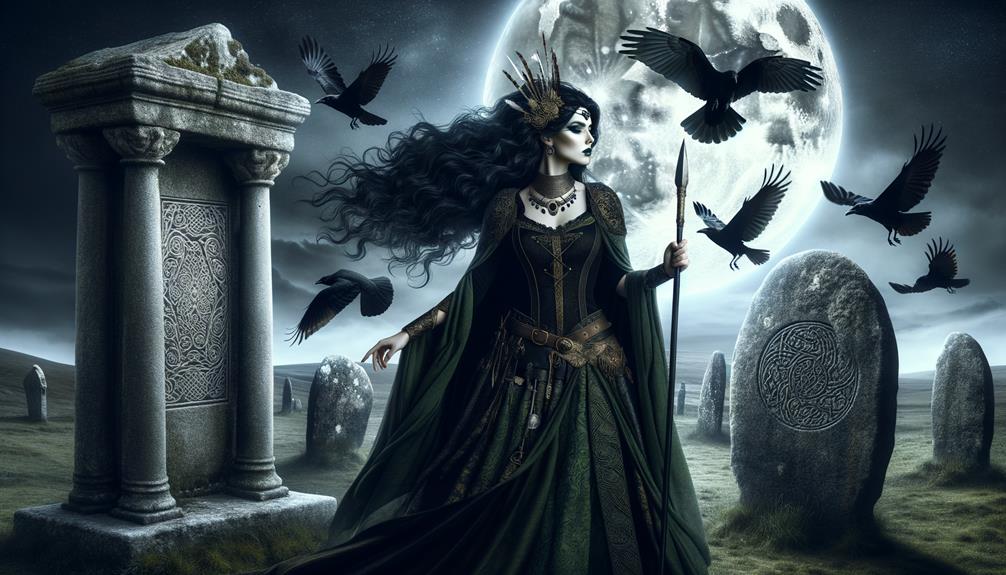
The Morrígan is one of the most formidable divine figures in medieval Irish literature, but she is not a neatly defined “Celtic war goddess” with a single biography. The surviving texts associate her with battle, prophecy, cattle, territory, kingship, and the fate of warriors. Her identity also overlaps with figures such as Badb, Macha, and Nemain in ways that change from one source to another.
That variation matters. “Celtic mythology” spans different languages, places, and centuries; the Morrígan belongs specifically to the Irish literary tradition preserved in medieval manuscripts. Modern summaries often combine separate passages into a fixed system that the sources themselves do not consistently present.
What does the name Morrígan mean?
The name appears in forms including Morrígan and Mórrígan. It is commonly explained as either “Phantom Queen” or “Great Queen,” depending on how its first element is understood. The competing interpretations reflect genuine linguistic debate, so neither translation should be treated as certain in every context.
Both readings fit parts of her literary character. She can be terrifying and elusive, yet she also speaks and acts with the authority of a figure connected to land, sovereignty, and collective fate. Her stories resist a simple choice between battlefield demon, territorial goddess, and queenly power.
The Morrígan in the Second Battle of Mag Tuired
In Cath Maige Tuired, the Second Battle of Mag Tuired, the Túatha Dé Danann prepare to fight the Fomoire. The Morrígan meets the Dagda beside a river around Samhain and promises to use her powers against the enemy. The episode binds sexuality, season, landscape, and warfare together rather than treating them as separate divine departments.
Before the battle she tells the Dagda where the Fomorian forces will land and describes how she will impede them. During the wider battle narrative, supernatural craft, weapons, healing, satire, and prophecy all contribute to victory. The Morrígan’s role belongs to that coordinated divine effort.
After the Túatha Dé Danann prevail, the Morrígan announces the victory to Ireland, its waters, and its estuaries. She then proclaims a vision of peace and abundance before foretelling a troubled future. This combination is central to her character: she does not merely cause bloodshed but interprets what battle means for the land and for the age that follows.
The Morrígan and Cú Chulainn
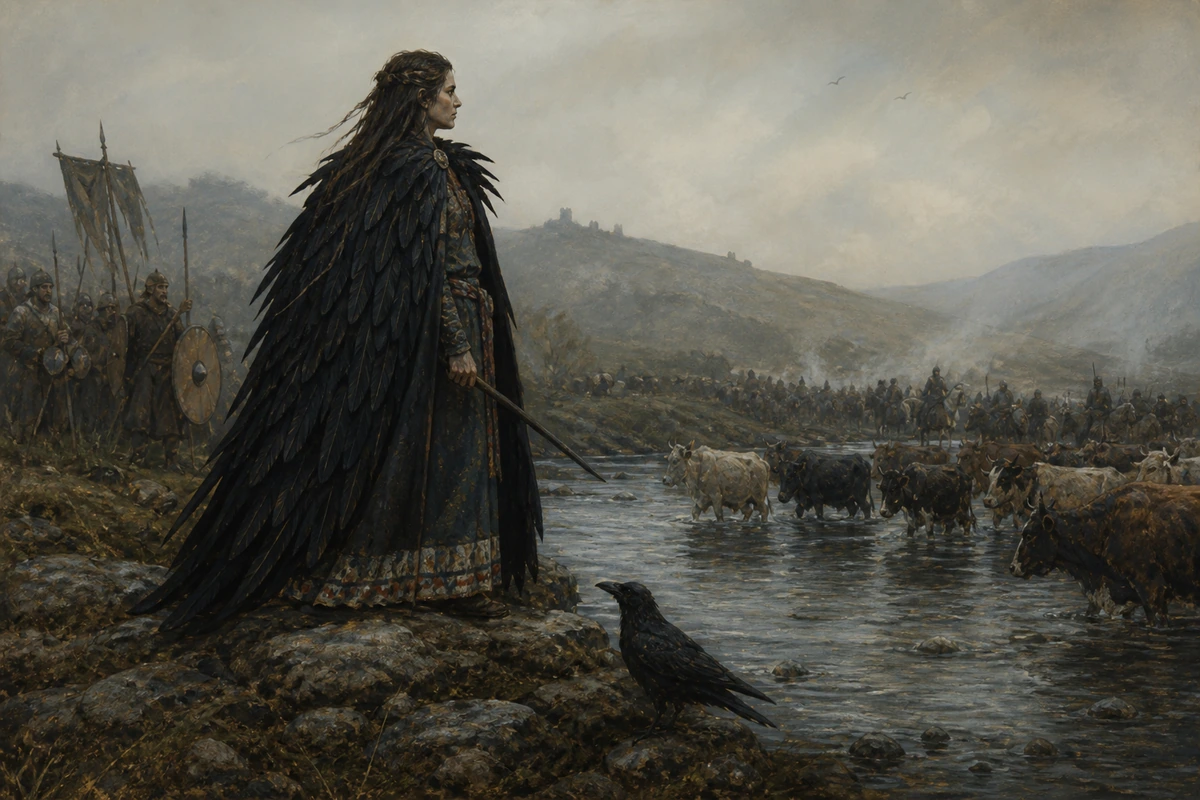
The Morrígan’s most complex relationship with a mortal hero appears in the Táin Bó Cúailnge, the Cattle Raid of Cooley. The epic concerns a contested bull and a war across Ulster, making cattle, territory, prestige, and combat inseparable. Cú Chulainn defends Ulster while its other warriors are disabled.
In one sequence the Morrígan approaches Cú Chulainn and he rejects or fails to recognize her. She warns that she will obstruct him in combat. During his fight at a ford she attacks in animal forms: an eel that entangles him, a wolf that drives cattle across the water, and a hornless red heifer leading the herd. He wounds each form.
She later appears as an old woman milking a cow, bearing the same injuries. Cú Chulainn accepts three drinks of milk and blesses her after each one, unintentionally healing the wounds he inflicted. The scene turns hostility into a binding exchange: the hero’s words have power even when he does not understand the identity of the recipient.
Crows, ravens, and animal transformations
Carrion birds naturally evoke a battlefield, and crow imagery is strongly associated with Badb and with the Morrígan’s wider tradition. Later tellings frequently use a raven as the Morrígan’s universal emblem. The sources support a bird connection, but they do not make every crow or raven an appearance of the goddess.
Her transformations in the Táin also include cattle and creatures of the water and hunt. These forms are not decorative symbols added to a human-shaped deity. They let her alter the movement of a fight, disturb boundaries, and connect violence at the ford to the cattle raid’s larger stakes.
| Source or setting | Role or form | What the episode emphasizes |
|---|---|---|
| Cath Maige Tuired | Prophet and ally in the war against the Fomoire | Battle, landscape, victory, and the future condition of Ireland |
| Táin Bó Cúailnge | Eel, wolf, heifer, and injured milking woman | Transformation, cattle, the ford, and Cú Chulainn’s dangerous speech |
| Names grouped with her | Badb, Macha, and sometimes Nemain | Overlapping identities rather than one consistent divine family tree |
Is the Morrígan a triple goddess?
She is often called a triple goddess in modern books and spiritual traditions. Medieval texts do sometimes describe a group of three women or use names such as Morrígan, Badb, and Macha in close association. However, the membership and relationships are not stable across the surviving record. Nemain may appear in related groupings, while a name can operate as an individual in one passage and as part of a collective in another.
It is therefore reasonable to discuss triadic patterns, but misleading to present one permanent trio with standardized roles as an ancient Irish creed. The literary evidence is fluid. That fluidity may be part of the point: battle produces confusion, identities shift, and a single voice can speak for a larger power.
War, sovereignty, and prophecy
Calling the Morrígan a “war goddess” is useful only as a starting point. She does not resemble a general who simply commands armies. She predicts outcomes, shapes encounters, inspires fear, moves through animal bodies, and announces how victory will affect the country. Her power concerns the conditions under which war becomes fate.
Cattle are likewise more than livestock in these narratives. They represent wealth, status, fertility, and political competition. Fords are more than scenery: they are boundaries where territories meet and heroes are tested. The Morrígan’s repeated presence around cattle, rivers, and contested land ties violence to sovereignty and material survival.
What the sources do not establish
There is no evidence for one universally worshipped pan-Celtic Morrígan with a standardized symbol, family tree, and ritual calendar. The literary texts were written by Christian scribes, often long after the settings they portray, and they preserve both inherited material and learned composition. They are indispensable evidence, but not transparent transcripts of pre-Christian worship.
Modern novels, games, comics, and spiritual practices have created meaningful new interpretations. Those receptions should be distinguished from claims about a particular medieval passage. Doing so makes the historical Morrígan more interesting, not less: she remains a figure whose identity is produced through prophecy, transformation, conflict, and the land itself.
Key takeaways
- The Morrígan belongs primarily to medieval Irish narrative, not a single uniform “Celtic pantheon.”
- Her name may mean “Phantom Queen” or “Great Queen”; the interpretation is debated.
- Cath Maige Tuired connects her to the Dagda, the battle against the Fomoire, victory, and prophecy.
- The Táin presents her in several animal forms and as an injured woman healed by Cú Chulainn’s blessings.
- Badb, Macha, Nemain, and the Morrígan overlap variably; a fixed modern triple-goddess scheme oversimplifies the evidence.