
Ranginui, often shortened to Rangi and called Raki or Rakinui in southern usage, is the sky parent in Māori cosmological traditions. With Papatūānuku, the earth parent, he generates atua and the conditions of the living world. Their separation opens Te Ao Mārama, the world of light, but it is not a clean victory: rain, mist, wind, and genealogy continue to express the parents’ attachment and the consequences of the children’s decision.
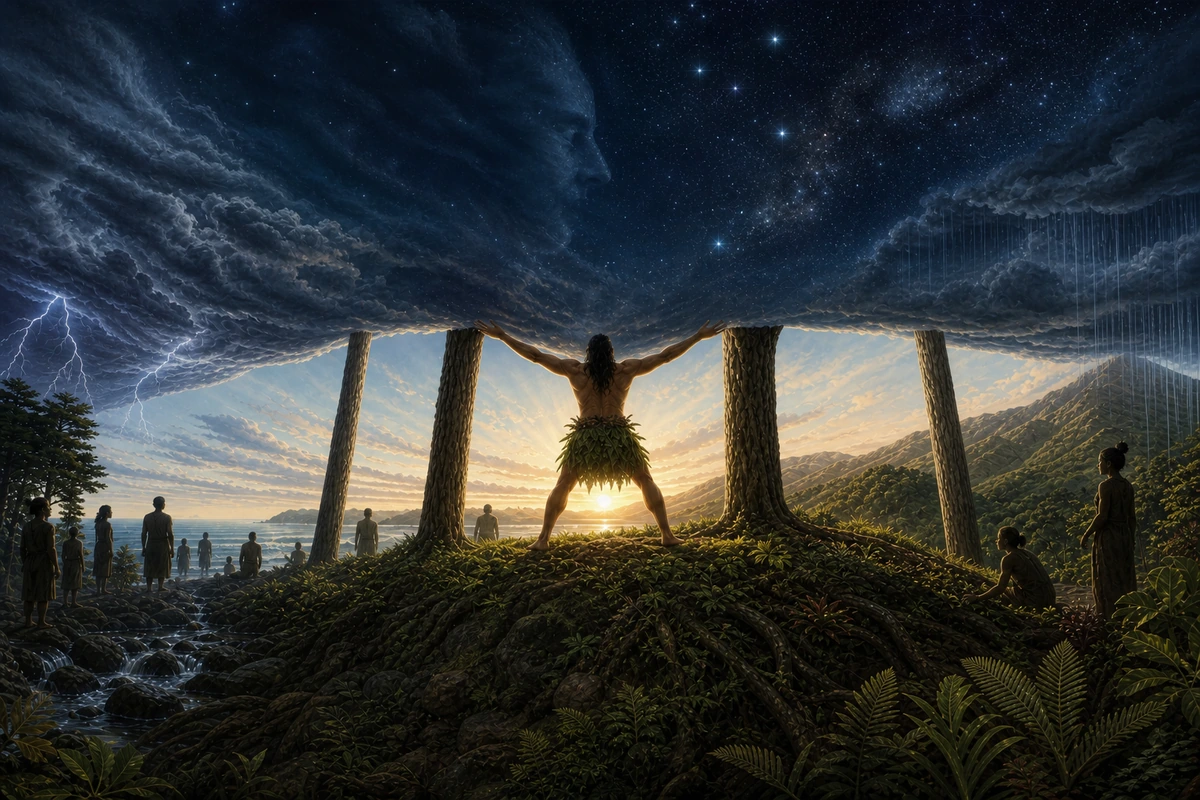
Ranginui and Papatūānuku in Te Pō
In a widely known account, Ranginui and Papatūānuku hold one another in a close embrace. Their children live compressed between them in Te Pō, darkness. The children can grow but cannot stand in light and open space. They meet to decide what must happen to their parents.
Tūmatauenga proposes killing them. Tāne argues that the parents should instead be separated, with earth remaining below and sky raised above. Several siblings attempt the task and fail. Tāne places his shoulders against Papatūānuku and his feet against Ranginui, then pushes until the parents are forced apart. Light enters and the children can inhabit Te Ao Mārama.
This form is strongly associated with the account given in the nineteenth century by Wiremu Maihi Te Rangikāheke of Te Arawa and later made widely available in writing. A Te Ara overview of Ranginui identifies the source and also presents other tribal material. Treating the popular version as “the Māori creation myth” hides the people who preserved it and the alternatives preserved elsewhere.
Why Tāwhirimātea opposed the separation
Tāwhirimātea, associated with wind and weather, refuses to support the plan. After the separation he ascends to Ranginui and turns against his siblings. Storms tear at Tāne’s forests. Seas rise against Tangaroa’s descendants. Rongo and Haumia seek refuge within Papatūānuku. Tūmatauenga alone withstands the attack and later turns on the siblings who abandoned him.
The conflict explains relationships within the environment rather than assigning each atua a simple “power.” Wind affects forest, sea, cultivated foods, and uncultivated foods. Humans use or consume descendants of those domains. Cosmology and ecology appear through whakapapa: beings interact because they are kin, not because nature has been divided into unrelated departments.
| Figure or state | Role in the widely told Te Arawa account | Caution |
|---|---|---|
| Ranginui | Sky parent raised above the earth | Names, partners, and genealogy vary among iwi |
| Papatūānuku | Earth parent who remains below and shelters children | She is an ancestor and living relationship, not merely “soil personified” |
| Tāne | Separates the parents and supports the heavens | Other traditions can assign different acts or relationships |
| Tāwhirimātea | Opposes the separation and attacks siblings through wind and storm | “God of weather” is only a shorthand for a wider whakapapa |
| Te Ao Mārama | The world of light and understanding opened by separation | It is more than daylight as a physical phenomenon |
Rain as grief and mist as longing
Separation creates the inhabited world, but it also causes enduring sorrow. Rain is often described as Ranginui’s tears falling toward Papatūānuku. Mist and dew rise from the land as her sighs or tears toward him. These images keep sky and earth in relationship even while they remain apart.
The imagery should not be reduced to a primitive attempt at meteorology. It works simultaneously as observation, genealogy, emotion, and ethics. Rain literally joins sky and land, while the story names that movement as communication between ancestors. Modern atmospheric science and whakapapa are not competing answers to one narrowly framed question.
Who are the children of Rangi and Papa?
Common lists name Tāne, Tāwhirimātea, Tangaroa, Tūmatauenga, Rongo, and Haumia-tiketike among the children. These names connect forests and birds, wind and weather, sea life, humanity and conflict, cultivated foods and peace, and uncultivated foods. Lists differ in spelling, number, sequence, and identity. Some accounts contain many more children and extend through detailed lines of descent.
A family tree assembled from several iwi sources may look comprehensive while producing relationships no single source recognizes. The correct method is to identify the tradition being summarized. Māori cosmology is held through whakapapa belonging to communities, not a centralized canon with one authorized diagram.
Rangi, Raki, and southern traditions
Kāi Tahu sources commonly use Raki or Rakinui. Southern genealogies have their own structure and can give Raki multiple partners, placing Papatūānuku within a broader sequence of unions and descendants. The name difference is not merely a misspelling, and southern accounts should not be corrected to match a North Island textbook version.
Variation also appears elsewhere. A Ngāti Raukawa account recorded in the nineteenth century gives a distinct context for Rangi and Papatūānuku, while Ngāti Kahungunu tradition includes Kewa and the retrieval of the whānau mārama, the family of light. These are not defective fragments waiting to be completed by the Te Arawa narrative.
How Ranginui became the adorned sky
In some traditions, after the separation Tāne ascends through the heavens to obtain knowledge or brings the celestial lights into proper order. Stars, the sun, and the moon adorn Ranginui and make the upper world navigable and beautiful. Accounts of layered heavens, baskets of knowledge, and the placement of stars vary substantially and should be presented with their source rather than folded into one universal sequel.
The sky is therefore not an empty roof. It contains ancestors, weather, light, seasonal signs, and routes used in navigation. Ranginui can be addressed in oratory and karakia because the relationship is genealogical and present, not confined to a story about a remote beginning.
Whakapapa, not simple personification
English summaries often call Ranginui the “personification of the sky.” That phrase can help a new reader, but it can also imply that humans imaginatively pasted a face onto an inert object. Whakapapa reverses the emphasis: sky, land, atua, plants, animals, and people exist within lines of relationship and descent. Human beings are not outside nature looking at it; they are junior relatives within it.
This is why the separation has ethical force. The children gain space and agency, yet their world depends on parents they have divided. Tāwhirimātea’s resistance is not random villainy. His storms express loyalty, injury, and an unresolved family conflict that remains active whenever domains meet.
Ranginui in contemporary Aotearoa
Ranginui and Papatūānuku remain active reference points in language, environmental thought, education, ceremony, art, and public life. Phrases that locate people between sky above and earth below can orient a speaker within a world of relationships. Environmental initiatives may draw on the parental framework to express care for atmosphere, climate, land, and waters.
Using the tradition responsibly means more than adding Māori names to a generic sustainability slogan. It requires attention to iwi authority, language, whakapapa, and the context in which knowledge is shared. A public educational summary cannot stand in for teaching from mana whenua.
Why there is no single canonical version
Māori knowledge was and is maintained by iwi and hapū with distinct histories. Oral transmission does not mean random change; it means accounts are situated within genealogy, land, performance, and responsibility. Written versions preserve valuable testimony, but publication can make one regional narrative appear universal simply because it became easy to quote.
Useful public starting points include Te Ara’s Ngāti Raukawa account of Ranginui and Papatūānuku, its broader Ranginui survey, and the New Zealand Ministry for the Environment’s clearly labeled one version of the creation sequence. Comparing them shows both recurring relationships and meaningful difference.
Ranginui’s “domain” is thus not simply the air above a boundary line. It is a living ancestral sky linked to earth by rain, grief, descendants, and memory. The separation creates light, but whakapapa ensures that sky and land are never truly unrelated.