
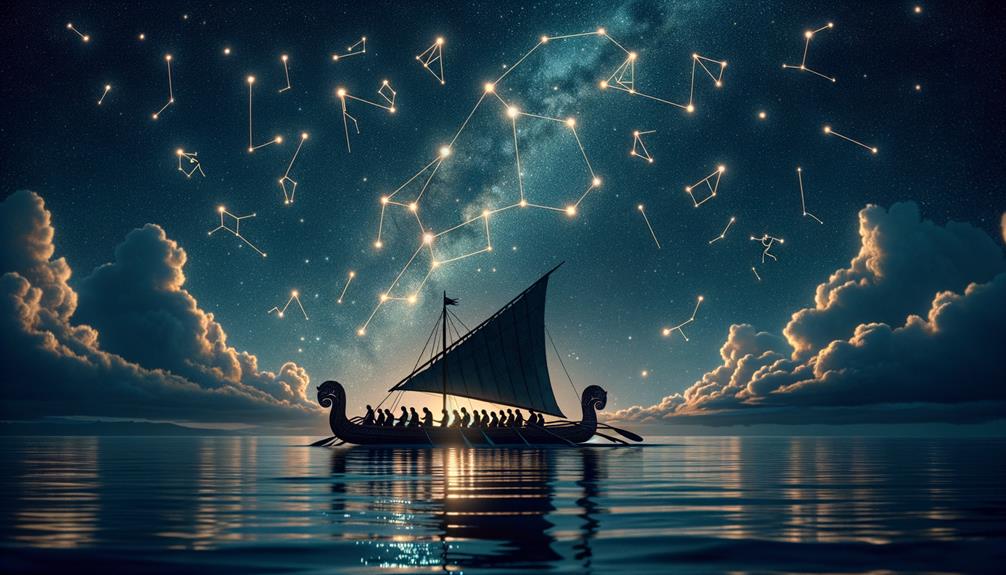
Kupe is remembered as a great voyager, explorer, and ancestor in many Māori traditions. His journeys connect Hawaiki with Aotearoa and attach names, events, and relationships to coasts from Te Tai Tokerau to Te Moana-o-Raukawa and Te Waipounamu. There is no single national “Kupe logbook,” however. Iwi and hapū preserve different canoes, companions, motives, routes, landfalls, and lines of descent.
Why did Kupe sail from Hawaiki?
In a widely told group of narratives, fishing grounds in Hawaiki are being disturbed by a giant wheke, or octopus, belonging to Muturangi. Kupe sets out in pursuit. The chase stretches across the ocean and continues along the coast of Aotearoa, finally reaching the Cook Strait region where the creature is killed. Names vary between accounts: the octopus may be Te Wheke-a-Muturangi or Te Wheke-o-Muturangi, and Kupe’s canoe appears as Matawhaorua or Matahorua.
Not every tribal tradition begins with the wheke, follows the same route, or assigns the same deeds to Kupe. Some emphasize conflict or relationships in Hawaiki; others foreground exploration, place-naming, or ancestry. A detail from one region should not be added to another region’s account merely to produce a more complete adventure story.
Hine-te-Aparangi, Kuramārōtini, and the sighting of land
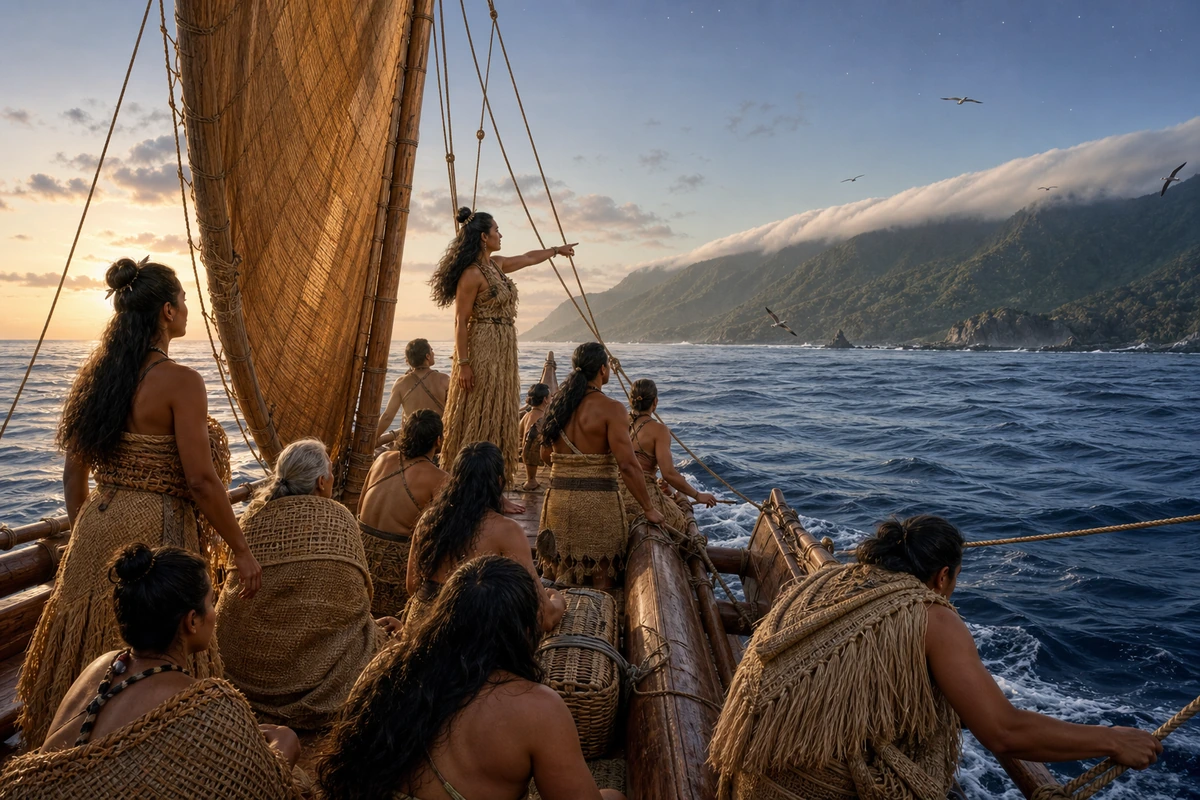
Women are active participants in Kupe traditions, although modern summaries have often reduced the voyage to one heroic man. In a familiar telling, Hine-te-Aparangi sees a long white cloud over land and calls attention to it. This scene is commonly associated with the name Aotearoa. Other sources name Kuramārōtini, Kupe’s wife, as the person who devises or speaks the name. The difference is not solved by silently merging the women into one character.
Names, kin relationships, and roles vary because the accounts belong to communities with their own histories. The responsible phrasing is “in this version” or “in some traditions,” followed by the source. The Museum of New Zealand Te Papa Tongarewa’s Kupe Sites project deliberately presents places and voices from several regions instead of flattening them into one route.
The pursuit of Te Wheke-a-Muturangi
The wheke pursuit supplies an ocean-spanning narrative thread. Te Papa notes that many iwi tell of Kupe leaving Hawaiki to pursue Muturangi’s giant octopus. Along the Wairarapa coast, landmarks record episodes in which the creature hides, escapes, or is chased onward. Cook Strait becomes a decisive location in several versions.
The story is more than an exotic monster fight. An octopus can move through caves, reefs, narrow channels, and rough tidal water, allowing the pursuit to explain dangerous maritime places. The chase turns coastal knowledge into memorable narrative. A named rock, current, or channel is not simply scenery: it becomes evidence of ancestral action and a guide to how a community understands its shore.
| Element | Commonly retold form | What varies |
|---|---|---|
| Reason for sailing | Pursuit of Muturangi’s giant wheke from Hawaiki | Other accounts stress conflict, exploration, kinship, or different circumstances |
| Canoe | Matawhaorua or Matahorua | Names, companion canoes, and crews differ by source |
| Land sighting | A woman recognizes a long white cloud over land | Hine-te-Aparangi and Kuramārōtini have different roles in different tellings |
| Route | Northland, Wairarapa, Cook Strait, and parts of Te Waipounamu | No single itinerary contains every site associated with Kupe |
| Chronology | Kupe precedes later settlement canoes in many traditions | Exact dates calculated from genealogies are modern reconstructions, not a universal oral calendar |
Kupe’s footprints in the land
Ngā tapuwae o Kupe, the footprints or traces of Kupe, are distributed across many landscapes. In Hokianga, traditions connect the navigator with departure and return. Wairarapa stories follow the wheke along a rocky coast. Te Whanganui-a-Tara and islands in the harbour carry memories of his party, while places around Te Moana-o-Raukawa, Te Aumiti, and northern Te Waipounamu preserve other episodes.
These names function as a geography of relationship. They can record what a person saw, did, left, divided, or named. Some refer to companions and animals rather than Kupe alone. A modern map can plot points, but it cannot replace the iwi explanation of why a place is significant or who holds authority to tell its history.
How could voyagers find Aotearoa?
Polynesian ocean voyaging depended on accumulated knowledge rather than accidental drifting. Navigators read stars, the rising and setting points of celestial bodies, ocean swells, wind, clouds, bird behavior, reflected light, and other signs. Crews maintained vessels, food, water, and social organization through long passages. The exact techniques named in a modern navigation manual should not automatically be inserted into every Kupe story, but the wider tradition makes the voyage technically credible.
Experimental voyages by modern Pacific navigators have helped demonstrate the sophistication of non-instrument navigation. This does not turn a particular oral account into a European-style ship’s log. It corrects an older colonial assumption that settlement must have been an accident because voyagers lacked compasses or written charts.
What archaeology can and cannot say about Kupe
Multiple forms of evidence indicate that the first permanent Polynesian settlements in Aotearoa were established between about 1250 and 1300 CE. Manatū Taonga’s overview of Pacific voyaging summarizes radiocarbon, environmental, DNA, genealogical, and other evidence behind that range.
Archaeology can date settlement sites and reveal voyaging origins, diet, tools, movement, and environmental change. It cannot excavate a label that says “Kupe was here on this date,” nor can it determine which community owns a particular ancestral account. Conversely, whakapapa is not invalid because it organizes time and relationship differently from archaeology. The two bodies of knowledge answer overlapping but non-identical questions.
The problem with exact dates and the “Great Fleet”
Nineteenth- and early twentieth-century scholars tried to combine tribal genealogies into one national chronology. By averaging generations, they assigned Kupe precise dates such as 950 CE and arranged later ancestors into a single “Great Fleet” supposedly arriving in 1350. These schemes were once repeated in schools but are not reliable summaries of the diversity of Māori tradition.
Rāwiri Taonui’s Te Ara discussion of scholars and whakapapa explains how this over-historicizing turned dynamic, community-specific genealogies into a false linear sequence. Differences in genealogical length do not necessarily prove that several unrelated men named Kupe existed, and agreement produced by editorial combination is not the same as agreement among iwi.
Did Kupe discover an empty country?
“Discovery” can be misleading when it imports the model of a European explorer claiming land for a distant crown. Kupe traditions establish ancestral relationships with places and later communities. Some Māori accounts also remember prior or nonhuman inhabitants, including tūrehu and patupaiarehe, or give other first-arrival ancestors central roles. Kupe is not the first figure in every tribal history.
Many narratives say Kupe returned to Hawaiki and gave directions that later voyagers followed. His journey thus becomes a bridge: it joins homelands, confirms a navigable route, names the new country, and prepares relationships later generations will renew. The enduring point is not ownership by one isolated “discoverer,” but a network of people, waka, places, and descendants.
Reading Kupe traditions responsibly
Begin with the iwi or hapū whose place is being discussed. Preserve Māori names and distinguish a locally held tradition from a national retelling. Include Hine-te-Aparangi, Kuramārōtini, Ngake or Ngahue, Pekahourangi, and other companions where the relevant source names them. Avoid using the wheke as a fantasy creature detached from the coastline and community that give the episode meaning.
Te Papa’s Kupe Sites: Ngā tapuwae o Kupe and Te Ara’s overview of Kupe traditions are useful entry points. Together they show why variation is not a flaw in the story. It is the record of Kupe’s many relationships across Aotearoa.